Event submissions
Published
This submission belongs to the session S3. Photocatalysis and Electrocatalysis of the event The 4th International Electronic Conference on Catalysis Sciences
Published date
16 Sep, 2026
Academic Editor
'%3e%3cpath%20d='M12.6657%2010.9104C12.4185%2010.325%2012.0599%209.79327%2011.6097%209.34482C11.1609%208.89508%2010.6293%208.5365%2010.0442%208.28888C10.0389%208.28626%2010.0337%208.28495%2010.0285%208.28233C10.8446%207.69279%2011.3752%206.73249%2011.3752%205.64904C11.3752%203.8542%209.92103%202.39999%208.1262%202.39999C6.33136%202.39999%204.87715%203.8542%204.87715%205.64904C4.87715%206.73249%205.40774%207.69279%206.22393%208.28364C6.21869%208.28626%206.21345%208.28757%206.20821%208.29019C5.62129%208.5378%205.09463%208.89284%204.64265%209.34613C4.1929%209.79493%203.83432%2010.3266%203.58671%2010.9117C3.34345%2011.4845%203.21226%2012.0987%203.20023%2012.7209C3.19988%2012.7349%203.20233%2012.7488%203.20744%2012.7619C3.21255%2012.7749%203.22022%2012.7867%203.22998%2012.7968C3.23975%2012.8068%203.25142%2012.8147%203.26431%2012.8202C3.2772%2012.8256%203.29105%2012.8284%203.30504%2012.8284H4.09109C4.14874%2012.8284%204.19459%2012.7825%204.1959%2012.7262C4.2221%2011.7148%204.62823%2010.7676%205.34617%2010.0497C6.08899%209.30683%207.0755%208.89808%208.1262%208.89808C9.17689%208.89808%2010.1634%209.30683%2010.9062%2010.0497C11.6242%2010.7676%2012.0303%2011.7148%2012.0565%2012.7262C12.0578%2012.7838%2012.1037%2012.8284%2012.1613%2012.8284H12.9474C12.9613%2012.8284%2012.9752%2012.8256%2012.9881%2012.8202C13.001%2012.8147%2013.0126%2012.8068%2013.0224%2012.7968C13.0322%2012.7867%2013.0398%2012.7749%2013.0449%2012.7619C13.0501%2012.7488%2013.0525%2012.7349%2013.0522%2012.7209C13.0391%2012.0947%2012.9094%2011.4855%2012.6657%2010.9104ZM8.1262%207.9024C7.52486%207.9024%206.9589%207.6679%206.53312%207.24211C6.10733%206.81633%205.87283%206.25037%205.87283%205.64904C5.87283%205.0477%206.10733%204.48174%206.53312%204.05596C6.9589%203.63018%207.52486%203.39567%208.1262%203.39567C8.72753%203.39567%209.29349%203.63018%209.71927%204.05596C10.1451%204.48174%2010.3796%205.0477%2010.3796%205.64904C10.3796%206.25037%2010.1451%206.81633%209.71927%207.24211C9.29349%207.6679%208.72753%207.9024%208.1262%207.9024Z'%20fill='%235D1EE1'/%3e%3c/g%3e%3c/svg%3e) Ioannis Konstantinou
Ioannis KonstantinouCitation
Mohamed Darouiche, Mohamed Rhaya, Brahim Ennasraoui, Said Alahiane, Amane Jada, Abdelaziz Ait Addi, hassan ouachtak, Design and Construction of an Ag₃PO₄/Sepiolite/Fe-MOF Hybrid Photocatalyst for Efficient Removal of Ciprofloxacin from Aqueous Environments under Visible Light, in Proceedings of The 4th International Electronic Conference on Catalysis Sciences, 22 September–24 September 2026, MDPI: Basel, Switzerland
Share
Email
Facebook
Twitter
LinkedIn
Design and Construction of an Ag₃PO₄/Sepiolite/Fe-MOF Hybrid Photocatalyst for Efficient Removal of Ciprofloxacin from Aqueous Environments under Visible Light
'%3e%3cpath%20d='M12.6647%2010.9104C12.4176%2010.325%2012.0589%209.7933%2011.6088%209.34485C11.16%208.89511%2010.6283%208.53653%2010.0432%208.28891C10.038%208.28629%2010.0327%208.28498%2010.0275%208.28236C10.8437%207.69282%2011.3743%206.73252%2011.3743%205.64907C11.3743%203.85423%209.92005%202.40002%208.12522%202.40002C6.33038%202.40002%204.87618%203.85423%204.87618%205.64907C4.87618%206.73252%205.40677%207.69282%206.22296%208.28367C6.21772%208.28629%206.21248%208.2876%206.20724%208.29022C5.62031%208.53783%205.09365%208.89287%204.64167%209.34616C4.19192%209.79496%203.83334%2010.3266%203.58573%2010.9117C3.34247%2011.4846%203.21128%2012.0987%203.19925%2012.721C3.1989%2012.735%203.20135%2012.7489%203.20646%2012.7619C3.21157%2012.7749%203.21924%2012.7868%203.22901%2012.7968C3.23877%2012.8068%203.25045%2012.8148%203.26334%2012.8202C3.27623%2012.8256%203.29007%2012.8284%203.30406%2012.8284H4.09012C4.14776%2012.8284%204.19362%2012.7825%204.19493%2012.7262C4.22113%2011.7148%204.62726%2010.7676%205.34519%2010.0497C6.08802%209.30686%207.07452%208.89811%208.12522%208.89811C9.17592%208.89811%2010.1624%209.30686%2010.9052%2010.0497C11.6232%2010.7676%2012.0293%2011.7148%2012.0555%2012.7262C12.0568%2012.7839%2012.1027%2012.8284%2012.1603%2012.8284H12.9464C12.9604%2012.8284%2012.9742%2012.8256%2012.9871%2012.8202C13%2012.8148%2013.0117%2012.8068%2013.0214%2012.7968C13.0312%2012.7868%2013.0389%2012.7749%2013.044%2012.7619C13.0491%2012.7489%2013.0515%2012.735%2013.0512%2012.721C13.0381%2012.0947%2012.9084%2011.4856%2012.6647%2010.9104ZM8.12522%207.90243C7.52388%207.90243%206.95792%207.66793%206.53214%207.24215C6.10636%206.81636%205.87185%206.2504%205.87185%205.64907C5.87185%205.04773%206.10636%204.48177%206.53214%204.05599C6.95792%203.63021%207.52388%203.3957%208.12522%203.3957C8.72655%203.3957%209.29252%203.63021%209.7183%204.05599C10.1441%204.48177%2010.3786%205.04773%2010.3786%205.64907C10.3786%206.2504%2010.1441%206.81636%209.7183%207.24215C9.29252%207.66793%208.72655%207.90243%208.12522%207.90243Z'%20fill='%235D1EE1'/%3e%3c/g%3e%3c/svg%3e)
Mohamed Darouiche 1
Mohamed Rhaya 1
Brahim Ennasraoui 1
Said Alahiane 1
Amane Jada 2,3
Abdelaziz Ait Addi 1
hassan ouachtak 1,4
1. Laboratory of Organic and Physical Chemistry, Faculty of Science, Ibn Zohr University, Agadir, Morocco
2. Institute of Materials Science of Mulhouse (IS2M), Haute Alsace University, Mulhouse 68100, France
3. Strasbourg University, Strasbourg 67081, France
4. Faculty of Applied Science, Ait Melloul, Ibn Zohr University, Agadir, Morocco
Abstract
The continuous discharge of pharmaceutical pollutants into aquatic ecosystems has become a major environmental challenge due to their persistence and harmful ecological effects. Ciprofloxacin (CIP), a widely used fluoroquinolone antibiotic, is frequently detected in wastewater and surface water, requiring the development of effective treatment technologies for its elimination. In this study, a novel ternary composite based on silver phosphate (Ag₃PO₄), sepiolite clay, and an iron-based metal–organic framework synthesized using gallic acid as an organic linker (Fe-GA MOF) was developed for the photocatalytic degradation of CIP in aqueous media. The designed hybrid material aims to combine the high visible-light photocatalytic activity of Ag₃PO₄, the adsorption capacity and structural stability of sepiolite, and the porous structure and active sites of the Fe-GA MOF to improve pollutant removal efficiency.
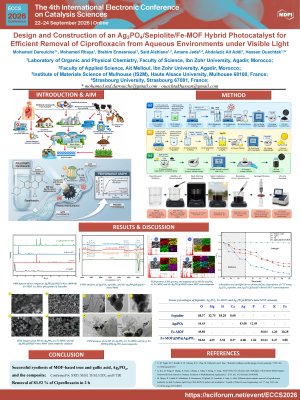
The synthesized composite was characterized using Fourier-transform infrared spectroscopy (FTIR) to identify the functional groups and investigate the interactions between the Ag₃PO₄, sepiolite, and Fe-GA MOF components, confirming the successful formation of the hybrid structure. X-ray diffraction (XRD) was employed to evaluate the crystalline phases and structural properties, while scanning electron microscopy (SEM) and transmission electron microscopy (TEM) were used to investigate the morphology and microstructural features of the composite. Energy-dispersive X-ray spectroscopy (EDX) was performed to confirm the elemental composition and distribution of the constituent elements. The photocatalytic performance of the Ag₃PO₄/Sepiolite/Fe-GA MOF composite was evaluated through ciprofloxacin (CIP) degradation experiments under irradiation conditions. The effects of initial CIP concentration and catalyst dosage were investigated to optimize the photocatalytic process, while scavenger tests were performed to explore the degradation mechanism. The synergistic interaction among the composite components is expected to enhance adsorption, promote charge separation, and suppress electron–hole recombination, leading to improved photocatalytic performance. The developed hybrid material demonstrates promising potential for sustainable remediation of pharmaceutical contaminants in wastewater treatment applications.
Keywords
Ag₃PO₄
Sepiolite
Fe-Gallic Acid MOF
Ciprofloxacin
Photocatalysis
Pharmaceutical Pollutants
Wastewater Treatmen
Poster
poster M Darouiche The 4th International Electronic Conference on Catalysis Sciences.pdf
Selective Alcohol and Hydrocarbon oxidation using new C-Scorpionate Cu(II) and Fe(III) catalysts: Synthesis, activity, and Mechanistic Insights
Computational insights into CO2 electrochemical cells : Multiscale modeling and Performance enhancement