Event submissions
Published
This submission belongs to the session S2. Environmental Catalysis of the event The 4th International Electronic Conference on Catalysis Sciences
Published date
16 Sep, 2026
Academic Editor
'%3e%3cpath%20d='M12.6657%2010.9104C12.4185%2010.325%2012.0599%209.79327%2011.6097%209.34482C11.1609%208.89508%2010.6293%208.5365%2010.0442%208.28888C10.0389%208.28626%2010.0337%208.28495%2010.0285%208.28233C10.8446%207.69279%2011.3752%206.73249%2011.3752%205.64904C11.3752%203.8542%209.92103%202.39999%208.1262%202.39999C6.33136%202.39999%204.87715%203.8542%204.87715%205.64904C4.87715%206.73249%205.40774%207.69279%206.22393%208.28364C6.21869%208.28626%206.21345%208.28757%206.20821%208.29019C5.62129%208.5378%205.09463%208.89284%204.64265%209.34613C4.1929%209.79493%203.83432%2010.3266%203.58671%2010.9117C3.34345%2011.4845%203.21226%2012.0987%203.20023%2012.7209C3.19988%2012.7349%203.20233%2012.7488%203.20744%2012.7619C3.21255%2012.7749%203.22022%2012.7867%203.22998%2012.7968C3.23975%2012.8068%203.25142%2012.8147%203.26431%2012.8202C3.2772%2012.8256%203.29105%2012.8284%203.30504%2012.8284H4.09109C4.14874%2012.8284%204.19459%2012.7825%204.1959%2012.7262C4.2221%2011.7148%204.62823%2010.7676%205.34617%2010.0497C6.08899%209.30683%207.0755%208.89808%208.1262%208.89808C9.17689%208.89808%2010.1634%209.30683%2010.9062%2010.0497C11.6242%2010.7676%2012.0303%2011.7148%2012.0565%2012.7262C12.0578%2012.7838%2012.1037%2012.8284%2012.1613%2012.8284H12.9474C12.9613%2012.8284%2012.9752%2012.8256%2012.9881%2012.8202C13.001%2012.8147%2013.0126%2012.8068%2013.0224%2012.7968C13.0322%2012.7867%2013.0398%2012.7749%2013.0449%2012.7619C13.0501%2012.7488%2013.0525%2012.7349%2013.0522%2012.7209C13.0391%2012.0947%2012.9094%2011.4855%2012.6657%2010.9104ZM8.1262%207.9024C7.52486%207.9024%206.9589%207.6679%206.53312%207.24211C6.10733%206.81633%205.87283%206.25037%205.87283%205.64904C5.87283%205.0477%206.10733%204.48174%206.53312%204.05596C6.9589%203.63018%207.52486%203.39567%208.1262%203.39567C8.72753%203.39567%209.29349%203.63018%209.71927%204.05596C10.1451%204.48174%2010.3796%205.0477%2010.3796%205.64904C10.3796%206.25037%2010.1451%206.81633%209.71927%207.24211C9.29349%207.6679%208.72753%207.9024%208.1262%207.9024Z'%20fill='%235D1EE1'/%3e%3c/g%3e%3c/svg%3e) Albin Pintar
Albin PintarCitation
Dr. Elias Assayehegn, Dr. Serhii Vorobiov, Dr. Peter Čendula, Dr. Vladimir Komanicky, Controlled Growth of delafossite CuFeO₂ Photoelectrodes for Superior Water Splitting Performance, in Proceedings of The 4th International Electronic Conference on Catalysis Sciences, 22 September–24 September 2026, MDPI: Basel, Switzerland
Share
Email
Facebook
Twitter
LinkedIn
Controlled Growth of delafossite CuFeO2 Photoelectrodes for Superior Water Splitting Performance
'%3e%3cpath%20d='M12.6647%2010.9104C12.4176%2010.325%2012.0589%209.7933%2011.6088%209.34485C11.16%208.89511%2010.6283%208.53653%2010.0432%208.28891C10.038%208.28629%2010.0327%208.28498%2010.0275%208.28236C10.8437%207.69282%2011.3743%206.73252%2011.3743%205.64907C11.3743%203.85423%209.92005%202.40002%208.12522%202.40002C6.33038%202.40002%204.87618%203.85423%204.87618%205.64907C4.87618%206.73252%205.40677%207.69282%206.22296%208.28367C6.21772%208.28629%206.21248%208.2876%206.20724%208.29022C5.62031%208.53783%205.09365%208.89287%204.64167%209.34616C4.19192%209.79496%203.83334%2010.3266%203.58573%2010.9117C3.34247%2011.4846%203.21128%2012.0987%203.19925%2012.721C3.1989%2012.735%203.20135%2012.7489%203.20646%2012.7619C3.21157%2012.7749%203.21924%2012.7868%203.22901%2012.7968C3.23877%2012.8068%203.25045%2012.8148%203.26334%2012.8202C3.27623%2012.8256%203.29007%2012.8284%203.30406%2012.8284H4.09012C4.14776%2012.8284%204.19362%2012.7825%204.19493%2012.7262C4.22113%2011.7148%204.62726%2010.7676%205.34519%2010.0497C6.08802%209.30686%207.07452%208.89811%208.12522%208.89811C9.17592%208.89811%2010.1624%209.30686%2010.9052%2010.0497C11.6232%2010.7676%2012.0293%2011.7148%2012.0555%2012.7262C12.0568%2012.7839%2012.1027%2012.8284%2012.1603%2012.8284H12.9464C12.9604%2012.8284%2012.9742%2012.8256%2012.9871%2012.8202C13%2012.8148%2013.0117%2012.8068%2013.0214%2012.7968C13.0312%2012.7868%2013.0389%2012.7749%2013.044%2012.7619C13.0491%2012.7489%2013.0515%2012.735%2013.0512%2012.721C13.0381%2012.0947%2012.9084%2011.4856%2012.6647%2010.9104ZM8.12522%207.90243C7.52388%207.90243%206.95792%207.66793%206.53214%207.24215C6.10636%206.81636%205.87185%206.2504%205.87185%205.64907C5.87185%205.04773%206.10636%204.48177%206.53214%204.05599C6.95792%203.63021%207.52388%203.3957%208.12522%203.3957C8.72655%203.3957%209.29252%203.63021%209.7183%204.05599C10.1441%204.48177%2010.3786%205.04773%2010.3786%205.64907C10.3786%206.2504%2010.1441%206.81636%209.7183%207.24215C9.29252%207.66793%208.72655%207.90243%208.12522%207.90243Z'%20fill='%235D1EE1'/%3e%3c/g%3e%3c/svg%3e)
Dr. Elias Assayehegn 1,2
Dr. Serhii Vorobiov 2
Dr. Peter Čendula 3
Dr. Vladimir Komanicky 2
1. Department of Chemistry, Mekelle University, P.O. Box 231, Mekelle-Tigray, Ethiopia
2. Faculty of Science, Pavol Jozef Šafárik University, Park Angelinum 9, 04001 Košice, Slovakia
3. Institute of Aurel Stodola, University of Žilina, Komenskeho 843, 03101, Liptovský Mikuláš, Slovakia
Abstract
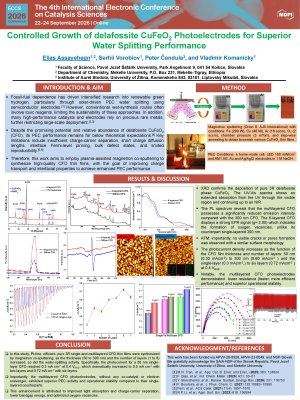
Fossil-fuel dependence has undermined both energy security and environmental sustainability, driving intensive research into renewable green-hydrogen production. Solar-driven photoelectrochemical (PEC) water splitting is a compelling route, and delafossite-based semiconductors are especially attractive owing to their favorable physicochemical properties. However, high-performance electrodes are often fabricated via conventional “wet” chemical synthesis, which typically relies on toxic solvents and complex precursors. Moreover, producing phase-pure delafossite CuFeO2 (CFO) thin films with controlled morphology and high electronic quality remains challenging. Here, we introduce plasma-assisted magnetron sputtering as a green, solvent-free strategy to fabricate efficient, phase-pure 3R delafossite CFO photoelectrodes. Optimized magnetron co-sputtering conditions were developed to achieve high-quality films, which were evaluated using X-ray diffraction (XRD), X-ray photoelectron spectroscopy (XPS), atomic force microscopy (AFM), scanning electron microscopy with energy-dispersive X-ray analysis (SEM–EDAX), UV–Vis spectroscopy, and electrochemical impedance spectroscopy (EIS). PEC performance was found to be strongly governed by film architecture. Increasing the thickness from 50 to 300 nm and the number of stacked layers from 1 to 6 progressively enhanced photocatalytic activity: the photocurrent increased from 0.3 mA cm-2 at 0.4 VRHE for a 50 nm single-layer film to 0.5 mA cm-2 for a two-layer configuration, reaching 0.72 mA cm-2 for a six-layer electrode. Multilayer CFO also exhibited improved operational stability relative to single-layer counterparts. Importantly, the best-performing six-layer film achieved strong activity without the addition of a co-catalyst or electron scavenger, which we attribute to synergistic contributions from improved light harvesting, a reduced effective band gap, and optimized surface roughness. Overall, the magnetron co-sputtering–based materials design offers a scalable and practical pathway to efficient and stable CFO photoelectrodes for PEC tandem-cell applications.
Keywords
Magnetron co-sputtering
Thin films
Delafossite
Water splitting
Photoelectrochemical
Poster
Sciforum-195073-Poster.pdf
Synthesis of Vanadium Oxide Nanoparticles for Efficient Photocatalysis
Catalytic oxidation of carbon monoxide on platinum deposited on alumina