Event submissions
Published
This submission belongs to the session S3. Photocatalysis and Electrocatalysis of the event The 4th International Electronic Conference on Catalysis Sciences
Published date
16 Sep, 2026
Academic Editor
'%3e%3cpath%20d='M12.6657%2010.9104C12.4185%2010.325%2012.0599%209.79327%2011.6097%209.34482C11.1609%208.89508%2010.6293%208.5365%2010.0442%208.28888C10.0389%208.28626%2010.0337%208.28495%2010.0285%208.28233C10.8446%207.69279%2011.3752%206.73249%2011.3752%205.64904C11.3752%203.8542%209.92103%202.39999%208.1262%202.39999C6.33136%202.39999%204.87715%203.8542%204.87715%205.64904C4.87715%206.73249%205.40774%207.69279%206.22393%208.28364C6.21869%208.28626%206.21345%208.28757%206.20821%208.29019C5.62129%208.5378%205.09463%208.89284%204.64265%209.34613C4.1929%209.79493%203.83432%2010.3266%203.58671%2010.9117C3.34345%2011.4845%203.21226%2012.0987%203.20023%2012.7209C3.19988%2012.7349%203.20233%2012.7488%203.20744%2012.7619C3.21255%2012.7749%203.22022%2012.7867%203.22998%2012.7968C3.23975%2012.8068%203.25142%2012.8147%203.26431%2012.8202C3.2772%2012.8256%203.29105%2012.8284%203.30504%2012.8284H4.09109C4.14874%2012.8284%204.19459%2012.7825%204.1959%2012.7262C4.2221%2011.7148%204.62823%2010.7676%205.34617%2010.0497C6.08899%209.30683%207.0755%208.89808%208.1262%208.89808C9.17689%208.89808%2010.1634%209.30683%2010.9062%2010.0497C11.6242%2010.7676%2012.0303%2011.7148%2012.0565%2012.7262C12.0578%2012.7838%2012.1037%2012.8284%2012.1613%2012.8284H12.9474C12.9613%2012.8284%2012.9752%2012.8256%2012.9881%2012.8202C13.001%2012.8147%2013.0126%2012.8068%2013.0224%2012.7968C13.0322%2012.7867%2013.0398%2012.7749%2013.0449%2012.7619C13.0501%2012.7488%2013.0525%2012.7349%2013.0522%2012.7209C13.0391%2012.0947%2012.9094%2011.4855%2012.6657%2010.9104ZM8.1262%207.9024C7.52486%207.9024%206.9589%207.6679%206.53312%207.24211C6.10733%206.81633%205.87283%206.25037%205.87283%205.64904C5.87283%205.0477%206.10733%204.48174%206.53312%204.05596C6.9589%203.63018%207.52486%203.39567%208.1262%203.39567C8.72753%203.39567%209.29349%203.63018%209.71927%204.05596C10.1451%204.48174%2010.3796%205.0477%2010.3796%205.64904C10.3796%206.25037%2010.1451%206.81633%209.71927%207.24211C9.29349%207.6679%208.72753%207.9024%208.1262%207.9024Z'%20fill='%235D1EE1'/%3e%3c/g%3e%3c/svg%3e) Ioannis Konstantinou
Ioannis KonstantinouCitation
Elouafi Assaad, Experimental Optical Assessment of the Photocatalytic Potential of Iron-Based Oxides and Phosphate Compounds, in Proceedings of The 4th International Electronic Conference on Catalysis Sciences, 22 September–24 September 2026, MDPI: Basel, Switzerland
Share
Email
Facebook
Twitter
LinkedIn
Experimental Optical Assessment of the Photocatalytic Potential of Iron-Based Oxides and Phosphate Compounds
'%3e%3cpath%20d='M12.6647%2010.9104C12.4176%2010.325%2012.0589%209.7933%2011.6088%209.34485C11.16%208.89511%2010.6283%208.53653%2010.0432%208.28891C10.038%208.28629%2010.0327%208.28498%2010.0275%208.28236C10.8437%207.69282%2011.3743%206.73252%2011.3743%205.64907C11.3743%203.85423%209.92005%202.40002%208.12522%202.40002C6.33038%202.40002%204.87618%203.85423%204.87618%205.64907C4.87618%206.73252%205.40677%207.69282%206.22296%208.28367C6.21772%208.28629%206.21248%208.2876%206.20724%208.29022C5.62031%208.53783%205.09365%208.89287%204.64167%209.34616C4.19192%209.79496%203.83334%2010.3266%203.58573%2010.9117C3.34247%2011.4846%203.21128%2012.0987%203.19925%2012.721C3.1989%2012.735%203.20135%2012.7489%203.20646%2012.7619C3.21157%2012.7749%203.21924%2012.7868%203.22901%2012.7968C3.23877%2012.8068%203.25045%2012.8148%203.26334%2012.8202C3.27623%2012.8256%203.29007%2012.8284%203.30406%2012.8284H4.09012C4.14776%2012.8284%204.19362%2012.7825%204.19493%2012.7262C4.22113%2011.7148%204.62726%2010.7676%205.34519%2010.0497C6.08802%209.30686%207.07452%208.89811%208.12522%208.89811C9.17592%208.89811%2010.1624%209.30686%2010.9052%2010.0497C11.6232%2010.7676%2012.0293%2011.7148%2012.0555%2012.7262C12.0568%2012.7839%2012.1027%2012.8284%2012.1603%2012.8284H12.9464C12.9604%2012.8284%2012.9742%2012.8256%2012.9871%2012.8202C13%2012.8148%2013.0117%2012.8068%2013.0214%2012.7968C13.0312%2012.7868%2013.0389%2012.7749%2013.044%2012.7619C13.0491%2012.7489%2013.0515%2012.735%2013.0512%2012.721C13.0381%2012.0947%2012.9084%2011.4856%2012.6647%2010.9104ZM8.12522%207.90243C7.52388%207.90243%206.95792%207.66793%206.53214%207.24215C6.10636%206.81636%205.87185%206.2504%205.87185%205.64907C5.87185%205.04773%206.10636%204.48177%206.53214%204.05599C6.95792%203.63021%207.52388%203.3957%208.12522%203.3957C8.72655%203.3957%209.29252%203.63021%209.7183%204.05599C10.1441%204.48177%2010.3786%205.04773%2010.3786%205.64907C10.3786%206.2504%2010.1441%206.81636%209.7183%207.24215C9.29252%207.66793%208.72655%207.90243%208.12522%207.90243Z'%20fill='%235D1EE1'/%3e%3c/g%3e%3c/svg%3e)
Elouafi Assaad 1,2
1. Laboratory of Processes, Mechanics, Materials, and Industrial Engineering, Higher School of Technology, Hassan II University of Casablanca, Casablanca, Morocco
2. Interdisciplinary Laboratory of Fundamental and Applied Sciences, Higher Normal School , Hassan II University of Casablanca, Casablanca, Morocco
Abstract
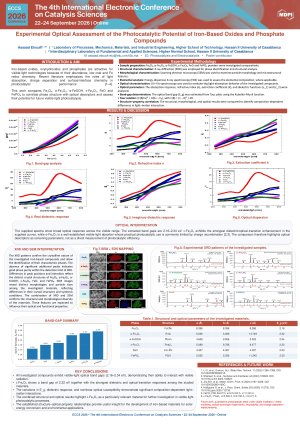
Iron-based oxides and phosphates have attracted considerable attention as low-cost, environmentally friendly materials for solar-energy conversion and environmental remediation. In this work, a comparative experimental investigation of Fe₃O₄, α-Fe₂O₃, α-FeOOH, ε-Fe₂O₃, FeO, and FePO₄ is carried out to establish the relationship between their structural, optical, and photocatalytic-related properties. SEM analysis reveals agglomerated nanosized particles, while optical characterization provides insight into light-harvesting capability and charge-transfer processes.
The investigated compounds exhibit optical band-gap energies within the visible-light region, ranging from 2.16 eV for Fe₃O₄ to 2.34 eV for α-FeOOH. Intermediate values of 2.20, 2.22, 2.30, and 2.32 eV are obtained for FeO, ε-Fe₂O₃, FePO₄, and α-Fe₂O₃, respectively. Significant differences in dielectric behavior are observed, with ε-Fe₂O₃ exhibiting a dielectric constant of approximately 9 compared with about 5 for Fe₃O₄. Moreover, the maximum value of the imaginary dielectric function reaches approximately 4 for ε-Fe₂O₃, significantly higher than those of α-Fe₂O₃ (≈1.6) and Fe₃O₄ (≈1.0), indicating stronger optical transitions and enhanced photon absorption. The third-order nonlinear optical susceptibility varies from 4.6 × 10⁻¹² to 1.1 × 10⁻¹¹ esu, highlighting substantial differences in light–matter interactions among the investigated compounds.
Among the studied materials, ε-Fe₂O₃ exhibits the most favorable combination of optical descriptors, including a visible-light band gap of 2.22 eV, enhanced dielectric response, and strong optical-transition intensity. These characteristics are expected to promote efficient light harvesting and charge separation, which are essential requirements for photocatalytic processes. The obtained structure–property correlations suggest that ε-Fe₂O₃ is a promising candidate for future visible-light-driven photocatalytic applications, including pollutant degradation, wastewater treatment, and solar-energy conversion. The present findings provide valuable guidelines for the rational design of advanced iron-based functional materials for environmental and energy-related technologies.
Keywords
Iron-based oxides
FePO₄
photocatalysis
electronic structure
optical properties
charge-transfer transitions
visible-light photocatalysts
environmental remediation.
Poster
ECCS2026_A0_Poster_Iron_Based_Optical_Photocatalysis_A0.pdf
Catalytic oxidation of carbon monoxide on platinum deposited on alumina
Evaluation of the Antibacterial Potential of Basidiomycetes