Event submissions
Published
This submission belongs to the session S2. Environmental Catalysis of the event The 4th International Electronic Conference on Catalysis Sciences
Published date
16 Sep, 2026
Academic Editor
'%3e%3cpath%20d='M12.6657%2010.9104C12.4185%2010.325%2012.0599%209.79327%2011.6097%209.34482C11.1609%208.89508%2010.6293%208.5365%2010.0442%208.28888C10.0389%208.28626%2010.0337%208.28495%2010.0285%208.28233C10.8446%207.69279%2011.3752%206.73249%2011.3752%205.64904C11.3752%203.8542%209.92103%202.39999%208.1262%202.39999C6.33136%202.39999%204.87715%203.8542%204.87715%205.64904C4.87715%206.73249%205.40774%207.69279%206.22393%208.28364C6.21869%208.28626%206.21345%208.28757%206.20821%208.29019C5.62129%208.5378%205.09463%208.89284%204.64265%209.34613C4.1929%209.79493%203.83432%2010.3266%203.58671%2010.9117C3.34345%2011.4845%203.21226%2012.0987%203.20023%2012.7209C3.19988%2012.7349%203.20233%2012.7488%203.20744%2012.7619C3.21255%2012.7749%203.22022%2012.7867%203.22998%2012.7968C3.23975%2012.8068%203.25142%2012.8147%203.26431%2012.8202C3.2772%2012.8256%203.29105%2012.8284%203.30504%2012.8284H4.09109C4.14874%2012.8284%204.19459%2012.7825%204.1959%2012.7262C4.2221%2011.7148%204.62823%2010.7676%205.34617%2010.0497C6.08899%209.30683%207.0755%208.89808%208.1262%208.89808C9.17689%208.89808%2010.1634%209.30683%2010.9062%2010.0497C11.6242%2010.7676%2012.0303%2011.7148%2012.0565%2012.7262C12.0578%2012.7838%2012.1037%2012.8284%2012.1613%2012.8284H12.9474C12.9613%2012.8284%2012.9752%2012.8256%2012.9881%2012.8202C13.001%2012.8147%2013.0126%2012.8068%2013.0224%2012.7968C13.0322%2012.7867%2013.0398%2012.7749%2013.0449%2012.7619C13.0501%2012.7488%2013.0525%2012.7349%2013.0522%2012.7209C13.0391%2012.0947%2012.9094%2011.4855%2012.6657%2010.9104ZM8.1262%207.9024C7.52486%207.9024%206.9589%207.6679%206.53312%207.24211C6.10733%206.81633%205.87283%206.25037%205.87283%205.64904C5.87283%205.0477%206.10733%204.48174%206.53312%204.05596C6.9589%203.63018%207.52486%203.39567%208.1262%203.39567C8.72753%203.39567%209.29349%203.63018%209.71927%204.05596C10.1451%204.48174%2010.3796%205.0477%2010.3796%205.64904C10.3796%206.25037%2010.1451%206.81633%209.71927%207.24211C9.29349%207.6679%208.72753%207.9024%208.1262%207.9024Z'%20fill='%235D1EE1'/%3e%3c/g%3e%3c/svg%3e) Albin Pintar
Albin PintarCitation
Natasza Maria Pardus, Katarzyna Latacz, Pablo Moreno, Agata Łamacz, Tailoring ZIF-8-based catalysts through template-assisted synthesis and metal modification for organic carbonate production, in Proceedings of The 4th International Electronic Conference on Catalysis Sciences, 22 September–24 September 2026, MDPI: Basel, Switzerland
Share
Email
Facebook
Twitter
LinkedIn
Tailoring ZIF-8-based catalysts through template-assisted synthesis and metal modification for organic carbonate production
'%3e%3cpath%20d='M12.6647%2010.9104C12.4176%2010.325%2012.0589%209.7933%2011.6088%209.34485C11.16%208.89511%2010.6283%208.53653%2010.0432%208.28891C10.038%208.28629%2010.0327%208.28498%2010.0275%208.28236C10.8437%207.69282%2011.3743%206.73252%2011.3743%205.64907C11.3743%203.85423%209.92005%202.40002%208.12522%202.40002C6.33038%202.40002%204.87618%203.85423%204.87618%205.64907C4.87618%206.73252%205.40677%207.69282%206.22296%208.28367C6.21772%208.28629%206.21248%208.2876%206.20724%208.29022C5.62031%208.53783%205.09365%208.89287%204.64167%209.34616C4.19192%209.79496%203.83334%2010.3266%203.58573%2010.9117C3.34247%2011.4846%203.21128%2012.0987%203.19925%2012.721C3.1989%2012.735%203.20135%2012.7489%203.20646%2012.7619C3.21157%2012.7749%203.21924%2012.7868%203.22901%2012.7968C3.23877%2012.8068%203.25045%2012.8148%203.26334%2012.8202C3.27623%2012.8256%203.29007%2012.8284%203.30406%2012.8284H4.09012C4.14776%2012.8284%204.19362%2012.7825%204.19493%2012.7262C4.22113%2011.7148%204.62726%2010.7676%205.34519%2010.0497C6.08802%209.30686%207.07452%208.89811%208.12522%208.89811C9.17592%208.89811%2010.1624%209.30686%2010.9052%2010.0497C11.6232%2010.7676%2012.0293%2011.7148%2012.0555%2012.7262C12.0568%2012.7839%2012.1027%2012.8284%2012.1603%2012.8284H12.9464C12.9604%2012.8284%2012.9742%2012.8256%2012.9871%2012.8202C13%2012.8148%2013.0117%2012.8068%2013.0214%2012.7968C13.0312%2012.7868%2013.0389%2012.7749%2013.044%2012.7619C13.0491%2012.7489%2013.0515%2012.735%2013.0512%2012.721C13.0381%2012.0947%2012.9084%2011.4856%2012.6647%2010.9104ZM8.12522%207.90243C7.52388%207.90243%206.95792%207.66793%206.53214%207.24215C6.10636%206.81636%205.87185%206.2504%205.87185%205.64907C5.87185%205.04773%206.10636%204.48177%206.53214%204.05599C6.95792%203.63021%207.52388%203.3957%208.12522%203.3957C8.72655%203.3957%209.29252%203.63021%209.7183%204.05599C10.1441%204.48177%2010.3786%205.04773%2010.3786%205.64907C10.3786%206.2504%2010.1441%206.81636%209.7183%207.24215C9.29252%207.66793%208.72655%207.90243%208.12522%207.90243Z'%20fill='%235D1EE1'/%3e%3c/g%3e%3c/svg%3e)
Natasza Maria Pardus 1
Katarzyna Latacz 1
Pablo Moreno 1

Agata Łamacz 1
1. Wroclaw University of Science and Technology, Department of Engineering and Technology of Chemical Processes, Gdańska 7/9, 50-344 Wrocław, Poland
Abstract
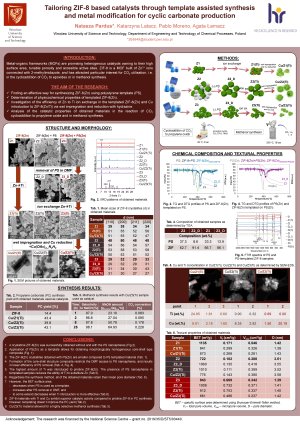
Introduction. Metal-organic frameworks (MOFs) are promising heterogeneous catalysts owing to their high surface area, tunable porosity, and accessible active sites. ZIF-8 has attracted particular interest for CO2 utilization, including cycloaddition of CO2 to epoxides or methanol synthesis. This study investigates the effect of polystyrene templating and bimetallic modification on the physicochemical and catalytic properties of ZIF-8-based materials.
Methods. ZIF-8-based materials were synthesized using unmodified PS and Zn-functionalized polystyrene PS(Zn) nanospheres as structure-directing templates. Following template removal, Ti and Cu were incorporated, yielding Cu/ZIF-8(Zn/Ti) catalysts characterized by SEM, XRD, FTIR, TGA and N2 sorption. Catalytic performance was evaluated in two reactions: (i) cycloaddition of CO2 to propylene oxide at 80°C and 2 bar in the presence of co-catalyst, and (ii) methanol synthesis at 200°C and 18 bars.
Results. The type of template strongly influenced the morphology and textural properties of obtained materials. ZIF-8 prepared using PS(Zn) exhibited a homogeneous core-shell morphology and higher specific surface area (943 m2/g) than the material synthesized with unmodified PS (722 m2/g). Template removal further increased the surface area to 1009 m2/g while preserving ZIF-8 crystal structure. Ti and Cu incorporation generated additional catalytic sites while maintaining high porosity. The obtained Cu/ZIF-8(Zn/Ti) achieved a propylene carbonate yield of 43%, 98% methanol selectivity and methanol yield of 83 gMeOH/kgcat/h. By comparison, untemplated catalysts achieved 39% of PC yield, 88% of methanol selectivity and 4.7 gMeOH/kgcat/h, highlighting the beneficial effect of template-assisted catalyst design. The Cu/ZIF-8(Zn/Ti) crystallinity was preserved after metal incorporation and catalytic testing.
Conclusions. Template-assisted synthesis combined with Ti and Cu modification effectively tailors ZIF-8 catalysts for CO₂ valorization. Zn-functionalized PS templates promote the formation of homogeneous porous structures with enhanced catalytic performance, demonstrating the importance of morphology control in the design of advanced MOF-based catalysts.
Keywords
metal-organic frameworks
CO2 conversion
template assisted synthesis
ZIF-8
Poster
Poster ECCS_Natasza Pardus.pdf
Binder free Cobalt Phosphate electrocatalyst for alkaline water splitting at elevated electrolyte temperatures
Effect of Cu incorporation strategy and Ce modification of UiO-66 on propylene carbonate formation via 1,2-propanediol carboxylation