Event submissions
Published
This submission belongs to the session S7. Catalysis in Organic and Polymer Chemistry of the event The 4th International Electronic Conference on Catalysis Sciences
Published date
16 Sep, 2026
Academic Editor
'%3e%3cpath%20d='M12.6657%2010.9104C12.4185%2010.325%2012.0599%209.79327%2011.6097%209.34482C11.1609%208.89508%2010.6293%208.5365%2010.0442%208.28888C10.0389%208.28626%2010.0337%208.28495%2010.0285%208.28233C10.8446%207.69279%2011.3752%206.73249%2011.3752%205.64904C11.3752%203.8542%209.92103%202.39999%208.1262%202.39999C6.33136%202.39999%204.87715%203.8542%204.87715%205.64904C4.87715%206.73249%205.40774%207.69279%206.22393%208.28364C6.21869%208.28626%206.21345%208.28757%206.20821%208.29019C5.62129%208.5378%205.09463%208.89284%204.64265%209.34613C4.1929%209.79493%203.83432%2010.3266%203.58671%2010.9117C3.34345%2011.4845%203.21226%2012.0987%203.20023%2012.7209C3.19988%2012.7349%203.20233%2012.7488%203.20744%2012.7619C3.21255%2012.7749%203.22022%2012.7867%203.22998%2012.7968C3.23975%2012.8068%203.25142%2012.8147%203.26431%2012.8202C3.2772%2012.8256%203.29105%2012.8284%203.30504%2012.8284H4.09109C4.14874%2012.8284%204.19459%2012.7825%204.1959%2012.7262C4.2221%2011.7148%204.62823%2010.7676%205.34617%2010.0497C6.08899%209.30683%207.0755%208.89808%208.1262%208.89808C9.17689%208.89808%2010.1634%209.30683%2010.9062%2010.0497C11.6242%2010.7676%2012.0303%2011.7148%2012.0565%2012.7262C12.0578%2012.7838%2012.1037%2012.8284%2012.1613%2012.8284H12.9474C12.9613%2012.8284%2012.9752%2012.8256%2012.9881%2012.8202C13.001%2012.8147%2013.0126%2012.8068%2013.0224%2012.7968C13.0322%2012.7867%2013.0398%2012.7749%2013.0449%2012.7619C13.0501%2012.7488%2013.0525%2012.7349%2013.0522%2012.7209C13.0391%2012.0947%2012.9094%2011.4855%2012.6657%2010.9104ZM8.1262%207.9024C7.52486%207.9024%206.9589%207.6679%206.53312%207.24211C6.10733%206.81633%205.87283%206.25037%205.87283%205.64904C5.87283%205.0477%206.10733%204.48174%206.53312%204.05596C6.9589%203.63018%207.52486%203.39567%208.1262%203.39567C8.72753%203.39567%209.29349%203.63018%209.71927%204.05596C10.1451%204.48174%2010.3796%205.0477%2010.3796%205.64904C10.3796%206.25037%2010.1451%206.81633%209.71927%207.24211C9.29349%207.6679%208.72753%207.9024%208.1262%207.9024Z'%20fill='%235D1EE1'/%3e%3c/g%3e%3c/svg%3e) Raffaella Mancuso
Raffaella MancusoCitation
Sid ahmed ELHABIRI, Keniche Assia, Yasmine Benmansou, Cyclodextrin-Assisted Enantioselective Organic Reactions: Supramolecular Recognition and Chiral Induction in Aqueous Media, in Proceedings of The 4th International Electronic Conference on Catalysis Sciences, 22 September–24 September 2026, MDPI: Basel, Switzerland
Share
Email
Facebook
Twitter
LinkedIn
Cyclodextrin-Assisted Enantioselective Organic Reactions: Supramolecular Recognition and Chiral Induction in Aqueous Media
'%3e%3cpath%20d='M12.6647%2010.9104C12.4176%2010.325%2012.0589%209.7933%2011.6088%209.34485C11.16%208.89511%2010.6283%208.53653%2010.0432%208.28891C10.038%208.28629%2010.0327%208.28498%2010.0275%208.28236C10.8437%207.69282%2011.3743%206.73252%2011.3743%205.64907C11.3743%203.85423%209.92005%202.40002%208.12522%202.40002C6.33038%202.40002%204.87618%203.85423%204.87618%205.64907C4.87618%206.73252%205.40677%207.69282%206.22296%208.28367C6.21772%208.28629%206.21248%208.2876%206.20724%208.29022C5.62031%208.53783%205.09365%208.89287%204.64167%209.34616C4.19192%209.79496%203.83334%2010.3266%203.58573%2010.9117C3.34247%2011.4846%203.21128%2012.0987%203.19925%2012.721C3.1989%2012.735%203.20135%2012.7489%203.20646%2012.7619C3.21157%2012.7749%203.21924%2012.7868%203.22901%2012.7968C3.23877%2012.8068%203.25045%2012.8148%203.26334%2012.8202C3.27623%2012.8256%203.29007%2012.8284%203.30406%2012.8284H4.09012C4.14776%2012.8284%204.19362%2012.7825%204.19493%2012.7262C4.22113%2011.7148%204.62726%2010.7676%205.34519%2010.0497C6.08802%209.30686%207.07452%208.89811%208.12522%208.89811C9.17592%208.89811%2010.1624%209.30686%2010.9052%2010.0497C11.6232%2010.7676%2012.0293%2011.7148%2012.0555%2012.7262C12.0568%2012.7839%2012.1027%2012.8284%2012.1603%2012.8284H12.9464C12.9604%2012.8284%2012.9742%2012.8256%2012.9871%2012.8202C13%2012.8148%2013.0117%2012.8068%2013.0214%2012.7968C13.0312%2012.7868%2013.0389%2012.7749%2013.044%2012.7619C13.0491%2012.7489%2013.0515%2012.735%2013.0512%2012.721C13.0381%2012.0947%2012.9084%2011.4856%2012.6647%2010.9104ZM8.12522%207.90243C7.52388%207.90243%206.95792%207.66793%206.53214%207.24215C6.10636%206.81636%205.87185%206.2504%205.87185%205.64907C5.87185%205.04773%206.10636%204.48177%206.53214%204.05599C6.95792%203.63021%207.52388%203.3957%208.12522%203.3957C8.72655%203.3957%209.29252%203.63021%209.7183%204.05599C10.1441%204.48177%2010.3786%205.04773%2010.3786%205.64907C10.3786%206.2504%2010.1441%206.81636%209.7183%207.24215C9.29252%207.66793%208.72655%207.90243%208.12522%207.90243Z'%20fill='%235D1EE1'/%3e%3c/g%3e%3c/svg%3e)
Sid ahmed ELHABIRI 1
Keniche Assia 2
Yasmine Benmansou 2
1. Laboratory of Separation and Purification Technologies, University of Abou Bekr Belkaid, Tlemcen, 13000, Algeria
2. Laboratory of Organic Chemistry, Natural Substances and Analysis (COSNA), Faculty of Sciences, Abou Bekr Belkaid University of Tlemcen, Tlemcen, 13000, Algeria
Abstract
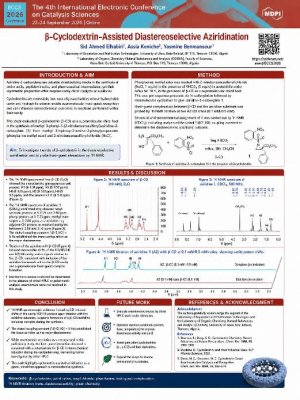
Introduction: The development of sustainable methods for asymmetric oxidation is important for the preparation of optically active sulfoxides used as pharmaceutical and fine-chemical intermediates. β-Cyclodextrin (β-CD) is a renewable and water-compatible oligosaccharide whose hydrophobic cavity can selectively accommodate organic substrates and create a chiral reaction microenvironment. This study investigated β-CD as a supramolecular host for the enantioselective oxidation of thioanisole to methyl phenyl sulfoxide using hydrogen peroxide in aqueous medium.
Methods: The effects of the β-CD/thioanisole molar ratio, pH, temperature, hydrogen peroxide concentration, and reaction time were systematically evaluated. Formation of the thioanisole–β-CD inclusion complex was examined by UV–Visible spectroscopy, FTIR, and ¹H NMR. Thioanisole conversion, methyl phenyl sulfoxide yield, sulfoxide selectivity relative to overoxidation products, and enantiomeric composition were determined chromatographically. A parallel reaction performed without β-CD served as the control.
Results: Spectroscopic changes associated with the internal H3/H5 protons of β-CD and with characteristic thioanisole bands supported formation of a host–guest inclusion complex and preferential accommodation of the aromatic substrate inside the cyclodextrin cavity. Under the optimized conditions, the β-CD-assisted system achieved 81.7% thioanisole conversion, 70.5% methyl phenyl sulfoxide yield, and 86.3% sulfoxide selectivity. An enantiomeric excess of 26.4% ee was obtained, with preferential formation of the (R)-enantiomer. In the absence of β-CD, conversion and sulfoxide yield decreased to 52.4% and 43.1%, respectively, while the enantiomeric excess was only 3.8%. The enhanced activity and stereoselectivity are attributed to hydrophobic inclusion, hydrogen-bonding interactions, and steric confinement within the chiral β-CD cavity.
Conclusions: β-CD significantly improved thioanisole conversion, sulfoxide yield, chemoselectivity, and enantioselectivity under mild aqueous conditions. The comparison with the β-CD-free control demonstrates that supramolecular substrate recognition and chiral confinement play central roles in the oxidation process. These findings support cyclodextrin-assisted oxidation with hydrogen peroxide as a green, metal-free strategy for the selective synthesis of optically enriched sulfoxides.
Keywords
β-cyclodextrin
enantioselective catalysis
asymmetric synthesis
supramolecular chemistry
host–guest complexation
chiral induction; green chemistry
Poster
poster_ECCS2026_ELHABIRI.pdf
The catalytic combustion of methane over platinum-based catalysts
Synthesis of Eugenol-Derived Dicyclic Carbonates toward Sustainable Non-Isocyanate Polyurethanes