Event submissions
Published
This submission belongs to the session S7. Catalysis in Organic and Polymer Chemistry of the event The 4th International Electronic Conference on Catalysis Sciences
Published date
17 Sep, 2026
Academic Editor
'%3e%3cpath%20d='M12.6657%2010.9104C12.4185%2010.325%2012.0599%209.79327%2011.6097%209.34482C11.1609%208.89508%2010.6293%208.5365%2010.0442%208.28888C10.0389%208.28626%2010.0337%208.28495%2010.0285%208.28233C10.8446%207.69279%2011.3752%206.73249%2011.3752%205.64904C11.3752%203.8542%209.92103%202.39999%208.1262%202.39999C6.33136%202.39999%204.87715%203.8542%204.87715%205.64904C4.87715%206.73249%205.40774%207.69279%206.22393%208.28364C6.21869%208.28626%206.21345%208.28757%206.20821%208.29019C5.62129%208.5378%205.09463%208.89284%204.64265%209.34613C4.1929%209.79493%203.83432%2010.3266%203.58671%2010.9117C3.34345%2011.4845%203.21226%2012.0987%203.20023%2012.7209C3.19988%2012.7349%203.20233%2012.7488%203.20744%2012.7619C3.21255%2012.7749%203.22022%2012.7867%203.22998%2012.7968C3.23975%2012.8068%203.25142%2012.8147%203.26431%2012.8202C3.2772%2012.8256%203.29105%2012.8284%203.30504%2012.8284H4.09109C4.14874%2012.8284%204.19459%2012.7825%204.1959%2012.7262C4.2221%2011.7148%204.62823%2010.7676%205.34617%2010.0497C6.08899%209.30683%207.0755%208.89808%208.1262%208.89808C9.17689%208.89808%2010.1634%209.30683%2010.9062%2010.0497C11.6242%2010.7676%2012.0303%2011.7148%2012.0565%2012.7262C12.0578%2012.7838%2012.1037%2012.8284%2012.1613%2012.8284H12.9474C12.9613%2012.8284%2012.9752%2012.8256%2012.9881%2012.8202C13.001%2012.8147%2013.0126%2012.8068%2013.0224%2012.7968C13.0322%2012.7867%2013.0398%2012.7749%2013.0449%2012.7619C13.0501%2012.7488%2013.0525%2012.7349%2013.0522%2012.7209C13.0391%2012.0947%2012.9094%2011.4855%2012.6657%2010.9104ZM8.1262%207.9024C7.52486%207.9024%206.9589%207.6679%206.53312%207.24211C6.10733%206.81633%205.87283%206.25037%205.87283%205.64904C5.87283%205.0477%206.10733%204.48174%206.53312%204.05596C6.9589%203.63018%207.52486%203.39567%208.1262%203.39567C8.72753%203.39567%209.29349%203.63018%209.71927%204.05596C10.1451%204.48174%2010.3796%205.0477%2010.3796%205.64904C10.3796%206.25037%2010.1451%206.81633%209.71927%207.24211C9.29349%207.6679%208.72753%207.9024%208.1262%207.9024Z'%20fill='%235D1EE1'/%3e%3c/g%3e%3c/svg%3e) Raffaella Mancuso
Raffaella MancusoCitation
Amine Ez-zoubi, Salah-Eddine Stiriba, Supramolecular Catalysis in Aqueous Media: Knoevenagel Condensation Mediated by Sodium Chloride‑Beta‑Cyclodextrin Metal Organic Frameworks (NaCl-β-CD), in Proceedings of The 4th International Electronic Conference on Catalysis Sciences, 22 September–24 September 2026, MDPI: Basel, Switzerland
Share
Email
Facebook
Twitter
LinkedIn
Supramolecular Catalysis in Aqueous Media: Knoevenagel Condensation Mediated by Sodium Chloride‑Beta‑Cyclodextrin Metal Organic Frameworks (NaCl-β-CD)
'%3e%3cpath%20d='M12.6647%2010.9104C12.4176%2010.325%2012.0589%209.7933%2011.6088%209.34485C11.16%208.89511%2010.6283%208.53653%2010.0432%208.28891C10.038%208.28629%2010.0327%208.28498%2010.0275%208.28236C10.8437%207.69282%2011.3743%206.73252%2011.3743%205.64907C11.3743%203.85423%209.92005%202.40002%208.12522%202.40002C6.33038%202.40002%204.87618%203.85423%204.87618%205.64907C4.87618%206.73252%205.40677%207.69282%206.22296%208.28367C6.21772%208.28629%206.21248%208.2876%206.20724%208.29022C5.62031%208.53783%205.09365%208.89287%204.64167%209.34616C4.19192%209.79496%203.83334%2010.3266%203.58573%2010.9117C3.34247%2011.4846%203.21128%2012.0987%203.19925%2012.721C3.1989%2012.735%203.20135%2012.7489%203.20646%2012.7619C3.21157%2012.7749%203.21924%2012.7868%203.22901%2012.7968C3.23877%2012.8068%203.25045%2012.8148%203.26334%2012.8202C3.27623%2012.8256%203.29007%2012.8284%203.30406%2012.8284H4.09012C4.14776%2012.8284%204.19362%2012.7825%204.19493%2012.7262C4.22113%2011.7148%204.62726%2010.7676%205.34519%2010.0497C6.08802%209.30686%207.07452%208.89811%208.12522%208.89811C9.17592%208.89811%2010.1624%209.30686%2010.9052%2010.0497C11.6232%2010.7676%2012.0293%2011.7148%2012.0555%2012.7262C12.0568%2012.7839%2012.1027%2012.8284%2012.1603%2012.8284H12.9464C12.9604%2012.8284%2012.9742%2012.8256%2012.9871%2012.8202C13%2012.8148%2013.0117%2012.8068%2013.0214%2012.7968C13.0312%2012.7868%2013.0389%2012.7749%2013.044%2012.7619C13.0491%2012.7489%2013.0515%2012.735%2013.0512%2012.721C13.0381%2012.0947%2012.9084%2011.4856%2012.6647%2010.9104ZM8.12522%207.90243C7.52388%207.90243%206.95792%207.66793%206.53214%207.24215C6.10636%206.81636%205.87185%206.2504%205.87185%205.64907C5.87185%205.04773%206.10636%204.48177%206.53214%204.05599C6.95792%203.63021%207.52388%203.3957%208.12522%203.3957C8.72655%203.3957%209.29252%203.63021%209.7183%204.05599C10.1441%204.48177%2010.3786%205.04773%2010.3786%205.64907C10.3786%206.2504%2010.1441%206.81636%209.7183%207.24215C9.29252%207.66793%208.72655%207.90243%208.12522%207.90243Z'%20fill='%235D1EE1'/%3e%3c/g%3e%3c/svg%3e)
Amine Ez-zoubi 1

Salah-Eddine Stiriba 2
1. Faculty of Sciences and Techniques, Sidi Mohamed Ben Abdellah University, Route d’Imouzzer, Fez, Morocco
2. Instituto de Ciencia Molecular (ICMol), Universidad de Valencia, C/ Catedrático José Beltrán 2, 46980 Paterna, València, Spain.
Abstract
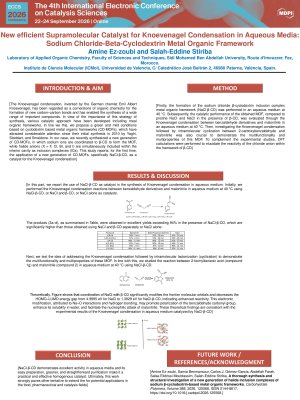
In this contribution, we focus on achieving a comprehensive understanding of the of a new generation of beta-cyclodextrin-based inclusion complex metal organic frameworks (b-CD-MOFs), as well as their applications as catalysts in organic reactions. First, sodium chloride β-cyclodextrin inclusion complex-based metal organic framework (NaCl-β-CD-MOFs) were successfully synthesized in aqueous medium at 40 °C. Subsequently, the catalytic performance of the obtained NaCl-β-CD-MOFs was evaluated in the Knoevenagel condensation between benzaldehyde derivatives and malonitrile in aqueous medium at 40 °C and compared with that of pristine NaCl and NaCl in the presence of β-CD.
Furthermore, the Knoevenagel condensation followed by intramolecular cyclization between 2-carboxybenzaldehyde and malonitrile was studied to demonstrate the multifunctionality and versatile catalytic properties of the NaCl-β-CD-MOFs. To complement the experimental studies, density functional theory (DFT) calculations were performed to elucidate the reactivity of the chloride anion within the β-CD framework.
The results demonstrate that NaCl-β-CD-MOFs act as a practical and efficient homogeneous catalyst for the synthesis of arylidene malononitrile cycloadduct derivatives, exhibiting excellent catalytic performance in terms of rate enhancement, under mild and environmentally friendly conditions, together with straightforward recyclability. In addition, the reaction between 2-carboxybenzaldehyde and malonitrile afforded the corresponding cyclized product in 92% yield within 1 h, without requiring any purification process.
Overall, this work strongly paves the way for the development of other b-CD-based supramolecular catalytic systems and broaden their applications in the field of sustainable catalysis.
Keywords
Beta-cyclodextrin
inclusion complex
metal organic framework
Knoevenagel condensation
green chemistry.
Poster
Amine Ez-zoubi.pdf
Synthesis of 1,4-disubstituted homoallylic alcohols in one step using a nickel-catalyzed three-component coupling reaction
Pyrite ashes as a catalyst for glucose conversion processes