Event submissions
Published
This submission belongs to the session S7. Catalysis in Organic and Polymer Chemistry of the event The 4th International Electronic Conference on Catalysis Sciences
Published date
17 Sep, 2026
Academic Editor
'%3e%3cpath%20d='M12.6657%2010.9104C12.4185%2010.325%2012.0599%209.79327%2011.6097%209.34482C11.1609%208.89508%2010.6293%208.5365%2010.0442%208.28888C10.0389%208.28626%2010.0337%208.28495%2010.0285%208.28233C10.8446%207.69279%2011.3752%206.73249%2011.3752%205.64904C11.3752%203.8542%209.92103%202.39999%208.1262%202.39999C6.33136%202.39999%204.87715%203.8542%204.87715%205.64904C4.87715%206.73249%205.40774%207.69279%206.22393%208.28364C6.21869%208.28626%206.21345%208.28757%206.20821%208.29019C5.62129%208.5378%205.09463%208.89284%204.64265%209.34613C4.1929%209.79493%203.83432%2010.3266%203.58671%2010.9117C3.34345%2011.4845%203.21226%2012.0987%203.20023%2012.7209C3.19988%2012.7349%203.20233%2012.7488%203.20744%2012.7619C3.21255%2012.7749%203.22022%2012.7867%203.22998%2012.7968C3.23975%2012.8068%203.25142%2012.8147%203.26431%2012.8202C3.2772%2012.8256%203.29105%2012.8284%203.30504%2012.8284H4.09109C4.14874%2012.8284%204.19459%2012.7825%204.1959%2012.7262C4.2221%2011.7148%204.62823%2010.7676%205.34617%2010.0497C6.08899%209.30683%207.0755%208.89808%208.1262%208.89808C9.17689%208.89808%2010.1634%209.30683%2010.9062%2010.0497C11.6242%2010.7676%2012.0303%2011.7148%2012.0565%2012.7262C12.0578%2012.7838%2012.1037%2012.8284%2012.1613%2012.8284H12.9474C12.9613%2012.8284%2012.9752%2012.8256%2012.9881%2012.8202C13.001%2012.8147%2013.0126%2012.8068%2013.0224%2012.7968C13.0322%2012.7867%2013.0398%2012.7749%2013.0449%2012.7619C13.0501%2012.7488%2013.0525%2012.7349%2013.0522%2012.7209C13.0391%2012.0947%2012.9094%2011.4855%2012.6657%2010.9104ZM8.1262%207.9024C7.52486%207.9024%206.9589%207.6679%206.53312%207.24211C6.10733%206.81633%205.87283%206.25037%205.87283%205.64904C5.87283%205.0477%206.10733%204.48174%206.53312%204.05596C6.9589%203.63018%207.52486%203.39567%208.1262%203.39567C8.72753%203.39567%209.29349%203.63018%209.71927%204.05596C10.1451%204.48174%2010.3796%205.0477%2010.3796%205.64904C10.3796%206.25037%2010.1451%206.81633%209.71927%207.24211C9.29349%207.6679%208.72753%207.9024%208.1262%207.9024Z'%20fill='%235D1EE1'/%3e%3c/g%3e%3c/svg%3e) Raffaella Mancuso
Raffaella MancusoCitation
Viktor Anishchenko, Olexii Dykun, Andrii Redko, Hanna Anishchenko, N-Benzoylation of Amino Acids under Inverse Phase-Transfer Catalysis, in Proceedings of The 4th International Electronic Conference on Catalysis Sciences, 22 September–24 September 2026, MDPI: Basel, Switzerland
Share
Email
Facebook
Twitter
LinkedIn
N-Benzoylation of Amino Acids under Inverse Phase-Transfer Catalysis
N-Benzoylation of Amino Acids under Inverse Phase-Transfer Catalysis
'%3e%3cpath%20d='M12.6647%2010.9104C12.4176%2010.325%2012.0589%209.7933%2011.6088%209.34485C11.16%208.89511%2010.6283%208.53653%2010.0432%208.28891C10.038%208.28629%2010.0327%208.28498%2010.0275%208.28236C10.8437%207.69282%2011.3743%206.73252%2011.3743%205.64907C11.3743%203.85423%209.92005%202.40002%208.12522%202.40002C6.33038%202.40002%204.87618%203.85423%204.87618%205.64907C4.87618%206.73252%205.40677%207.69282%206.22296%208.28367C6.21772%208.28629%206.21248%208.2876%206.20724%208.29022C5.62031%208.53783%205.09365%208.89287%204.64167%209.34616C4.19192%209.79496%203.83334%2010.3266%203.58573%2010.9117C3.34247%2011.4846%203.21128%2012.0987%203.19925%2012.721C3.1989%2012.735%203.20135%2012.7489%203.20646%2012.7619C3.21157%2012.7749%203.21924%2012.7868%203.22901%2012.7968C3.23877%2012.8068%203.25045%2012.8148%203.26334%2012.8202C3.27623%2012.8256%203.29007%2012.8284%203.30406%2012.8284H4.09012C4.14776%2012.8284%204.19362%2012.7825%204.19493%2012.7262C4.22113%2011.7148%204.62726%2010.7676%205.34519%2010.0497C6.08802%209.30686%207.07452%208.89811%208.12522%208.89811C9.17592%208.89811%2010.1624%209.30686%2010.9052%2010.0497C11.6232%2010.7676%2012.0293%2011.7148%2012.0555%2012.7262C12.0568%2012.7839%2012.1027%2012.8284%2012.1603%2012.8284H12.9464C12.9604%2012.8284%2012.9742%2012.8256%2012.9871%2012.8202C13%2012.8148%2013.0117%2012.8068%2013.0214%2012.7968C13.0312%2012.7868%2013.0389%2012.7749%2013.044%2012.7619C13.0491%2012.7489%2013.0515%2012.735%2013.0512%2012.721C13.0381%2012.0947%2012.9084%2011.4856%2012.6647%2010.9104ZM8.12522%207.90243C7.52388%207.90243%206.95792%207.66793%206.53214%207.24215C6.10636%206.81636%205.87185%206.2504%205.87185%205.64907C5.87185%205.04773%206.10636%204.48177%206.53214%204.05599C6.95792%203.63021%207.52388%203.3957%208.12522%203.3957C8.72655%203.3957%209.29252%203.63021%209.7183%204.05599C10.1441%204.48177%2010.3786%205.04773%2010.3786%205.64907C10.3786%206.2504%2010.1441%206.81636%209.7183%207.24215C9.29252%207.66793%208.72655%207.90243%208.12522%207.90243Z'%20fill='%235D1EE1'/%3e%3c/g%3e%3c/svg%3e)
Viktor Anishchenko 1
Olexii Dykun 1
Andrii Redko 1
Hanna Anishchenko 1
1. Spectrochemical research department, L.M. Litvynenko Institute of Physical-Organic Chemistry and Coal Chemistry of NAS of Ukraine, 50 Kharkivske Shose, Kyiv, 02155, Ukraine
Abstract
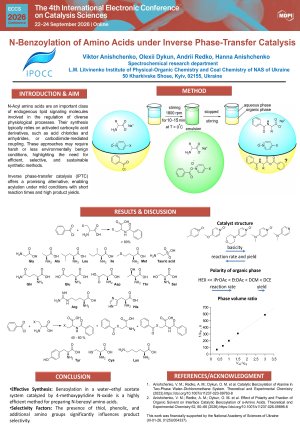
N-Acyl amino acids are an important class of endogenous lipid signaling molecules involved in the regulation of various physiological processes. They are commonly synthesized by acylation of amino groups with activated carboxylic acid derivatives, including acid chlorides and anhydrides, or by carbodiimide-mediated activation. Therefore, the development of efficient, environmentally acceptable, and highly selective methods for their synthesis remains relevant. One promising approach is inverse phase-transfer catalysis (IPTC), which enables reactions under mild conditions, within short reaction times, and with high product yields.
Aim. To study the effect of reaction conditions on the reaction rate and yield of N-acyl amino acids.
Materials and methods. Glycine, alanine, leucine, isoleucine, tyrosine, glutamine, glutamic acid, aspartic acid, threonine, methionine, serine, cysteine, lysine, histidine, arginine, and taurine were used as substrates. 4-methyl-, 4-methoxy-, 4-morpholino-, and 4-dimethylaminopyridine N-oxides, and 4-dimethylaminopyridine, were tested as catalysts. The reaction was monitored by RP-HPLC using an Agilent 1260 Infinity II system.
Results. The effects of catalyst structure, amino acid structure, phase volume ratio, polarity of organic phase, acidity, and ionic strength of the aqueous phase were examined. In alanine benzoylation, 4-methoxypyridine N-oxide showed the highest catalytic activity. More basic catalysts decreased the rate of the target reaction and promoted benzoyl chloride hydrolysis. Replacing dichloromethane with ethyl acetate reduced the reaction rate but had little effect on the final yield. Under optimized conditions, most amino acids gave the corresponding N-benzoyl derivatives in yields above 80%. Cysteine, tyrosine, and lysine were exceptions, forming additional thioester, ester, or diamide products due to reactive side-chain groups.
Conclusions. Benzoylation in a water–ethyl acetate system catalyzed by 4-methoxypyridine N-oxide is an effective method for preparing N-benzoyl amino acids. Thiol, phenolic, and additional amino groups significantly influence product selectivity.
Keywords
amino acids
benzoylation
inverse phase-transfer catalysis
HPLC
Poster
ECCS 2026 poster Anishchenko Viktor.pdf
Pyrite ashes as a catalyst for glucose conversion processes
Blue light-Mediated Oxidative Degradation of Polystyrene by Ni(II)-Amido-Quinoline Complexes