Event submissions
Published
This submission belongs to the session S7. Catalysis in Organic and Polymer Chemistry of the event The 4th International Electronic Conference on Catalysis Sciences
Published date
17 Sep, 2026
Academic Editor
'%3e%3cpath%20d='M12.6657%2010.9104C12.4185%2010.325%2012.0599%209.79327%2011.6097%209.34482C11.1609%208.89508%2010.6293%208.5365%2010.0442%208.28888C10.0389%208.28626%2010.0337%208.28495%2010.0285%208.28233C10.8446%207.69279%2011.3752%206.73249%2011.3752%205.64904C11.3752%203.8542%209.92103%202.39999%208.1262%202.39999C6.33136%202.39999%204.87715%203.8542%204.87715%205.64904C4.87715%206.73249%205.40774%207.69279%206.22393%208.28364C6.21869%208.28626%206.21345%208.28757%206.20821%208.29019C5.62129%208.5378%205.09463%208.89284%204.64265%209.34613C4.1929%209.79493%203.83432%2010.3266%203.58671%2010.9117C3.34345%2011.4845%203.21226%2012.0987%203.20023%2012.7209C3.19988%2012.7349%203.20233%2012.7488%203.20744%2012.7619C3.21255%2012.7749%203.22022%2012.7867%203.22998%2012.7968C3.23975%2012.8068%203.25142%2012.8147%203.26431%2012.8202C3.2772%2012.8256%203.29105%2012.8284%203.30504%2012.8284H4.09109C4.14874%2012.8284%204.19459%2012.7825%204.1959%2012.7262C4.2221%2011.7148%204.62823%2010.7676%205.34617%2010.0497C6.08899%209.30683%207.0755%208.89808%208.1262%208.89808C9.17689%208.89808%2010.1634%209.30683%2010.9062%2010.0497C11.6242%2010.7676%2012.0303%2011.7148%2012.0565%2012.7262C12.0578%2012.7838%2012.1037%2012.8284%2012.1613%2012.8284H12.9474C12.9613%2012.8284%2012.9752%2012.8256%2012.9881%2012.8202C13.001%2012.8147%2013.0126%2012.8068%2013.0224%2012.7968C13.0322%2012.7867%2013.0398%2012.7749%2013.0449%2012.7619C13.0501%2012.7488%2013.0525%2012.7349%2013.0522%2012.7209C13.0391%2012.0947%2012.9094%2011.4855%2012.6657%2010.9104ZM8.1262%207.9024C7.52486%207.9024%206.9589%207.6679%206.53312%207.24211C6.10733%206.81633%205.87283%206.25037%205.87283%205.64904C5.87283%205.0477%206.10733%204.48174%206.53312%204.05596C6.9589%203.63018%207.52486%203.39567%208.1262%203.39567C8.72753%203.39567%209.29349%203.63018%209.71927%204.05596C10.1451%204.48174%2010.3796%205.0477%2010.3796%205.64904C10.3796%206.25037%2010.1451%206.81633%209.71927%207.24211C9.29349%207.6679%208.72753%207.9024%208.1262%207.9024Z'%20fill='%235D1EE1'/%3e%3c/g%3e%3c/svg%3e) Raffaella Mancuso
Raffaella MancusoCitation
Rodica Zavoianu, Dana Georgeta Popescu, Vasile I. Pârvulescu, Bogdan Cojocaru, Octavian-D. Pavel, Enhancing the Catalytic Performance of MgCuAl-LDH Composites in Claisen-Schmidt Condensation via Organic Alkali Treatment, in Proceedings of The 4th International Electronic Conference on Catalysis Sciences, 22 September–24 September 2026, MDPI: Basel, Switzerland
Share
Email
Facebook
Twitter
LinkedIn
Enhancing the Catalytic Performance of MgCuAl-LDH Composites in Claisen-Schmidt Condensation via Organic Alkali Treatment

Rodica Zavoianu 1,2

Dana Georgeta Popescu 3

Vasile I. Pârvulescu 2,4

Bogdan Cojocaru 2,4

Octavian-D. Pavel 2,5
1. Department of Inorganic & Organic Chemistry, Biochemistry and Catalysis, Faculty of Chemistry, University of Bucharest, 4-12 Regina Elisabeta Av., S3, 030018, Romania
2. Research Center for Catalysts & Catalytic Processes, Faculty of Chemistry, University of Bucharest, 4-12 Regina Elisabeta Av., 030018 Bucharest, Romania
3. National Institute of Materials Physics, Atomistilor 405A, 077125 Magurele, Romania
4. Department of Organic Chemistry, Biochemistry and Catalysis, Faculty of Chemistry, University of Bucharest, 4-12 Regina Elisabeta Av., S3, 030018, Romania
5. Faculty of Chemistry, University of Bucharest, Bucharest, Romania
Abstract
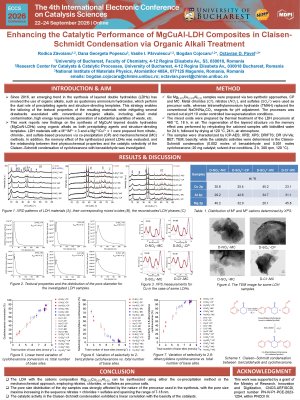
In the last decade, a distinct trend in the synthesis of Layered Double Hydroxides (LDHs) has emerged: the use of organic alkalis. These compounds serve a dual purpose, acting as both synthesis agents and template molecules. This approach allows for the tailoring of the solid's textural properties while avoiding the drawbacks of inorganic alkalis, such as alkali metal contamination, high energy consumption, and significant waste production. Notably, the Claisen-Schmidt condensation between benzaldehyde and cyclohexanone is a critical pathway for the synthesis of pharmaceutical intermediates and high density fuel precursors.
MgCuAl-LDH catalysts were synthesized using various metal precursors (e.g. nitrates, sulfates and chlorides) in the presence of an organic base via two distinct routes: traditional co-precipitation and non-traditional mechanochemistry. To investigate the influence of the memory effect on the physicochemical properties, the materials were calcined at 460 °C and subsequently hydrated. To assess the impact of these parameters on the physicochemical properties, a comprehensive suite of characterization techniques such as: XRD, DRIFT, ATR, DR-UV-Vis, BET, TEM and surface basicity determination.
Tetramethylammonium hydroxide templating yielded solids with low surface areas and narrow pore distribution. The catalytic activity was correlated linearly with the basicity. The presence of Cu cations introduced acid sites and lowered overall basicity; paradoxically, these factors, often viewed as disadvantages, were crucial for directing the transformation selectively toward the mono-condensed product, i.e. 2-benzylidenecyclohexanone. The highest catalytic performance was reached with the samples obtained from nitrate precursors (conversion of 89% with 97% selectivity in di-condensed compound). In contrast, the sample synthesized from sulfates favored side reactions, converting 46% of the benzaldehyde into benzoic acid. Regarding stability, structural changes occurred after three reaction cycles.
Acknowledgment
This work was supported by a grant of the Ministry of Research, Innovation and Digitization, CNCS-UEFISCDI, project number PN-IV-P1-PCE-2023-1254, within PNCDI IV.
Keywords
Layered double hydroxides
Claisen-Schmidt condensation
2-benzylidenecyclohexanone
Poster
Poster ODP 4IECCS.pdf
Metal–Organic Frameworks (MOFs) as Catalysts/Photocatalysts for Organic Synthesis
Chiral [6,5,3]Fused Bipyridine Ligand Enables Nickel-Catalyzed Asymmetric Coupling Reaction