Event submissions
Published
This submission belongs to the session S8. Catalysts Synthesis and Characterization of the event The 4th International Electronic Conference on Catalysis Sciences
Published date
17 Sep, 2026
Academic Editor
'%3e%3cpath%20d='M12.6657%2010.9104C12.4185%2010.325%2012.0599%209.79327%2011.6097%209.34482C11.1609%208.89508%2010.6293%208.5365%2010.0442%208.28888C10.0389%208.28626%2010.0337%208.28495%2010.0285%208.28233C10.8446%207.69279%2011.3752%206.73249%2011.3752%205.64904C11.3752%203.8542%209.92103%202.39999%208.1262%202.39999C6.33136%202.39999%204.87715%203.8542%204.87715%205.64904C4.87715%206.73249%205.40774%207.69279%206.22393%208.28364C6.21869%208.28626%206.21345%208.28757%206.20821%208.29019C5.62129%208.5378%205.09463%208.89284%204.64265%209.34613C4.1929%209.79493%203.83432%2010.3266%203.58671%2010.9117C3.34345%2011.4845%203.21226%2012.0987%203.20023%2012.7209C3.19988%2012.7349%203.20233%2012.7488%203.20744%2012.7619C3.21255%2012.7749%203.22022%2012.7867%203.22998%2012.7968C3.23975%2012.8068%203.25142%2012.8147%203.26431%2012.8202C3.2772%2012.8256%203.29105%2012.8284%203.30504%2012.8284H4.09109C4.14874%2012.8284%204.19459%2012.7825%204.1959%2012.7262C4.2221%2011.7148%204.62823%2010.7676%205.34617%2010.0497C6.08899%209.30683%207.0755%208.89808%208.1262%208.89808C9.17689%208.89808%2010.1634%209.30683%2010.9062%2010.0497C11.6242%2010.7676%2012.0303%2011.7148%2012.0565%2012.7262C12.0578%2012.7838%2012.1037%2012.8284%2012.1613%2012.8284H12.9474C12.9613%2012.8284%2012.9752%2012.8256%2012.9881%2012.8202C13.001%2012.8147%2013.0126%2012.8068%2013.0224%2012.7968C13.0322%2012.7867%2013.0398%2012.7749%2013.0449%2012.7619C13.0501%2012.7488%2013.0525%2012.7349%2013.0522%2012.7209C13.0391%2012.0947%2012.9094%2011.4855%2012.6657%2010.9104ZM8.1262%207.9024C7.52486%207.9024%206.9589%207.6679%206.53312%207.24211C6.10733%206.81633%205.87283%206.25037%205.87283%205.64904C5.87283%205.0477%206.10733%204.48174%206.53312%204.05596C6.9589%203.63018%207.52486%203.39567%208.1262%203.39567C8.72753%203.39567%209.29349%203.63018%209.71927%204.05596C10.1451%204.48174%2010.3796%205.0477%2010.3796%205.64904C10.3796%206.25037%2010.1451%206.81633%209.71927%207.24211C9.29349%207.6679%208.72753%207.9024%208.1262%207.9024Z'%20fill='%235D1EE1'/%3e%3c/g%3e%3c/svg%3e) Monica Trif
Monica TrifCitation
Diana Hanganu, Lidia Favier, Amalia Maria Sescu, Maria HARJA, Highly Reactive Mesoporous Catalytic Systems for Photocatalytic Degradation of An Emergent Water Contaminant: Synthesis, Characterization, and Reactivity, in Proceedings of The 4th International Electronic Conference on Catalysis Sciences, 22 September–24 September 2026, MDPI: Basel, Switzerland
Share
Email
Facebook
Twitter
LinkedIn
Highly Reactive Mesoporous Catalytic Systems for Photocatalytic Degradation of An Emergent Water Contaminant: Synthesis, Characterization, and Reactivity
'%3e%3cpath%20d='M12.6647%2010.9104C12.4176%2010.325%2012.0589%209.7933%2011.6088%209.34485C11.16%208.89511%2010.6283%208.53653%2010.0432%208.28891C10.038%208.28629%2010.0327%208.28498%2010.0275%208.28236C10.8437%207.69282%2011.3743%206.73252%2011.3743%205.64907C11.3743%203.85423%209.92005%202.40002%208.12522%202.40002C6.33038%202.40002%204.87618%203.85423%204.87618%205.64907C4.87618%206.73252%205.40677%207.69282%206.22296%208.28367C6.21772%208.28629%206.21248%208.2876%206.20724%208.29022C5.62031%208.53783%205.09365%208.89287%204.64167%209.34616C4.19192%209.79496%203.83334%2010.3266%203.58573%2010.9117C3.34247%2011.4846%203.21128%2012.0987%203.19925%2012.721C3.1989%2012.735%203.20135%2012.7489%203.20646%2012.7619C3.21157%2012.7749%203.21924%2012.7868%203.22901%2012.7968C3.23877%2012.8068%203.25045%2012.8148%203.26334%2012.8202C3.27623%2012.8256%203.29007%2012.8284%203.30406%2012.8284H4.09012C4.14776%2012.8284%204.19362%2012.7825%204.19493%2012.7262C4.22113%2011.7148%204.62726%2010.7676%205.34519%2010.0497C6.08802%209.30686%207.07452%208.89811%208.12522%208.89811C9.17592%208.89811%2010.1624%209.30686%2010.9052%2010.0497C11.6232%2010.7676%2012.0293%2011.7148%2012.0555%2012.7262C12.0568%2012.7839%2012.1027%2012.8284%2012.1603%2012.8284H12.9464C12.9604%2012.8284%2012.9742%2012.8256%2012.9871%2012.8202C13%2012.8148%2013.0117%2012.8068%2013.0214%2012.7968C13.0312%2012.7868%2013.0389%2012.7749%2013.044%2012.7619C13.0491%2012.7489%2013.0515%2012.735%2013.0512%2012.721C13.0381%2012.0947%2012.9084%2011.4856%2012.6647%2010.9104ZM8.12522%207.90243C7.52388%207.90243%206.95792%207.66793%206.53214%207.24215C6.10636%206.81636%205.87185%206.2504%205.87185%205.64907C5.87185%205.04773%206.10636%204.48177%206.53214%204.05599C6.95792%203.63021%207.52388%203.3957%208.12522%203.3957C8.72655%203.3957%209.29252%203.63021%209.7183%204.05599C10.1441%204.48177%2010.3786%205.04773%2010.3786%205.64907C10.3786%206.2504%2010.1441%206.81636%209.7183%207.24215C9.29252%207.66793%208.72655%207.90243%208.12522%207.90243Z'%20fill='%235D1EE1'/%3e%3c/g%3e%3c/svg%3e)
Diana Hanganu 1

Lidia Favier 2
Amalia Maria Sescu 1

Maria HARJA 1
1. Department of Chemical Engineering, Faculty of Chemical Engineering and Environmental Protection, Gheorghe Asachi Technical University of Iasi, Iasi, 70050, D. Mangeron 73, street, Romania
2. Univ Rennes, École Nationale Supérieure de Chimie de Rennes
Abstract
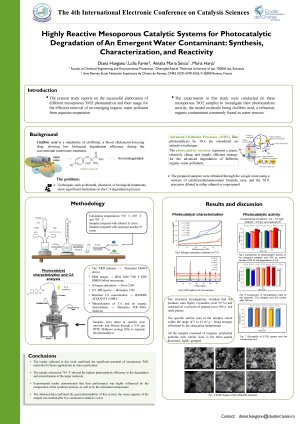
Introduction: The removal of organic micropollutants has become a major challenge for wastewater treatment plants, as these compounds have increasingly been detected in the environment at concentrations. Photocatalysis is an extensively studied removal method with several advantages, including low cost and ease of operation, enabling the elimination of pollutants without secondary pollution. This study focuses on the synthesis and characterization of mesoporous TiO₂ materials, obtained through a sol-gel process assisted by a soft-templating approach. The aim was to correlate synthesis parameters, structural evolution, and photocatalytic performance under UV-A irradiation conditions.
Methods: Titanium isopropoxide was used as a precursor, ethanol and isopropanol were employed during preparation process. Cetyltrimethylammonium bromide was used as a structure-templating agent for mesoporosity, while urea acted as a pH regulator and stabilizer of the precursor. The resulting gels were calcined at 550, 650, and 750 °C, affecting both crystallinity and surface properties. Clofibric acid was used as model pollutant to evaluate photocatalytic degradation. The materials were characterized using XRD, SEM, and BET.
Results: X-ray diffraction revealed that ethanol favored the retention of anatase, whereas isopropanol promoted earlier formation of rutile. The BET surface area decreased with temperature, ranging from 9 m²·g⁻¹ at 750 °C to 43 m²·g⁻¹ at 550 °C. Microscopic analyses demonstrated that the mesoporous framework was preserved after template removal. Photocatalytic tests performed under UV-A light (λ ≈ 365 nm) showed that the sample treated at 750 °C exhibited the highest degradation and mineralization efficiency toward clofibric acid. This enhanced photocatalytic performance can be attributed to an improved crystallinity, enhancing charge separation. Material stability was confirmed by maintaining high degradation during reusability without noticeable structural loss.
Conclusions: The synthesis of mesoporous titanium dioxide (TiO₂) via a combined sol-gel and soft-templating approach yielded a highly efficient photocatalyst with well-controlled textural properties and anatase-rutile phase composition, demonstrating strong potential for future application in advanced water treatment.
Keywords
Photocatalysts
Characterization
TiO2 mesoporous
Clofibric acid
Poster
Poster_ECCS_2026_Hanganu.pdf
Closed-Loop Machine Learning-Guided Optimization of Fe- and Mo-Doped Ni Nanocatalysts for Efficient Hydrogen Evolution Reaction
Decoupling ROS generation and photocatalytic activity in Au-Ag-Pt/g-C3N4 systems under visible light.