Event submissions
Published
This submission belongs to the session S8. Catalysts Synthesis and Characterization of the event The 4th International Electronic Conference on Catalysis Sciences
Published date
17 Sep, 2026
Academic Editor
'%3e%3cpath%20d='M12.6657%2010.9104C12.4185%2010.325%2012.0599%209.79327%2011.6097%209.34482C11.1609%208.89508%2010.6293%208.5365%2010.0442%208.28888C10.0389%208.28626%2010.0337%208.28495%2010.0285%208.28233C10.8446%207.69279%2011.3752%206.73249%2011.3752%205.64904C11.3752%203.8542%209.92103%202.39999%208.1262%202.39999C6.33136%202.39999%204.87715%203.8542%204.87715%205.64904C4.87715%206.73249%205.40774%207.69279%206.22393%208.28364C6.21869%208.28626%206.21345%208.28757%206.20821%208.29019C5.62129%208.5378%205.09463%208.89284%204.64265%209.34613C4.1929%209.79493%203.83432%2010.3266%203.58671%2010.9117C3.34345%2011.4845%203.21226%2012.0987%203.20023%2012.7209C3.19988%2012.7349%203.20233%2012.7488%203.20744%2012.7619C3.21255%2012.7749%203.22022%2012.7867%203.22998%2012.7968C3.23975%2012.8068%203.25142%2012.8147%203.26431%2012.8202C3.2772%2012.8256%203.29105%2012.8284%203.30504%2012.8284H4.09109C4.14874%2012.8284%204.19459%2012.7825%204.1959%2012.7262C4.2221%2011.7148%204.62823%2010.7676%205.34617%2010.0497C6.08899%209.30683%207.0755%208.89808%208.1262%208.89808C9.17689%208.89808%2010.1634%209.30683%2010.9062%2010.0497C11.6242%2010.7676%2012.0303%2011.7148%2012.0565%2012.7262C12.0578%2012.7838%2012.1037%2012.8284%2012.1613%2012.8284H12.9474C12.9613%2012.8284%2012.9752%2012.8256%2012.9881%2012.8202C13.001%2012.8147%2013.0126%2012.8068%2013.0224%2012.7968C13.0322%2012.7867%2013.0398%2012.7749%2013.0449%2012.7619C13.0501%2012.7488%2013.0525%2012.7349%2013.0522%2012.7209C13.0391%2012.0947%2012.9094%2011.4855%2012.6657%2010.9104ZM8.1262%207.9024C7.52486%207.9024%206.9589%207.6679%206.53312%207.24211C6.10733%206.81633%205.87283%206.25037%205.87283%205.64904C5.87283%205.0477%206.10733%204.48174%206.53312%204.05596C6.9589%203.63018%207.52486%203.39567%208.1262%203.39567C8.72753%203.39567%209.29349%203.63018%209.71927%204.05596C10.1451%204.48174%2010.3796%205.0477%2010.3796%205.64904C10.3796%206.25037%2010.1451%206.81633%209.71927%207.24211C9.29349%207.6679%208.72753%207.9024%208.1262%207.9024Z'%20fill='%235D1EE1'/%3e%3c/g%3e%3c/svg%3e) Monica Trif
Monica TrifCitation
Mohammad Mahmoudnezhad, Rouein Halladj, Sima Askari, Generative Artificial Intelligence for the Inverse Design of Organic Structure-Directing Agents in Zeolite Synthesis, in Proceedings of The 4th International Electronic Conference on Catalysis Sciences, 22 September–24 September 2026, MDPI: Basel, Switzerland
Share
Email
Facebook
Twitter
LinkedIn
Generative Artificial Intelligence for the Inverse Design of Organic Structure-Directing Agents in Zeolite Synthesis
'%3e%3cpath%20d='M12.6647%2010.9104C12.4176%2010.325%2012.0589%209.7933%2011.6088%209.34485C11.16%208.89511%2010.6283%208.53653%2010.0432%208.28891C10.038%208.28629%2010.0327%208.28498%2010.0275%208.28236C10.8437%207.69282%2011.3743%206.73252%2011.3743%205.64907C11.3743%203.85423%209.92005%202.40002%208.12522%202.40002C6.33038%202.40002%204.87618%203.85423%204.87618%205.64907C4.87618%206.73252%205.40677%207.69282%206.22296%208.28367C6.21772%208.28629%206.21248%208.2876%206.20724%208.29022C5.62031%208.53783%205.09365%208.89287%204.64167%209.34616C4.19192%209.79496%203.83334%2010.3266%203.58573%2010.9117C3.34247%2011.4846%203.21128%2012.0987%203.19925%2012.721C3.1989%2012.735%203.20135%2012.7489%203.20646%2012.7619C3.21157%2012.7749%203.21924%2012.7868%203.22901%2012.7968C3.23877%2012.8068%203.25045%2012.8148%203.26334%2012.8202C3.27623%2012.8256%203.29007%2012.8284%203.30406%2012.8284H4.09012C4.14776%2012.8284%204.19362%2012.7825%204.19493%2012.7262C4.22113%2011.7148%204.62726%2010.7676%205.34519%2010.0497C6.08802%209.30686%207.07452%208.89811%208.12522%208.89811C9.17592%208.89811%2010.1624%209.30686%2010.9052%2010.0497C11.6232%2010.7676%2012.0293%2011.7148%2012.0555%2012.7262C12.0568%2012.7839%2012.1027%2012.8284%2012.1603%2012.8284H12.9464C12.9604%2012.8284%2012.9742%2012.8256%2012.9871%2012.8202C13%2012.8148%2013.0117%2012.8068%2013.0214%2012.7968C13.0312%2012.7868%2013.0389%2012.7749%2013.044%2012.7619C13.0491%2012.7489%2013.0515%2012.735%2013.0512%2012.721C13.0381%2012.0947%2012.9084%2011.4856%2012.6647%2010.9104ZM8.12522%207.90243C7.52388%207.90243%206.95792%207.66793%206.53214%207.24215C6.10636%206.81636%205.87185%206.2504%205.87185%205.64907C5.87185%205.04773%206.10636%204.48177%206.53214%204.05599C6.95792%203.63021%207.52388%203.3957%208.12522%203.3957C8.72655%203.3957%209.29252%203.63021%209.7183%204.05599C10.1441%204.48177%2010.3786%205.04773%2010.3786%205.64907C10.3786%206.2504%2010.1441%206.81636%209.7183%207.24215C9.29252%207.66793%208.72655%207.90243%208.12522%207.90243Z'%20fill='%235D1EE1'/%3e%3c/g%3e%3c/svg%3e)
Mohammad Mahmoudnezhad 1
Rouein Halladj 1
Sima Askari 2
1. Department of Chemical Engineering, Amirkabir University of Technology, Tehran, Iran
2. Department of Chemical Engineering, SR.C., Islamic Azad University, Tehran, Iran
Abstract
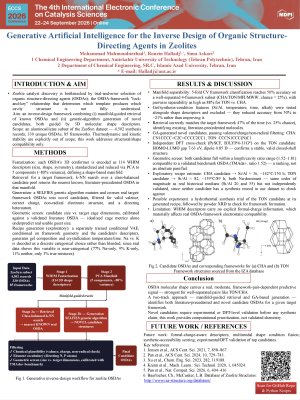
Introduction: The discovery of novel zeolite catalysts is currently impeded by the challenge of identifying effective organic structure-directing agents (OSDAs) within a high-dimensional and sparsely populated chemical space. Traditional trial-and-error synthesis remains a primary bottleneck, as the exact mechanisms of zeolite nucleation and the lock-and-key relationship between OSDAs and frameworks are not fully understood. To move beyond heuristic approaches, a generative machine learning framework is presented to navigate the OSDA–zeolite manifold and enable the inverse design of targeted zeolite structural descriptors.
Methods: Leveraging a previously reported dataset of synthesis routes extracted via natural language processing, the complex relationships between organic molecular architecture and the targeted geometric descriptors of the resulting zeolite cages are mapped. Organic molecules are futurized using 3D weighted holistic invariant molecular (WHIM) descriptors to capture size, shape, and symmetry. Dimensionality reduction through principal component analysis (PCA) is applied to construct a latent chemical manifold, thereby defining the specific descriptor envelopes required for targeted zeolite structures. A generative neural network is then trained to stochastically sample these latent regions to propose novel OSDA candidates as SMILES strings.
Results: It is demonstrated that OSDAs are successfully clustered by PCA into distinct regions based on targeted structural descriptors, effectively capturing essential shape-matching requirements. Optimized descriptor combinations are identified by the generative model, and novel OSDA candidates that exhibit structural compatibility and thermodynamic stability comparable to established benchmarking agents. This exploration bypasses the limitations of forward-prediction models by directly identifying the physicochemical requirements for targeted synthesis.
Conclusions: A data-driven generative pipeline for the in-silico design of OSDAs is established. By utilizing latent space exploration for inverse material design based on zeolite structural features, a systematic pathway is provided for the high-throughput discovery of next-generation zeolite catalysts.
Keywords
Inverse Design
Generative Artificial Intelligence
Zeolite Catalysts
Organic Structure-Directing Agents
Poster
ECCS 2026_ Prof. Halladj.pdf
Decoupling ROS generation and photocatalytic activity in Au-Ag-Pt/g-C3N4 systems under visible light.
Enhanced Acetaminophen Degradation via Peroxymonosulfate Activation Using Cu-FeOOH Catalyst