Event submissions
Published
This submission belongs to the session S8. Catalysts Synthesis and Characterization of the event The 4th International Electronic Conference on Catalysis Sciences
Published date
17 Sep, 2026
Academic Editor
'%3e%3cpath%20d='M12.6657%2010.9104C12.4185%2010.325%2012.0599%209.79327%2011.6097%209.34482C11.1609%208.89508%2010.6293%208.5365%2010.0442%208.28888C10.0389%208.28626%2010.0337%208.28495%2010.0285%208.28233C10.8446%207.69279%2011.3752%206.73249%2011.3752%205.64904C11.3752%203.8542%209.92103%202.39999%208.1262%202.39999C6.33136%202.39999%204.87715%203.8542%204.87715%205.64904C4.87715%206.73249%205.40774%207.69279%206.22393%208.28364C6.21869%208.28626%206.21345%208.28757%206.20821%208.29019C5.62129%208.5378%205.09463%208.89284%204.64265%209.34613C4.1929%209.79493%203.83432%2010.3266%203.58671%2010.9117C3.34345%2011.4845%203.21226%2012.0987%203.20023%2012.7209C3.19988%2012.7349%203.20233%2012.7488%203.20744%2012.7619C3.21255%2012.7749%203.22022%2012.7867%203.22998%2012.7968C3.23975%2012.8068%203.25142%2012.8147%203.26431%2012.8202C3.2772%2012.8256%203.29105%2012.8284%203.30504%2012.8284H4.09109C4.14874%2012.8284%204.19459%2012.7825%204.1959%2012.7262C4.2221%2011.7148%204.62823%2010.7676%205.34617%2010.0497C6.08899%209.30683%207.0755%208.89808%208.1262%208.89808C9.17689%208.89808%2010.1634%209.30683%2010.9062%2010.0497C11.6242%2010.7676%2012.0303%2011.7148%2012.0565%2012.7262C12.0578%2012.7838%2012.1037%2012.8284%2012.1613%2012.8284H12.9474C12.9613%2012.8284%2012.9752%2012.8256%2012.9881%2012.8202C13.001%2012.8147%2013.0126%2012.8068%2013.0224%2012.7968C13.0322%2012.7867%2013.0398%2012.7749%2013.0449%2012.7619C13.0501%2012.7488%2013.0525%2012.7349%2013.0522%2012.7209C13.0391%2012.0947%2012.9094%2011.4855%2012.6657%2010.9104ZM8.1262%207.9024C7.52486%207.9024%206.9589%207.6679%206.53312%207.24211C6.10733%206.81633%205.87283%206.25037%205.87283%205.64904C5.87283%205.0477%206.10733%204.48174%206.53312%204.05596C6.9589%203.63018%207.52486%203.39567%208.1262%203.39567C8.72753%203.39567%209.29349%203.63018%209.71927%204.05596C10.1451%204.48174%2010.3796%205.0477%2010.3796%205.64904C10.3796%206.25037%2010.1451%206.81633%209.71927%207.24211C9.29349%207.6679%208.72753%207.9024%208.1262%207.9024Z'%20fill='%235D1EE1'/%3e%3c/g%3e%3c/svg%3e) Monica Trif
Monica TrifCitation
Ada Isabel Montilla Saavedra, Paula Caregnato, Mónica Cristina Gonzalez, DEGRADATION OF CARBAMAZEPINE USING MODIFIED CARBON NITRIDE-BASED PHOTOCATALYSTS UNDER VARIOUS IRRADIATION SOURCES, in Proceedings of The 4th International Electronic Conference on Catalysis Sciences, 22 September–24 September 2026, MDPI: Basel, Switzerland
Share
Email
Facebook
Twitter
LinkedIn
DEGRADATION OF CARBAMAZEPINE USING MODIFIED CARBON NITRIDE-BASED PHOTOCATALYSTS UNDER VARIOUS IRRADIATION SOURCES
'%3e%3cpath%20d='M12.6647%2010.9104C12.4176%2010.325%2012.0589%209.7933%2011.6088%209.34485C11.16%208.89511%2010.6283%208.53653%2010.0432%208.28891C10.038%208.28629%2010.0327%208.28498%2010.0275%208.28236C10.8437%207.69282%2011.3743%206.73252%2011.3743%205.64907C11.3743%203.85423%209.92005%202.40002%208.12522%202.40002C6.33038%202.40002%204.87618%203.85423%204.87618%205.64907C4.87618%206.73252%205.40677%207.69282%206.22296%208.28367C6.21772%208.28629%206.21248%208.2876%206.20724%208.29022C5.62031%208.53783%205.09365%208.89287%204.64167%209.34616C4.19192%209.79496%203.83334%2010.3266%203.58573%2010.9117C3.34247%2011.4846%203.21128%2012.0987%203.19925%2012.721C3.1989%2012.735%203.20135%2012.7489%203.20646%2012.7619C3.21157%2012.7749%203.21924%2012.7868%203.22901%2012.7968C3.23877%2012.8068%203.25045%2012.8148%203.26334%2012.8202C3.27623%2012.8256%203.29007%2012.8284%203.30406%2012.8284H4.09012C4.14776%2012.8284%204.19362%2012.7825%204.19493%2012.7262C4.22113%2011.7148%204.62726%2010.7676%205.34519%2010.0497C6.08802%209.30686%207.07452%208.89811%208.12522%208.89811C9.17592%208.89811%2010.1624%209.30686%2010.9052%2010.0497C11.6232%2010.7676%2012.0293%2011.7148%2012.0555%2012.7262C12.0568%2012.7839%2012.1027%2012.8284%2012.1603%2012.8284H12.9464C12.9604%2012.8284%2012.9742%2012.8256%2012.9871%2012.8202C13%2012.8148%2013.0117%2012.8068%2013.0214%2012.7968C13.0312%2012.7868%2013.0389%2012.7749%2013.044%2012.7619C13.0491%2012.7489%2013.0515%2012.735%2013.0512%2012.721C13.0381%2012.0947%2012.9084%2011.4856%2012.6647%2010.9104ZM8.12522%207.90243C7.52388%207.90243%206.95792%207.66793%206.53214%207.24215C6.10636%206.81636%205.87185%206.2504%205.87185%205.64907C5.87185%205.04773%206.10636%204.48177%206.53214%204.05599C6.95792%203.63021%207.52388%203.3957%208.12522%203.3957C8.72655%203.3957%209.29252%203.63021%209.7183%204.05599C10.1441%204.48177%2010.3786%205.04773%2010.3786%205.64907C10.3786%206.2504%2010.1441%206.81636%209.7183%207.24215C9.29252%207.66793%208.72655%207.90243%208.12522%207.90243Z'%20fill='%235D1EE1'/%3e%3c/g%3e%3c/svg%3e)
Ada Isabel Montilla Saavedra 1
Paula Caregnato 1
Mónica Cristina Gonzalez 1
1. Institute of Theoretical and Applied Physicochemical Research (INIFTA), CCT La Plata, CONICET, Faculty of Exact Sciences, National University of La Plata, Diagonal 113 and 64 S/N, B1904DPI La Plata, Argentina
Abstract
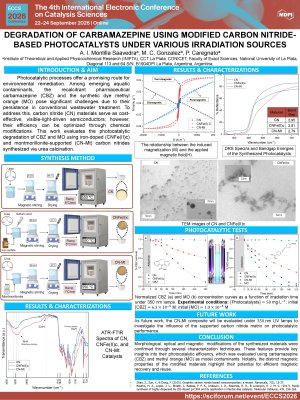
In environmental protection, removing anthropogenic pollutants via photocatalytic processes is highly relevant. Carbamazepine (CBZ), an emerging pharmaceutical contaminant in aquatic environments due to incomplete human metabolism and excretion, resists conventional wastewater treatments, leading to its accumulation in water bodies.
Carbon nitride (C₃N₄) is a low-cost, easily synthesized, non-toxic, and biodegradable semiconductor capable of absorbing visible solar light, making it a promising photocatalyst. To enhance efficiency and facilitate recovery, modification strategies including metal doping (iron) and supporting matrices are employed. Herein, carbon nitride (CN) particles were synthesized via urea calcination. Subsequently, CN was modified by calcination with a Fe(II) salt (CNFe(II)c) and supported on montmorillonite (CN-Mt). The catalysts were characterized using ATR-IR, UV-Vis absorption spectroscopy, zeta potential measurements, and diffuse reflectance spectroscopy (DRS) to estimate bandgap energies. Total organic carbon (TOC) analysis and other characterization techniques provided additional materials insights.
The photocatalytic performance was evaluated through CBZ degradation assays under various irradiation sources. Samples were collected periodically, and high-performance liquid chromatography (HPLC) was utilized to monitor concentration as a function of irradiation time.
The CBZ removal efficiency of the different photocatalysts was evaluated under identical experimental conditions. Based on the obtained results, a future study is proposed to investigate the mechanisms involved in CBZ degradation. This will provide a deeper understanding of the outcomes and lay the groundwork for future studies regarding the toxicity of the reaction mixture after treatment, as well as the evaluation of other emerging pharmaceutical contaminants.
Keywords
Nanoparticles
carbon nitrides
photocatalysis
Poster
ECCS 2026.pdf
Development of multifunctional catalysts for fatty acid hydrodeoxygenation as a route towards aviation biofuel production under mild conditions
ZIF-8/CNT Composites Prepared via Zinc-Functionalized Carbon Nanotubes