Event submissions
Published
This submission belongs to the session S8. Catalysts Synthesis and Characterization of the event The 4th International Electronic Conference on Catalysis Sciences
Published date
17 Sep, 2026
Academic Editor
'%3e%3cpath%20d='M12.6657%2010.9104C12.4185%2010.325%2012.0599%209.79327%2011.6097%209.34482C11.1609%208.89508%2010.6293%208.5365%2010.0442%208.28888C10.0389%208.28626%2010.0337%208.28495%2010.0285%208.28233C10.8446%207.69279%2011.3752%206.73249%2011.3752%205.64904C11.3752%203.8542%209.92103%202.39999%208.1262%202.39999C6.33136%202.39999%204.87715%203.8542%204.87715%205.64904C4.87715%206.73249%205.40774%207.69279%206.22393%208.28364C6.21869%208.28626%206.21345%208.28757%206.20821%208.29019C5.62129%208.5378%205.09463%208.89284%204.64265%209.34613C4.1929%209.79493%203.83432%2010.3266%203.58671%2010.9117C3.34345%2011.4845%203.21226%2012.0987%203.20023%2012.7209C3.19988%2012.7349%203.20233%2012.7488%203.20744%2012.7619C3.21255%2012.7749%203.22022%2012.7867%203.22998%2012.7968C3.23975%2012.8068%203.25142%2012.8147%203.26431%2012.8202C3.2772%2012.8256%203.29105%2012.8284%203.30504%2012.8284H4.09109C4.14874%2012.8284%204.19459%2012.7825%204.1959%2012.7262C4.2221%2011.7148%204.62823%2010.7676%205.34617%2010.0497C6.08899%209.30683%207.0755%208.89808%208.1262%208.89808C9.17689%208.89808%2010.1634%209.30683%2010.9062%2010.0497C11.6242%2010.7676%2012.0303%2011.7148%2012.0565%2012.7262C12.0578%2012.7838%2012.1037%2012.8284%2012.1613%2012.8284H12.9474C12.9613%2012.8284%2012.9752%2012.8256%2012.9881%2012.8202C13.001%2012.8147%2013.0126%2012.8068%2013.0224%2012.7968C13.0322%2012.7867%2013.0398%2012.7749%2013.0449%2012.7619C13.0501%2012.7488%2013.0525%2012.7349%2013.0522%2012.7209C13.0391%2012.0947%2012.9094%2011.4855%2012.6657%2010.9104ZM8.1262%207.9024C7.52486%207.9024%206.9589%207.6679%206.53312%207.24211C6.10733%206.81633%205.87283%206.25037%205.87283%205.64904C5.87283%205.0477%206.10733%204.48174%206.53312%204.05596C6.9589%203.63018%207.52486%203.39567%208.1262%203.39567C8.72753%203.39567%209.29349%203.63018%209.71927%204.05596C10.1451%204.48174%2010.3796%205.0477%2010.3796%205.64904C10.3796%206.25037%2010.1451%206.81633%209.71927%207.24211C9.29349%207.6679%208.72753%207.9024%208.1262%207.9024Z'%20fill='%235D1EE1'/%3e%3c/g%3e%3c/svg%3e) Monica Trif
Monica TrifCitation
Patryk Hubert Pakuła, Agata Łamacz, Magdalena Dulas, ZIF-8/CNT Composites Prepared via Zinc-Functionalized Carbon Nanotubes, in Proceedings of The 4th International Electronic Conference on Catalysis Sciences, 22 September–24 September 2026, MDPI: Basel, Switzerland
Share
Email
Facebook
Twitter
LinkedIn
ZIF-8/CNT Composites Prepared via Zinc-Functionalized Carbon Nanotubes
'%3e%3cpath%20d='M12.6647%2010.9104C12.4176%2010.325%2012.0589%209.7933%2011.6088%209.34485C11.16%208.89511%2010.6283%208.53653%2010.0432%208.28891C10.038%208.28629%2010.0327%208.28498%2010.0275%208.28236C10.8437%207.69282%2011.3743%206.73252%2011.3743%205.64907C11.3743%203.85423%209.92005%202.40002%208.12522%202.40002C6.33038%202.40002%204.87618%203.85423%204.87618%205.64907C4.87618%206.73252%205.40677%207.69282%206.22296%208.28367C6.21772%208.28629%206.21248%208.2876%206.20724%208.29022C5.62031%208.53783%205.09365%208.89287%204.64167%209.34616C4.19192%209.79496%203.83334%2010.3266%203.58573%2010.9117C3.34247%2011.4846%203.21128%2012.0987%203.19925%2012.721C3.1989%2012.735%203.20135%2012.7489%203.20646%2012.7619C3.21157%2012.7749%203.21924%2012.7868%203.22901%2012.7968C3.23877%2012.8068%203.25045%2012.8148%203.26334%2012.8202C3.27623%2012.8256%203.29007%2012.8284%203.30406%2012.8284H4.09012C4.14776%2012.8284%204.19362%2012.7825%204.19493%2012.7262C4.22113%2011.7148%204.62726%2010.7676%205.34519%2010.0497C6.08802%209.30686%207.07452%208.89811%208.12522%208.89811C9.17592%208.89811%2010.1624%209.30686%2010.9052%2010.0497C11.6232%2010.7676%2012.0293%2011.7148%2012.0555%2012.7262C12.0568%2012.7839%2012.1027%2012.8284%2012.1603%2012.8284H12.9464C12.9604%2012.8284%2012.9742%2012.8256%2012.9871%2012.8202C13%2012.8148%2013.0117%2012.8068%2013.0214%2012.7968C13.0312%2012.7868%2013.0389%2012.7749%2013.044%2012.7619C13.0491%2012.7489%2013.0515%2012.735%2013.0512%2012.721C13.0381%2012.0947%2012.9084%2011.4856%2012.6647%2010.9104ZM8.12522%207.90243C7.52388%207.90243%206.95792%207.66793%206.53214%207.24215C6.10636%206.81636%205.87185%206.2504%205.87185%205.64907C5.87185%205.04773%206.10636%204.48177%206.53214%204.05599C6.95792%203.63021%207.52388%203.3957%208.12522%203.3957C8.72655%203.3957%209.29252%203.63021%209.7183%204.05599C10.1441%204.48177%2010.3786%205.04773%2010.3786%205.64907C10.3786%206.2504%2010.1441%206.81636%209.7183%207.24215C9.29252%207.66793%208.72655%207.90243%208.12522%207.90243Z'%20fill='%235D1EE1'/%3e%3c/g%3e%3c/svg%3e)
Patryk Hubert Pakuła 1

Agata Łamacz 1
Magdalena Dulas 1
1. Department of Chemical Process Engineering and Technology, Wrocław University of Science and Technology, Wrocław, Poland.
Abstract
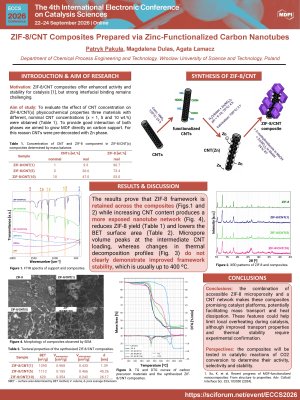
Integrating metal-organic frameworks like ZIF-8 with multi-walled carbon nanotubes (CNTs) is a powerful strategy to synthesize advanced catalytic materials with enhanced conductivity and structural stability. This work presents a multi-step synthesis of ZIF-8/CNT composites, focusing on a pre-anchoring zinc phase strategy onto the nanotubes to optimize interfacial interaction and template the framework growth.
CNTs were first functionalized using concentrated nitric acid under reflux to introduce oxygen-containing groups. A zinc precursor was then anchored onto the functionalized CNTs via NaOH precipitation followed by high-temperature calcination at 700 °C under argon to yield stable Zn/CNT matrices. Finally, ZIF-8 was grown in-situ on these matrices at room temperature for 24 h using 2-methylimidazole in methanol, targeting varying weight fractions.
XRD and FTIR analyses confirmed the successful room-temperature crystallization of ZIF-8(Zn) frameworks directly anchored onto the CNTs. The initial pre-zincification step significantly enhanced nanotube dispersion during the synthesis process. The BET surface area reached 1290 m²/g for the ZIF-8/CNT(1) composite. As the CNT mass fraction increased, the surface area predictably decreased (down to 620 m²/g for the CNT(10) variant). Furthermore, preliminary TGA profiling indicates that the integrated carbon scaffold successfully preserves and complements the thermal stability of the MOF structure.
A synthesis procedure for ZIF-8/CNT(1) composites was successfully developed, demonstrating that nanotubes act as effective nucleation centers, which significantly increased the process yield from 9% to 47%. XRD and FTIR analyses confirmed the MOF matrix's crystalline integrity and the successful formation of key Zn-N coordination bonds. Despite reducing the overall surface area, higher CNT content introduces mesopores that facilitate mass transport, enhancing the material's suitability for catalytic applications.
Keywords
MOF
ZIF-8
CNT
Poster
Poster presentation ECCS final version Pakula.pdf
DEGRADATION OF CARBAMAZEPINE USING MODIFIED CARBON NITRIDE-BASED PHOTOCATALYSTS UNDER VARIOUS IRRADIATION SOURCES
Influence of Picolinate Substituents on the Catalytic Activity of Oxidorhenium(V) Complexes in Olefin Epoxidation