Event submissions
Published
This submission belongs to the session S8. Catalysts Synthesis and Characterization of the event The 4th International Electronic Conference on Catalysis Sciences
Published date
17 Sep, 2026
Academic Editor
'%3e%3cpath%20d='M12.6657%2010.9104C12.4185%2010.325%2012.0599%209.79327%2011.6097%209.34482C11.1609%208.89508%2010.6293%208.5365%2010.0442%208.28888C10.0389%208.28626%2010.0337%208.28495%2010.0285%208.28233C10.8446%207.69279%2011.3752%206.73249%2011.3752%205.64904C11.3752%203.8542%209.92103%202.39999%208.1262%202.39999C6.33136%202.39999%204.87715%203.8542%204.87715%205.64904C4.87715%206.73249%205.40774%207.69279%206.22393%208.28364C6.21869%208.28626%206.21345%208.28757%206.20821%208.29019C5.62129%208.5378%205.09463%208.89284%204.64265%209.34613C4.1929%209.79493%203.83432%2010.3266%203.58671%2010.9117C3.34345%2011.4845%203.21226%2012.0987%203.20023%2012.7209C3.19988%2012.7349%203.20233%2012.7488%203.20744%2012.7619C3.21255%2012.7749%203.22022%2012.7867%203.22998%2012.7968C3.23975%2012.8068%203.25142%2012.8147%203.26431%2012.8202C3.2772%2012.8256%203.29105%2012.8284%203.30504%2012.8284H4.09109C4.14874%2012.8284%204.19459%2012.7825%204.1959%2012.7262C4.2221%2011.7148%204.62823%2010.7676%205.34617%2010.0497C6.08899%209.30683%207.0755%208.89808%208.1262%208.89808C9.17689%208.89808%2010.1634%209.30683%2010.9062%2010.0497C11.6242%2010.7676%2012.0303%2011.7148%2012.0565%2012.7262C12.0578%2012.7838%2012.1037%2012.8284%2012.1613%2012.8284H12.9474C12.9613%2012.8284%2012.9752%2012.8256%2012.9881%2012.8202C13.001%2012.8147%2013.0126%2012.8068%2013.0224%2012.7968C13.0322%2012.7867%2013.0398%2012.7749%2013.0449%2012.7619C13.0501%2012.7488%2013.0525%2012.7349%2013.0522%2012.7209C13.0391%2012.0947%2012.9094%2011.4855%2012.6657%2010.9104ZM8.1262%207.9024C7.52486%207.9024%206.9589%207.6679%206.53312%207.24211C6.10733%206.81633%205.87283%206.25037%205.87283%205.64904C5.87283%205.0477%206.10733%204.48174%206.53312%204.05596C6.9589%203.63018%207.52486%203.39567%208.1262%203.39567C8.72753%203.39567%209.29349%203.63018%209.71927%204.05596C10.1451%204.48174%2010.3796%205.0477%2010.3796%205.64904C10.3796%206.25037%2010.1451%206.81633%209.71927%207.24211C9.29349%207.6679%208.72753%207.9024%208.1262%207.9024Z'%20fill='%235D1EE1'/%3e%3c/g%3e%3c/svg%3e) Monica Trif
Monica TrifCitation
Niloofar Mozaffari, Synthesis of Mesoporous Cerium Oxide Using SBA-15 as a Hard Template, in Proceedings of The 4th International Electronic Conference on Catalysis Sciences, 22 September–24 September 2026, MDPI: Basel, Switzerland
Share
Email
Facebook
Twitter
LinkedIn
Synthesis of Mesoporous Cerium Oxide Using SBA-15 as a Hard Template
'%3e%3cpath%20d='M12.6647%2010.9104C12.4176%2010.325%2012.0589%209.7933%2011.6088%209.34485C11.16%208.89511%2010.6283%208.53653%2010.0432%208.28891C10.038%208.28629%2010.0327%208.28498%2010.0275%208.28236C10.8437%207.69282%2011.3743%206.73252%2011.3743%205.64907C11.3743%203.85423%209.92005%202.40002%208.12522%202.40002C6.33038%202.40002%204.87618%203.85423%204.87618%205.64907C4.87618%206.73252%205.40677%207.69282%206.22296%208.28367C6.21772%208.28629%206.21248%208.2876%206.20724%208.29022C5.62031%208.53783%205.09365%208.89287%204.64167%209.34616C4.19192%209.79496%203.83334%2010.3266%203.58573%2010.9117C3.34247%2011.4846%203.21128%2012.0987%203.19925%2012.721C3.1989%2012.735%203.20135%2012.7489%203.20646%2012.7619C3.21157%2012.7749%203.21924%2012.7868%203.22901%2012.7968C3.23877%2012.8068%203.25045%2012.8148%203.26334%2012.8202C3.27623%2012.8256%203.29007%2012.8284%203.30406%2012.8284H4.09012C4.14776%2012.8284%204.19362%2012.7825%204.19493%2012.7262C4.22113%2011.7148%204.62726%2010.7676%205.34519%2010.0497C6.08802%209.30686%207.07452%208.89811%208.12522%208.89811C9.17592%208.89811%2010.1624%209.30686%2010.9052%2010.0497C11.6232%2010.7676%2012.0293%2011.7148%2012.0555%2012.7262C12.0568%2012.7839%2012.1027%2012.8284%2012.1603%2012.8284H12.9464C12.9604%2012.8284%2012.9742%2012.8256%2012.9871%2012.8202C13%2012.8148%2013.0117%2012.8068%2013.0214%2012.7968C13.0312%2012.7868%2013.0389%2012.7749%2013.044%2012.7619C13.0491%2012.7489%2013.0515%2012.735%2013.0512%2012.721C13.0381%2012.0947%2012.9084%2011.4856%2012.6647%2010.9104ZM8.12522%207.90243C7.52388%207.90243%206.95792%207.66793%206.53214%207.24215C6.10636%206.81636%205.87185%206.2504%205.87185%205.64907C5.87185%205.04773%206.10636%204.48177%206.53214%204.05599C6.95792%203.63021%207.52388%203.3957%208.12522%203.3957C8.72655%203.3957%209.29252%203.63021%209.7183%204.05599C10.1441%204.48177%2010.3786%205.04773%2010.3786%205.64907C10.3786%206.2504%2010.1441%206.81636%209.7183%207.24215C9.29252%207.66793%208.72655%207.90243%208.12522%207.90243Z'%20fill='%235D1EE1'/%3e%3c/g%3e%3c/svg%3e)
Niloofar Mozaffari 1
1. Chemical Engineering Department, Université Laval, Quebec, G1V 0A6, Canada
Abstract
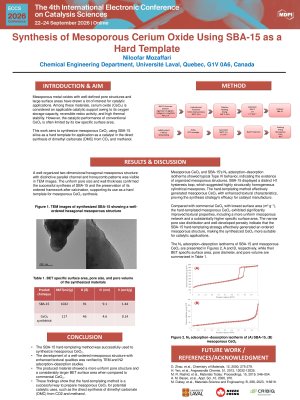
Mesoporous metal oxides with well-defined pore structures and large surface areas have drawn a lot of interest for catalytic applications. Among these materials, cerium oxide (CeO₂) is considered an applicable catalytic support owing to its oxygen storage capacity, reversible redox activity, and high thermal stability. However, the catalytic performance of conventional CeO₂ is sometimes limited in many applications because of its low specific surface area. Developing mesoporous CeO₂ with customized textural qualities is therefore of major interest. This work aims to develop mesoporous CeO₂ as a catalyst for the direct synthesis of dimethyl carbonate (DMC) from CO₂ and methanol.
Mesoporous CeO₂ was produced using a hard-templating technique based on SBA-15 mesoporous silica, which was initially produced and characterized by nitrogen adsorption–desorption (BET) studies and transmission electron microscopy (TEM) to establish its ordered mesoporous structure. Following the removal of the template and infiltration of the cerium precursor, BET analysis was used to analyze the textural characteristics of the produced and commercial CeO₂.
The synthetic SBA-15 was shown to have a well-ordered hexagonal mesoporous structure by TEM. SBA 15's nitrogen adsorption–desorption investigation revealed a type IV isotherm with an H1 hysteresis loop, a high BET surface area of 1022 m² g⁻¹ and a pore volume of 1.44 cm³ g⁻¹. In comparison to commercial CeO₂ (7 m² g⁻¹), the hard-templating approach produced mesoporous CeO₂ with a BET surface area of 117 m² g⁻¹, an average pore diameter of 4.6 nm, and a pore volume of 0.14 cm³ g⁻¹. These findings verify that the hard-templating method is successful in creating mesoporous CeO₂ with improved textural characteristics.
The results suggest that the hard-templating technique is an effective method for synthesizing mesoporous CeO₂. The significant increase in surface area indicates that it is a good option for future catalytic applications and emphasizes the significance of controlled synthesis in catalyst design.
Keywords
Cerium oxide (CeO₂)
Mesoporous materials
SBA-15
Hard-template synthesis
BET analysis
Poster
Niloofar Mozaffari-poster presentation.pdf
Sustainable Synthesis and Physicochemical Characterization of Bio-Derived Catalytic Materials from Fruit and Vegetable Waste Streams
Metalloradical Catalysed Olefin Hydrogenation: A New Approach To Radical Hydrogenation