Event submissions
Published
This submission belongs to the session S1. Catalytic Materials of the event The 4th International Electronic Conference on Catalysis Sciences
Published date
17 Sep, 2026
Academic Editor
'%3e%3cpath%20d='M12.6657%2010.9104C12.4185%2010.325%2012.0599%209.79327%2011.6097%209.34482C11.1609%208.89508%2010.6293%208.5365%2010.0442%208.28888C10.0389%208.28626%2010.0337%208.28495%2010.0285%208.28233C10.8446%207.69279%2011.3752%206.73249%2011.3752%205.64904C11.3752%203.8542%209.92103%202.39999%208.1262%202.39999C6.33136%202.39999%204.87715%203.8542%204.87715%205.64904C4.87715%206.73249%205.40774%207.69279%206.22393%208.28364C6.21869%208.28626%206.21345%208.28757%206.20821%208.29019C5.62129%208.5378%205.09463%208.89284%204.64265%209.34613C4.1929%209.79493%203.83432%2010.3266%203.58671%2010.9117C3.34345%2011.4845%203.21226%2012.0987%203.20023%2012.7209C3.19988%2012.7349%203.20233%2012.7488%203.20744%2012.7619C3.21255%2012.7749%203.22022%2012.7867%203.22998%2012.7968C3.23975%2012.8068%203.25142%2012.8147%203.26431%2012.8202C3.2772%2012.8256%203.29105%2012.8284%203.30504%2012.8284H4.09109C4.14874%2012.8284%204.19459%2012.7825%204.1959%2012.7262C4.2221%2011.7148%204.62823%2010.7676%205.34617%2010.0497C6.08899%209.30683%207.0755%208.89808%208.1262%208.89808C9.17689%208.89808%2010.1634%209.30683%2010.9062%2010.0497C11.6242%2010.7676%2012.0303%2011.7148%2012.0565%2012.7262C12.0578%2012.7838%2012.1037%2012.8284%2012.1613%2012.8284H12.9474C12.9613%2012.8284%2012.9752%2012.8256%2012.9881%2012.8202C13.001%2012.8147%2013.0126%2012.8068%2013.0224%2012.7968C13.0322%2012.7867%2013.0398%2012.7749%2013.0449%2012.7619C13.0501%2012.7488%2013.0525%2012.7349%2013.0522%2012.7209C13.0391%2012.0947%2012.9094%2011.4855%2012.6657%2010.9104ZM8.1262%207.9024C7.52486%207.9024%206.9589%207.6679%206.53312%207.24211C6.10733%206.81633%205.87283%206.25037%205.87283%205.64904C5.87283%205.0477%206.10733%204.48174%206.53312%204.05596C6.9589%203.63018%207.52486%203.39567%208.1262%203.39567C8.72753%203.39567%209.29349%203.63018%209.71927%204.05596C10.1451%204.48174%2010.3796%205.0477%2010.3796%205.64904C10.3796%206.25037%2010.1451%206.81633%209.71927%207.24211C9.29349%207.6679%208.72753%207.9024%208.1262%207.9024Z'%20fill='%235D1EE1'/%3e%3c/g%3e%3c/svg%3e) Narendra Kumar
Narendra KumarCitation
Pradeep Mallamolla, Shanthi Priya Samudrala, Hydrogen Production from Glycerol via Aqueous Phase Reforming: A Systematic Review of Catalyst Systems, Reaction Mechanisms, and Process Parameters, in Proceedings of The 4th International Electronic Conference on Catalysis Sciences, 22 September–24 September 2026, MDPI: Basel, Switzerland
Share
Email
Facebook
Twitter
LinkedIn
Hydrogen Production from Glycerol via Aqueous Phase Reforming: A Systematic Review of Catalyst Systems, Reaction Mechanisms, and Process Parameters
'%3e%3cpath%20d='M12.6647%2010.9104C12.4176%2010.325%2012.0589%209.7933%2011.6088%209.34485C11.16%208.89511%2010.6283%208.53653%2010.0432%208.28891C10.038%208.28629%2010.0327%208.28498%2010.0275%208.28236C10.8437%207.69282%2011.3743%206.73252%2011.3743%205.64907C11.3743%203.85423%209.92005%202.40002%208.12522%202.40002C6.33038%202.40002%204.87618%203.85423%204.87618%205.64907C4.87618%206.73252%205.40677%207.69282%206.22296%208.28367C6.21772%208.28629%206.21248%208.2876%206.20724%208.29022C5.62031%208.53783%205.09365%208.89287%204.64167%209.34616C4.19192%209.79496%203.83334%2010.3266%203.58573%2010.9117C3.34247%2011.4846%203.21128%2012.0987%203.19925%2012.721C3.1989%2012.735%203.20135%2012.7489%203.20646%2012.7619C3.21157%2012.7749%203.21924%2012.7868%203.22901%2012.7968C3.23877%2012.8068%203.25045%2012.8148%203.26334%2012.8202C3.27623%2012.8256%203.29007%2012.8284%203.30406%2012.8284H4.09012C4.14776%2012.8284%204.19362%2012.7825%204.19493%2012.7262C4.22113%2011.7148%204.62726%2010.7676%205.34519%2010.0497C6.08802%209.30686%207.07452%208.89811%208.12522%208.89811C9.17592%208.89811%2010.1624%209.30686%2010.9052%2010.0497C11.6232%2010.7676%2012.0293%2011.7148%2012.0555%2012.7262C12.0568%2012.7839%2012.1027%2012.8284%2012.1603%2012.8284H12.9464C12.9604%2012.8284%2012.9742%2012.8256%2012.9871%2012.8202C13%2012.8148%2013.0117%2012.8068%2013.0214%2012.7968C13.0312%2012.7868%2013.0389%2012.7749%2013.044%2012.7619C13.0491%2012.7489%2013.0515%2012.735%2013.0512%2012.721C13.0381%2012.0947%2012.9084%2011.4856%2012.6647%2010.9104ZM8.12522%207.90243C7.52388%207.90243%206.95792%207.66793%206.53214%207.24215C6.10636%206.81636%205.87185%206.2504%205.87185%205.64907C5.87185%205.04773%206.10636%204.48177%206.53214%204.05599C6.95792%203.63021%207.52388%203.3957%208.12522%203.3957C8.72655%203.3957%209.29252%203.63021%209.7183%204.05599C10.1441%204.48177%2010.3786%205.04773%2010.3786%205.64907C10.3786%206.2504%2010.1441%206.81636%209.7183%207.24215C9.29252%207.66793%208.72655%207.90243%208.12522%207.90243Z'%20fill='%235D1EE1'/%3e%3c/g%3e%3c/svg%3e)
Pradeep Mallamolla 1

Shanthi Priya Samudrala 1
1. Department of Chemical and Biological Engineering, Monash University, Melbourne, Australia
Abstract
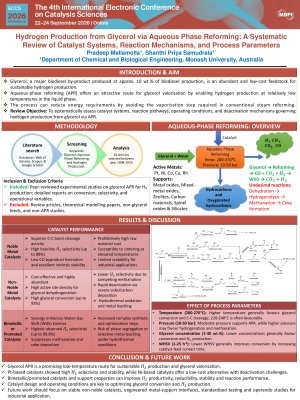
Glycerol, a major by-product of biodiesel production, has emerged as an attractive feedstock for H₂ production due to its abundance and low cost. Among the various reforming technologies, Aqueous Phase Reforming (APR) offers lower-temperature operation and eliminates energy-intensive water and fuel vaporization steps, making it an efficient and sustainable approach. This systematic review aims to critically assess catalyst design, reaction mechanisms, process parameters, and catalyst deactivation mechanisms affecting production through glycerol APR. A systematic search of major scientific databases identified 24 eligible experimental studies published between 2008 and 2026 for qualitative and comparative analysis. Search terms included combinations of “glycerol”, “aqueous phase reforming”, and “hydrogen production”. Experimental APR studies were included, while reviews, modelling-studies, and non-APR studies were excluded. The study evaluated approximately 100 catalyst-process configurations including bimetallic catalysts supported on various oxide and carbon-based supports. The investigated operating conditions varied between 200-270℃, 10-50 bar, and 1-30 wt.% feed concentration. Pt-based catalysts consistently reported the highest selectivity (80%) and stability, with glycerol conversions exceeding 90% under optimised conditions. Ni-based systems provided cost effective alternative but often suffered deactivation via coke deposition and sintering. Bimetallic and promoted catalysts improvedproductivity, catalyst reducibility, water-gas shift activity, and stability. Metal dispersion, acid-base characteristics, hydrothermal stability, and reaction pathways were significantly affected by support properties. Direct comparison among studies was limited by variations in reactor configurations, catalyst synthesis, operating conditions, and reported performance parameters. Collectively, catalyst design and operating conditions were identified as the key determinants of APR performance. Beyond improving catalyst stability, future research should prioritize the rational design of advanced catalysts with engineered metal-support interfaces, and improved hydrothermal stability. Standardized catalyst synthesis & evaluation protocols, operando characterization, and mechanistic studies are essential to establish structure-performance relationships and promote development of cost-effective catalysts for industrial-scale production from glycerol APR.
Keywords
Glycerol
Aqueous Phase Reforming
Hydrogen Production
Catalysts
Reaction Mechanisms
Process Optimization.
Poster
Poster.pdf
Enhanced Catalytic Performance of Hierarchical Mesoporous Fe-Modified ZSM-5 for Light Olefin Synthesis via CO and CO2 Hydrogenation
Controlled Stability of Liquid-Phase Dispersed Catalytic Systems for Benzene Hydroxylation to Phenol: DLS, Zeta-Potential and EPR/FMR Diagnostics