Event submissions
Published
This submission belongs to the session S1. Catalytic Materials of the event The 4th International Electronic Conference on Catalysis Sciences
Published date
17 Sep, 2026
Academic Editor
'%3e%3cpath%20d='M12.6657%2010.9104C12.4185%2010.325%2012.0599%209.79327%2011.6097%209.34482C11.1609%208.89508%2010.6293%208.5365%2010.0442%208.28888C10.0389%208.28626%2010.0337%208.28495%2010.0285%208.28233C10.8446%207.69279%2011.3752%206.73249%2011.3752%205.64904C11.3752%203.8542%209.92103%202.39999%208.1262%202.39999C6.33136%202.39999%204.87715%203.8542%204.87715%205.64904C4.87715%206.73249%205.40774%207.69279%206.22393%208.28364C6.21869%208.28626%206.21345%208.28757%206.20821%208.29019C5.62129%208.5378%205.09463%208.89284%204.64265%209.34613C4.1929%209.79493%203.83432%2010.3266%203.58671%2010.9117C3.34345%2011.4845%203.21226%2012.0987%203.20023%2012.7209C3.19988%2012.7349%203.20233%2012.7488%203.20744%2012.7619C3.21255%2012.7749%203.22022%2012.7867%203.22998%2012.7968C3.23975%2012.8068%203.25142%2012.8147%203.26431%2012.8202C3.2772%2012.8256%203.29105%2012.8284%203.30504%2012.8284H4.09109C4.14874%2012.8284%204.19459%2012.7825%204.1959%2012.7262C4.2221%2011.7148%204.62823%2010.7676%205.34617%2010.0497C6.08899%209.30683%207.0755%208.89808%208.1262%208.89808C9.17689%208.89808%2010.1634%209.30683%2010.9062%2010.0497C11.6242%2010.7676%2012.0303%2011.7148%2012.0565%2012.7262C12.0578%2012.7838%2012.1037%2012.8284%2012.1613%2012.8284H12.9474C12.9613%2012.8284%2012.9752%2012.8256%2012.9881%2012.8202C13.001%2012.8147%2013.0126%2012.8068%2013.0224%2012.7968C13.0322%2012.7867%2013.0398%2012.7749%2013.0449%2012.7619C13.0501%2012.7488%2013.0525%2012.7349%2013.0522%2012.7209C13.0391%2012.0947%2012.9094%2011.4855%2012.6657%2010.9104ZM8.1262%207.9024C7.52486%207.9024%206.9589%207.6679%206.53312%207.24211C6.10733%206.81633%205.87283%206.25037%205.87283%205.64904C5.87283%205.0477%206.10733%204.48174%206.53312%204.05596C6.9589%203.63018%207.52486%203.39567%208.1262%203.39567C8.72753%203.39567%209.29349%203.63018%209.71927%204.05596C10.1451%204.48174%2010.3796%205.0477%2010.3796%205.64904C10.3796%206.25037%2010.1451%206.81633%209.71927%207.24211C9.29349%207.6679%208.72753%207.9024%208.1262%207.9024Z'%20fill='%235D1EE1'/%3e%3c/g%3e%3c/svg%3e) Narendra Kumar
Narendra KumarCitation
Qasimova Khaleddin Lala, Aygun Ildirim Rustamova, Sevinj Nasib Osmanova, Yegana Abdulazimova, Gunel Mammadova, Fidan Samir İbrahimova, Zulfiyya Mammad Mammadova, Etibar Hummat Ismailov, Controlled Stability of Liquid-Phase Dispersed Catalytic Systems for Benzene Hydroxylation to Phenol: DLS, Zeta-Potential and EPR/FMR Diagnostics, in Proceedings of The 4th International Electronic Conference on Catalysis Sciences, 22 September–24 September 2026, MDPI: Basel, Switzerland
Share
Email
Facebook
Twitter
LinkedIn
Controlled Stability of Liquid-Phase Dispersed Catalytic Systems for Benzene Hydroxylation to Phenol: DLS, Zeta-Potential and EPR/FMR Diagnostics
'%3e%3cpath%20d='M12.6647%2010.9104C12.4176%2010.325%2012.0589%209.7933%2011.6088%209.34485C11.16%208.89511%2010.6283%208.53653%2010.0432%208.28891C10.038%208.28629%2010.0327%208.28498%2010.0275%208.28236C10.8437%207.69282%2011.3743%206.73252%2011.3743%205.64907C11.3743%203.85423%209.92005%202.40002%208.12522%202.40002C6.33038%202.40002%204.87618%203.85423%204.87618%205.64907C4.87618%206.73252%205.40677%207.69282%206.22296%208.28367C6.21772%208.28629%206.21248%208.2876%206.20724%208.29022C5.62031%208.53783%205.09365%208.89287%204.64167%209.34616C4.19192%209.79496%203.83334%2010.3266%203.58573%2010.9117C3.34247%2011.4846%203.21128%2012.0987%203.19925%2012.721C3.1989%2012.735%203.20135%2012.7489%203.20646%2012.7619C3.21157%2012.7749%203.21924%2012.7868%203.22901%2012.7968C3.23877%2012.8068%203.25045%2012.8148%203.26334%2012.8202C3.27623%2012.8256%203.29007%2012.8284%203.30406%2012.8284H4.09012C4.14776%2012.8284%204.19362%2012.7825%204.19493%2012.7262C4.22113%2011.7148%204.62726%2010.7676%205.34519%2010.0497C6.08802%209.30686%207.07452%208.89811%208.12522%208.89811C9.17592%208.89811%2010.1624%209.30686%2010.9052%2010.0497C11.6232%2010.7676%2012.0293%2011.7148%2012.0555%2012.7262C12.0568%2012.7839%2012.1027%2012.8284%2012.1603%2012.8284H12.9464C12.9604%2012.8284%2012.9742%2012.8256%2012.9871%2012.8202C13%2012.8148%2013.0117%2012.8068%2013.0214%2012.7968C13.0312%2012.7868%2013.0389%2012.7749%2013.044%2012.7619C13.0491%2012.7489%2013.0515%2012.735%2013.0512%2012.721C13.0381%2012.0947%2012.9084%2011.4856%2012.6647%2010.9104ZM8.12522%207.90243C7.52388%207.90243%206.95792%207.66793%206.53214%207.24215C6.10636%206.81636%205.87185%206.2504%205.87185%205.64907C5.87185%205.04773%206.10636%204.48177%206.53214%204.05599C6.95792%203.63021%207.52388%203.3957%208.12522%203.3957C8.72655%203.3957%209.29252%203.63021%209.7183%204.05599C10.1441%204.48177%2010.3786%205.04773%2010.3786%205.64907C10.3786%206.2504%2010.1441%206.81636%209.7183%207.24215C9.29252%207.66793%208.72655%207.90243%208.12522%207.90243Z'%20fill='%235D1EE1'/%3e%3c/g%3e%3c/svg%3e)
Qasimova Khaleddin Lala 1
Aygun Ildirim Rustamova 2,3

Sevinj Nasib Osmanova 4,5
Yegana Abdulazimova 6
Gunel Mammadova 7
Fidan Samir İbrahimova 8
Zulfiyya Mammad Mammadova 9
Etibar Hummat Ismailov 4
1. Department of Physical-Chemical studies, Institute of Petrochemical Processes Named after Academician Y. Mammadaliyev, 30 Khojaly Ave., Baku, AZ1025, Azerbaijan
2. Department of Nanokomposites and Nanocatalysts, Institute of Chemistry, Ministry of Science and Education,113 H. Javid Ave., Baku, AZ1143, Azerbaijan
3. Department of Technical Sciences, Baku Branch of Moscow State University, Khojasan Str., Baku, AZ1146, Azerbaijan
4. Department of Physical-Chemical Analysis, Institute of Chemistry, Ministry of Science and Education, 113 H. Javid Ave., Baku, AZ1143, Azerbaijan
5. Chemistry and Chemical Engineering Department, Khazar University,41 Mahsati Str., Baku, AZ1096, Azerbaijan
6. Department of Mechanical Engineering, Baku Engineering University, 120 Hasan Aliyev Str., Khirdalan, Az0101,Azerbaijan
7. Department of Petrochemical Technology and Industrial Ecology, Azerbaijan State Oil and Industry University, 10 Azadlig Ave., Baku, AZ1010, Azerbaijan
8. Department for processing mineral raw materials containing non-ferrous and ferrous metals , Institute of Chemistry, Ministry of Science and Education, 113 H. Javid Ave., Baku, AZ1143, Azerbaijan
9. Department of Nanokomposites and Nanocatalysts, Institute of Chemistry, Ministry of Science and Education, 113 H. Javid Ave., Baku, AZ1143, Azerbaijan
Abstract
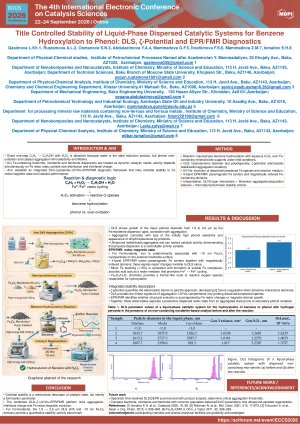
Direct liquid-phase hydroxylation of benzene to phenol is considered a promising alternative to the conventional multistep cumene process, since it can shorten the reaction pathway, reduce the formation of stoichiometric by-products, and employ hydrogen peroxide as an oxidant that ideally yields water as the main reduction product under relatively mild conditions. However, practical implementation of this process is limited not only by catalytic activity and phenol selectivity, but also by the controlled stability of the dispersed catalytic medium under real reaction conditions. In this work, iron-containing catalytic systems based on boehmite, mordenite, and bentonite were investigated using dynamic light scattering, zeta-potential measurements, UV/Vis spectroscopy, and electron paramagnetic/ferromagnetic resonance. The scientific novelty of the work consists in treating these methods as an integrated diagnostic platform for describing the structural, colloidal, interfacial, and redox stability of liquid-phase catalytic dispersions. The DLS results show measurable changes in hydrodynamic particle size and polydispersity during the reaction, reflecting the balance between dispersion stabilization and aggregation of iron-containing particles. These parameters may serve as early indicators of the transition from a catalytically active dispersed state to a less stable aggregated state. ζ -Potential measurements reveal changes in the electrostatic stabilization of the catalytic medium and make it possible to evaluate the role of interparticle interactions in maintaining catalytic dispersion stability. EPR/FMR studies demonstrate the formation and transformation of paramagnetic iron centers and magnetically ordered Fe-containing domains involved in hydrogen peroxide activation and radical generation. Thus, the combined DLS, zeta-potential, and EPR/FMR data provide an experimental basis for correlating colloidal stability, interfacial charge, redox activity, and catalytic performance. Population-balance, DLVO-type, Brownian aggregation, and kinetic-stability approaches are considered as a framework for predictive control of structurally dynamic liquid-phase catalytic systems.
Keywords
Keywords: benzene to phenol
liquid-phase hydroxylation
iron catalyst
UV/Vis
ζ-potential
EPR/FMR.
Poster
Lala_Qasimova.pdf
Hydrogen Production from Glycerol via Aqueous Phase Reforming: A Systematic Review of Catalyst Systems, Reaction Mechanisms, and Process Parameters
Synergistic Cu/Pt-TiO2 photocatalysts for enhanced visible-light ROS generation and BPA degradation