Event submissions
Published
This submission belongs to the session S8. Catalysts Synthesis and Characterization of the event The 4th International Electronic Conference on Catalysis Sciences
Published date
17 Sep, 2026
Academic Editor
'%3e%3cpath%20d='M12.6657%2010.9104C12.4185%2010.325%2012.0599%209.79327%2011.6097%209.34482C11.1609%208.89508%2010.6293%208.5365%2010.0442%208.28888C10.0389%208.28626%2010.0337%208.28495%2010.0285%208.28233C10.8446%207.69279%2011.3752%206.73249%2011.3752%205.64904C11.3752%203.8542%209.92103%202.39999%208.1262%202.39999C6.33136%202.39999%204.87715%203.8542%204.87715%205.64904C4.87715%206.73249%205.40774%207.69279%206.22393%208.28364C6.21869%208.28626%206.21345%208.28757%206.20821%208.29019C5.62129%208.5378%205.09463%208.89284%204.64265%209.34613C4.1929%209.79493%203.83432%2010.3266%203.58671%2010.9117C3.34345%2011.4845%203.21226%2012.0987%203.20023%2012.7209C3.19988%2012.7349%203.20233%2012.7488%203.20744%2012.7619C3.21255%2012.7749%203.22022%2012.7867%203.22998%2012.7968C3.23975%2012.8068%203.25142%2012.8147%203.26431%2012.8202C3.2772%2012.8256%203.29105%2012.8284%203.30504%2012.8284H4.09109C4.14874%2012.8284%204.19459%2012.7825%204.1959%2012.7262C4.2221%2011.7148%204.62823%2010.7676%205.34617%2010.0497C6.08899%209.30683%207.0755%208.89808%208.1262%208.89808C9.17689%208.89808%2010.1634%209.30683%2010.9062%2010.0497C11.6242%2010.7676%2012.0303%2011.7148%2012.0565%2012.7262C12.0578%2012.7838%2012.1037%2012.8284%2012.1613%2012.8284H12.9474C12.9613%2012.8284%2012.9752%2012.8256%2012.9881%2012.8202C13.001%2012.8147%2013.0126%2012.8068%2013.0224%2012.7968C13.0322%2012.7867%2013.0398%2012.7749%2013.0449%2012.7619C13.0501%2012.7488%2013.0525%2012.7349%2013.0522%2012.7209C13.0391%2012.0947%2012.9094%2011.4855%2012.6657%2010.9104ZM8.1262%207.9024C7.52486%207.9024%206.9589%207.6679%206.53312%207.24211C6.10733%206.81633%205.87283%206.25037%205.87283%205.64904C5.87283%205.0477%206.10733%204.48174%206.53312%204.05596C6.9589%203.63018%207.52486%203.39567%208.1262%203.39567C8.72753%203.39567%209.29349%203.63018%209.71927%204.05596C10.1451%204.48174%2010.3796%205.0477%2010.3796%205.64904C10.3796%206.25037%2010.1451%206.81633%209.71927%207.24211C9.29349%207.6679%208.72753%207.9024%208.1262%207.9024Z'%20fill='%235D1EE1'/%3e%3c/g%3e%3c/svg%3e) Monica Trif
Monica TrifCitation
Paulo Henrique Eleuterio Falsetti, Carlos Henrique da Silva Santos, Wilton Moreira Ferraz Junior, Guillermo Díaz-Sainz, Vagner Romito de Mendonça, 2D SprayPath: An open-Source tool for the reproducible fabrication of Gas Diffusion Electrodes by spray coating CO₂ electroreduction, in Proceedings of The 4th International Electronic Conference on Catalysis Sciences, 22 September–24 September 2026, MDPI: Basel, Switzerland
Share
Email
Facebook
Twitter
LinkedIn
2D SprayPath: An open-Source tool for the reproducible fabrication of Gas Diffusion Electrodes by spray coating CO2 electroreduction
'%3e%3cpath%20d='M12.6647%2010.9104C12.4176%2010.325%2012.0589%209.7933%2011.6088%209.34485C11.16%208.89511%2010.6283%208.53653%2010.0432%208.28891C10.038%208.28629%2010.0327%208.28498%2010.0275%208.28236C10.8437%207.69282%2011.3743%206.73252%2011.3743%205.64907C11.3743%203.85423%209.92005%202.40002%208.12522%202.40002C6.33038%202.40002%204.87618%203.85423%204.87618%205.64907C4.87618%206.73252%205.40677%207.69282%206.22296%208.28367C6.21772%208.28629%206.21248%208.2876%206.20724%208.29022C5.62031%208.53783%205.09365%208.89287%204.64167%209.34616C4.19192%209.79496%203.83334%2010.3266%203.58573%2010.9117C3.34247%2011.4846%203.21128%2012.0987%203.19925%2012.721C3.1989%2012.735%203.20135%2012.7489%203.20646%2012.7619C3.21157%2012.7749%203.21924%2012.7868%203.22901%2012.7968C3.23877%2012.8068%203.25045%2012.8148%203.26334%2012.8202C3.27623%2012.8256%203.29007%2012.8284%203.30406%2012.8284H4.09012C4.14776%2012.8284%204.19362%2012.7825%204.19493%2012.7262C4.22113%2011.7148%204.62726%2010.7676%205.34519%2010.0497C6.08802%209.30686%207.07452%208.89811%208.12522%208.89811C9.17592%208.89811%2010.1624%209.30686%2010.9052%2010.0497C11.6232%2010.7676%2012.0293%2011.7148%2012.0555%2012.7262C12.0568%2012.7839%2012.1027%2012.8284%2012.1603%2012.8284H12.9464C12.9604%2012.8284%2012.9742%2012.8256%2012.9871%2012.8202C13%2012.8148%2013.0117%2012.8068%2013.0214%2012.7968C13.0312%2012.7868%2013.0389%2012.7749%2013.044%2012.7619C13.0491%2012.7489%2013.0515%2012.735%2013.0512%2012.721C13.0381%2012.0947%2012.9084%2011.4856%2012.6647%2010.9104ZM8.12522%207.90243C7.52388%207.90243%206.95792%207.66793%206.53214%207.24215C6.10636%206.81636%205.87185%206.2504%205.87185%205.64907C5.87185%205.04773%206.10636%204.48177%206.53214%204.05599C6.95792%203.63021%207.52388%203.3957%208.12522%203.3957C8.72655%203.3957%209.29252%203.63021%209.7183%204.05599C10.1441%204.48177%2010.3786%205.04773%2010.3786%205.64907C10.3786%206.2504%2010.1441%206.81636%209.7183%207.24215C9.29252%207.66793%208.72655%207.90243%208.12522%207.90243Z'%20fill='%235D1EE1'/%3e%3c/g%3e%3c/svg%3e)
Paulo Henrique Eleuterio Falsetti 1,2
Carlos Henrique da Silva Santos 3
Wilton Moreira Ferraz Junior 3

Guillermo Díaz-Sainz 1
Vagner Romito de Mendonça 2,3
1. Chemical and Biomolecular Engineering Department, University of Cantabria, Avenida de los Castros, 46, Santander, Cantabria, 39005, Spain
2. Federal University of São Carlos, Rodovia João Leme dos Santos, Km 110, SP-264, Itinga District, Sorocaba, São Paulo, 18052-780, Brasil
3. Federal Institute of Education, Science and Technology of São Paulo, Avenida João Olímpio de Oliveira, 1561, Vila Asem, Itapetininga, São Paulo, 18202-000, Brasil
Abstract
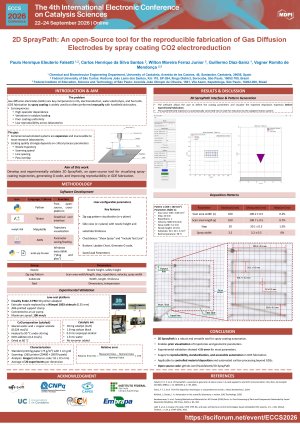
Spray coating is widely used in catalysis and electrocatalysis to deposit catalyst layers onto gas diffusion electrodes (GDEs), which are key components in CO2 electroreduction, water electrolysis, and fuel cells. However, GDEs are often fabricated manually using handheld airbrushes, making the deposition process highly dependent on operator skill and leading to variations in catalyst loading, coating uniformity, and performance. Although automated systems improve reproducibility, their high cost limits their adoption in research laboratories. Furthermore, coating quality remains strongly dependent on process parameters such as nozzle trajectory, scanning speed, line spacing, and pass overlap. To address these challenges, this work presents 2D SprayPath, an open-source tool for automating and standardizing spray coating through parameterized trajectories in the x–y plane. The software enables precise control of deposition parameters and automatically generates G-code for motion systems. Users can define coating dimensions, spray width, line spacing, scanning velocity, nozzle height, and substrate geometry, while visualizing the deposition pattern prior to execution. The tool was validated using a modified 3D-printer platform with an airbrush-based system for depositing catalytic inks used in GDE fabrication. Planned and measured trajectory parameters showed deviations below 1%, demonstrating high positional accuracy and robust pattern reproduction. This approach improves catalyst layer consistency and enables reproducible manufacturing of gas diffusion electrodes while reducing operator-dependent variability. By facilitating reliable deposition, 2D SprayPath supports the standardization of GDE fabrication and catalyst layer preparation in catalysis laboratories. Beyond GDE production, the methodology can extend to controlled material deposition and automated surface processing applications in electrocatalysis. The code is available in the open-source GitHub repository PauloFalsetti/2D_SprayPath.
Keywords
Software
Spray coating
Experimental automation
Parametrized trajectories
Reproducibility
Poster
Presentation_2D SprayPath.pdf
Insights into surface chemistry of Silica-based Dual Function Materials.
Thermochemically-driven exchange reactions for the rapid synthesis of crystalline metal borides and carbon-supported composites and their investigation as hydrogen evolution electrocatalysts