Event submissions
Published
This submission belongs to the session S1. Medical Imaging and Theranostics of the event The 1st International Online Conference on Diagnostics
Published date
18 Sep, 2026
Academic Editor
'%3e%3cpath%20d='M12.6657%2010.9104C12.4185%2010.325%2012.0599%209.79327%2011.6097%209.34482C11.1609%208.89508%2010.6293%208.5365%2010.0442%208.28888C10.0389%208.28626%2010.0337%208.28495%2010.0285%208.28233C10.8446%207.69279%2011.3752%206.73249%2011.3752%205.64904C11.3752%203.8542%209.92103%202.39999%208.1262%202.39999C6.33136%202.39999%204.87715%203.8542%204.87715%205.64904C4.87715%206.73249%205.40774%207.69279%206.22393%208.28364C6.21869%208.28626%206.21345%208.28757%206.20821%208.29019C5.62129%208.5378%205.09463%208.89284%204.64265%209.34613C4.1929%209.79493%203.83432%2010.3266%203.58671%2010.9117C3.34345%2011.4845%203.21226%2012.0987%203.20023%2012.7209C3.19988%2012.7349%203.20233%2012.7488%203.20744%2012.7619C3.21255%2012.7749%203.22022%2012.7867%203.22998%2012.7968C3.23975%2012.8068%203.25142%2012.8147%203.26431%2012.8202C3.2772%2012.8256%203.29105%2012.8284%203.30504%2012.8284H4.09109C4.14874%2012.8284%204.19459%2012.7825%204.1959%2012.7262C4.2221%2011.7148%204.62823%2010.7676%205.34617%2010.0497C6.08899%209.30683%207.0755%208.89808%208.1262%208.89808C9.17689%208.89808%2010.1634%209.30683%2010.9062%2010.0497C11.6242%2010.7676%2012.0303%2011.7148%2012.0565%2012.7262C12.0578%2012.7838%2012.1037%2012.8284%2012.1613%2012.8284H12.9474C12.9613%2012.8284%2012.9752%2012.8256%2012.9881%2012.8202C13.001%2012.8147%2013.0126%2012.8068%2013.0224%2012.7968C13.0322%2012.7867%2013.0398%2012.7749%2013.0449%2012.7619C13.0501%2012.7488%2013.0525%2012.7349%2013.0522%2012.7209C13.0391%2012.0947%2012.9094%2011.4855%2012.6657%2010.9104ZM8.1262%207.9024C7.52486%207.9024%206.9589%207.6679%206.53312%207.24211C6.10733%206.81633%205.87283%206.25037%205.87283%205.64904C5.87283%205.0477%206.10733%204.48174%206.53312%204.05596C6.9589%203.63018%207.52486%203.39567%208.1262%203.39567C8.72753%203.39567%209.29349%203.63018%209.71927%204.05596C10.1451%204.48174%2010.3796%205.0477%2010.3796%205.64904C10.3796%206.25037%2010.1451%206.81633%209.71927%207.24211C9.29349%207.6679%208.72753%207.9024%208.1262%207.9024Z'%20fill='%235D1EE1'/%3e%3c/g%3e%3c/svg%3e) Fabiano Bini
Fabiano BiniCitation
ABDEL AMIDE GBADAMASSI, Hafsa Bensimimou, Halima Batani, Mahdi Ahmed, Cosme Boutros Nato, Zakaria Ouassafrar, Amal Guensi, Diagnostic Contribution and Therapeutic Impact of ¹⁸F-FDG PET/CT in TENIS Syndrome, in Proceedings of The 1st International Online Conference on Diagnostics, 23 September–24 September 2026, MDPI: Basel, Switzerland
Share
Email
Facebook
Twitter
LinkedIn
Diagnostic Contribution and Therapeutic Impact of 18F-FDG PET/CT in TENIS Syndrome
'%3e%3cpath%20d='M12.6647%2010.9104C12.4176%2010.325%2012.0589%209.7933%2011.6088%209.34485C11.16%208.89511%2010.6283%208.53653%2010.0432%208.28891C10.038%208.28629%2010.0327%208.28498%2010.0275%208.28236C10.8437%207.69282%2011.3743%206.73252%2011.3743%205.64907C11.3743%203.85423%209.92005%202.40002%208.12522%202.40002C6.33038%202.40002%204.87618%203.85423%204.87618%205.64907C4.87618%206.73252%205.40677%207.69282%206.22296%208.28367C6.21772%208.28629%206.21248%208.2876%206.20724%208.29022C5.62031%208.53783%205.09365%208.89287%204.64167%209.34616C4.19192%209.79496%203.83334%2010.3266%203.58573%2010.9117C3.34247%2011.4846%203.21128%2012.0987%203.19925%2012.721C3.1989%2012.735%203.20135%2012.7489%203.20646%2012.7619C3.21157%2012.7749%203.21924%2012.7868%203.22901%2012.7968C3.23877%2012.8068%203.25045%2012.8148%203.26334%2012.8202C3.27623%2012.8256%203.29007%2012.8284%203.30406%2012.8284H4.09012C4.14776%2012.8284%204.19362%2012.7825%204.19493%2012.7262C4.22113%2011.7148%204.62726%2010.7676%205.34519%2010.0497C6.08802%209.30686%207.07452%208.89811%208.12522%208.89811C9.17592%208.89811%2010.1624%209.30686%2010.9052%2010.0497C11.6232%2010.7676%2012.0293%2011.7148%2012.0555%2012.7262C12.0568%2012.7839%2012.1027%2012.8284%2012.1603%2012.8284H12.9464C12.9604%2012.8284%2012.9742%2012.8256%2012.9871%2012.8202C13%2012.8148%2013.0117%2012.8068%2013.0214%2012.7968C13.0312%2012.7868%2013.0389%2012.7749%2013.044%2012.7619C13.0491%2012.7489%2013.0515%2012.735%2013.0512%2012.721C13.0381%2012.0947%2012.9084%2011.4856%2012.6647%2010.9104ZM8.12522%207.90243C7.52388%207.90243%206.95792%207.66793%206.53214%207.24215C6.10636%206.81636%205.87185%206.2504%205.87185%205.64907C5.87185%205.04773%206.10636%204.48177%206.53214%204.05599C6.95792%203.63021%207.52388%203.3957%208.12522%203.3957C8.72655%203.3957%209.29252%203.63021%209.7183%204.05599C10.1441%204.48177%2010.3786%205.04773%2010.3786%205.64907C10.3786%206.2504%2010.1441%206.81636%209.7183%207.24215C9.29252%207.66793%208.72655%207.90243%208.12522%207.90243Z'%20fill='%235D1EE1'/%3e%3c/g%3e%3c/svg%3e)
ABDEL AMIDE GBADAMASSI 1,2
Hafsa Bensimimou 2
Halima Batani 2
Mahdi Ahmed 2
Cosme Boutros Nato 3
Zakaria Ouassafrar 2
Amal Guensi 2
1. Laboratory of Mechanics and High Energy Physics, Faculty of Sciences Ain Chok, Hassan Second University of Casablanca, Casablanca, Morocco
2. Nuclear Medicine Department, Ibn Rochd University Hospital Center, Casablanca, Morocco
3. Mohammed VI Center for Cancer Treatment, Ibn Rochd University Hospital Center, Casablanca, Morocco
Abstract
Introduction: TENIS (Thyroglobulin Elevation with Negative Iodine Scintigraphy) syndrome is characterized by serum elevated thyroglobulin despite a negative whole-body radioiodine scan in patients treated for differentiated thyroid carcinoma. This study evaluated the diagnostic performance and therapeutic impact of [18F]FDG PET/CT in patients with TENIS syndrome.
Methods: We conducted a retrospective descriptive and analytical study at the Nuclear Medicine Department of Ibn Rochd University Hospital, Casablanca, between 2021 and 2025. Patients with TENIS syndrome were included. Clinical, histopathological, biochemical, and PET/CT data were analyzed. Univariate analysis identified factors associated with PET/CT positivity, while the correlation between serum thyroglobulin and SUVmax was assessed. Therapeutic impact was classified as none, moderate (diagnostic confirmation without treatment modification), or major (change in treatment strategy, including surgery, lymph node dissection, external beam radiotherapy, systemic therapy, or discontinuation of radioiodine therapy).
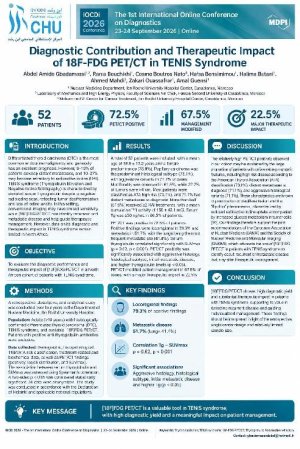
Results: PET/CT was positive in 72.5% of patients. Positive findings were locoregional in 79.3% and metastatic in 51.7%, with the lungs being the most frequent metastatic site (41.4%). Serum thyroglobulin correlated significantly with SUVmax (ρ = 0.62, p < 0.001). PET/CT positivity was significantly associated with aggressive histology, histological subtype, initial metastatic disease, and higher thyroglobulin levels (p < 0.05). PET/CT modified patient management in 67.5% of cases, with a major therapeutic impact in 22.5%.
Conclusion: [18F]FDG PET/CT showed high diagnostic yield and substantial therapeutic impact in patients with TENIS syndrome, supporting its value in detecting recurrent disease and guiding individualized management. These findings should be interpreted in light of the retrospective, single-center design and relatively limited sample size.
Keywords
TENIS syndrome
18F-FDG PET/CT
Thyroglobulin
Poster
Poster_AAG.pdf
Celiac-Mesenteric Anastomosis (Arc of Bühler): Original Evidence and Proposed Classification System
Development of a Nucleic Acid Lateral Flow Assay as a Rapid Point of Care Alternative to PCR-Based Diagnostics.