Event submissions
Published
This submission belongs to the session S5. Point-of-Care Diagnostics and Other Diagnostic Procedures of the event The 1st International Online Conference on Diagnostics
Published date
18 Sep, 2026
Academic Editor
'%3e%3cpath%20d='M12.6657%2010.9104C12.4185%2010.325%2012.0599%209.79327%2011.6097%209.34482C11.1609%208.89508%2010.6293%208.5365%2010.0442%208.28888C10.0389%208.28626%2010.0337%208.28495%2010.0285%208.28233C10.8446%207.69279%2011.3752%206.73249%2011.3752%205.64904C11.3752%203.8542%209.92103%202.39999%208.1262%202.39999C6.33136%202.39999%204.87715%203.8542%204.87715%205.64904C4.87715%206.73249%205.40774%207.69279%206.22393%208.28364C6.21869%208.28626%206.21345%208.28757%206.20821%208.29019C5.62129%208.5378%205.09463%208.89284%204.64265%209.34613C4.1929%209.79493%203.83432%2010.3266%203.58671%2010.9117C3.34345%2011.4845%203.21226%2012.0987%203.20023%2012.7209C3.19988%2012.7349%203.20233%2012.7488%203.20744%2012.7619C3.21255%2012.7749%203.22022%2012.7867%203.22998%2012.7968C3.23975%2012.8068%203.25142%2012.8147%203.26431%2012.8202C3.2772%2012.8256%203.29105%2012.8284%203.30504%2012.8284H4.09109C4.14874%2012.8284%204.19459%2012.7825%204.1959%2012.7262C4.2221%2011.7148%204.62823%2010.7676%205.34617%2010.0497C6.08899%209.30683%207.0755%208.89808%208.1262%208.89808C9.17689%208.89808%2010.1634%209.30683%2010.9062%2010.0497C11.6242%2010.7676%2012.0303%2011.7148%2012.0565%2012.7262C12.0578%2012.7838%2012.1037%2012.8284%2012.1613%2012.8284H12.9474C12.9613%2012.8284%2012.9752%2012.8256%2012.9881%2012.8202C13.001%2012.8147%2013.0126%2012.8068%2013.0224%2012.7968C13.0322%2012.7867%2013.0398%2012.7749%2013.0449%2012.7619C13.0501%2012.7488%2013.0525%2012.7349%2013.0522%2012.7209C13.0391%2012.0947%2012.9094%2011.4855%2012.6657%2010.9104ZM8.1262%207.9024C7.52486%207.9024%206.9589%207.6679%206.53312%207.24211C6.10733%206.81633%205.87283%206.25037%205.87283%205.64904C5.87283%205.0477%206.10733%204.48174%206.53312%204.05596C6.9589%203.63018%207.52486%203.39567%208.1262%203.39567C8.72753%203.39567%209.29349%203.63018%209.71927%204.05596C10.1451%204.48174%2010.3796%205.0477%2010.3796%205.64904C10.3796%206.25037%2010.1451%206.81633%209.71927%207.24211C9.29349%207.6679%208.72753%207.9024%208.1262%207.9024Z'%20fill='%235D1EE1'/%3e%3c/g%3e%3c/svg%3e) Gerald J. Kost
Gerald J. KostCitation
Eileen Hannigan, Peter Curley, Brian Ward, Tera McCool, Development of a Nucleic Acid Lateral Flow Assay as a Rapid Point of Care Alternative to PCR-Based Diagnostics., in Proceedings of The 1st International Online Conference on Diagnostics, 23 September–24 September 2026, MDPI: Basel, Switzerland
Share
Email
Facebook
Twitter
LinkedIn
Development of a Nucleic Acid Lateral Flow Assay as a Rapid Point of Care Alternative to PCR-Based Diagnostics.
'%3e%3cpath%20d='M12.6647%2010.9104C12.4176%2010.325%2012.0589%209.7933%2011.6088%209.34485C11.16%208.89511%2010.6283%208.53653%2010.0432%208.28891C10.038%208.28629%2010.0327%208.28498%2010.0275%208.28236C10.8437%207.69282%2011.3743%206.73252%2011.3743%205.64907C11.3743%203.85423%209.92005%202.40002%208.12522%202.40002C6.33038%202.40002%204.87618%203.85423%204.87618%205.64907C4.87618%206.73252%205.40677%207.69282%206.22296%208.28367C6.21772%208.28629%206.21248%208.2876%206.20724%208.29022C5.62031%208.53783%205.09365%208.89287%204.64167%209.34616C4.19192%209.79496%203.83334%2010.3266%203.58573%2010.9117C3.34247%2011.4846%203.21128%2012.0987%203.19925%2012.721C3.1989%2012.735%203.20135%2012.7489%203.20646%2012.7619C3.21157%2012.7749%203.21924%2012.7868%203.22901%2012.7968C3.23877%2012.8068%203.25045%2012.8148%203.26334%2012.8202C3.27623%2012.8256%203.29007%2012.8284%203.30406%2012.8284H4.09012C4.14776%2012.8284%204.19362%2012.7825%204.19493%2012.7262C4.22113%2011.7148%204.62726%2010.7676%205.34519%2010.0497C6.08802%209.30686%207.07452%208.89811%208.12522%208.89811C9.17592%208.89811%2010.1624%209.30686%2010.9052%2010.0497C11.6232%2010.7676%2012.0293%2011.7148%2012.0555%2012.7262C12.0568%2012.7839%2012.1027%2012.8284%2012.1603%2012.8284H12.9464C12.9604%2012.8284%2012.9742%2012.8256%2012.9871%2012.8202C13%2012.8148%2013.0117%2012.8068%2013.0214%2012.7968C13.0312%2012.7868%2013.0389%2012.7749%2013.044%2012.7619C13.0491%2012.7489%2013.0515%2012.735%2013.0512%2012.721C13.0381%2012.0947%2012.9084%2011.4856%2012.6647%2010.9104ZM8.12522%207.90243C7.52388%207.90243%206.95792%207.66793%206.53214%207.24215C6.10636%206.81636%205.87185%206.2504%205.87185%205.64907C5.87185%205.04773%206.10636%204.48177%206.53214%204.05599C6.95792%203.63021%207.52388%203.3957%208.12522%203.3957C8.72655%203.3957%209.29252%203.63021%209.7183%204.05599C10.1441%204.48177%2010.3786%205.04773%2010.3786%205.64907C10.3786%206.2504%2010.1441%206.81636%209.7183%207.24215C9.29252%207.66793%208.72655%207.90243%208.12522%207.90243Z'%20fill='%235D1EE1'/%3e%3c/g%3e%3c/svg%3e)
Eileen Hannigan 1
Peter Curley 1
Brian Ward 2
Tera McCool 3
1. Assay Development Services, Diagnostics and Regulated Materials, Advanced Solutions, Life Science, Merck KGaA, Darmstadt
2. Biology Production Materials, Diagnostics and Regulated Materials, Advanced Solutions, Life Science, MilliporeSigma, Life Science business of Merck KGaA, Darmstadt
3. Assay Development Services, Diagnostics and Regulated Materials, Advanced Solutions, Life Science, MilliporeSigma, Life Science business of Merck KGaA, Darmstadt
Abstract
Introduction
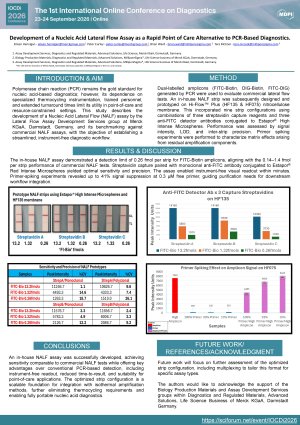
Polymerase chain reaction (PCR) remains the gold standard for molecular diagnostics; however, its dependence on specialized thermocycling instrumentation, trained personnel, and extended turnaround times limit its utility in point-of-care and resource-constrained settings. Nucleic acid lateral flow (NALF) assays present a compelling alternative, combining the molecular specificity of nucleic acid amplification with the simplicity and speed of lateral flow detection. This study describes the development and benchmarking of an in-house NALF assay against commercial formats by the Lateral Flow Assay Development Services group at Merck KGaA, Darmstadt, Germany.
Methods
Dual-labelled amplicons (FITC-Biotin, DIG-Biotin, FITC-DIG) generated by PCR were used to evaluate commercial lateral flow tests. An in-house NALF strip was subsequently designed and prototyped on Hi-Flow™ Plus nitrocellulose membrane, incorporating nine strip configurations varying across three streptavidin capture reagents and three anti-FITC detector antibodies conjugated to Estapor® Red Intense Microspheres. Performance was assessed by signal intensity, LOD, and inter-strip precision. Primer spiking experiments were performed to characterize matrix effects arising from residual amplification components.
Results
The in-house NALF assay detected 0.26 fmol per strip for FITC-Biotin amplicons, an improvement over the 1.4 fmol per strip detected by commercial tests. Optimal performance was achieved using streptavidin capture paired with monoclonal anti-FITC antibody conjugated to Estapor® Red Intense Microspheres. The novel High Intense Microspheres delivered enhanced signal intensity over conventional particles, enabling a quicker and more discernible instrument-free visual readout. Primer-spiking experiments revealed up to 41% signal suppression at 0.3 µM free primer, informing purification requirements for downstream integration.
Conclusions
An in-house NALF assay was successfully developed with improved sensitivity over commercial tests, offering instrument-free readout, reduced time-to-result, and point-of-care suitability. Estapor® detection particle sizes support assay tailoring, while colour diversity enables multiplexing capability. The optimised configuration provides a scalable foundation for integration with isothermal amplification, eliminating thermocycling requirements and enabling fully portable nucleic acid diagnostics.
Keywords
Nucleic Acid Lateral Flow Assay
Molecular Diagnostics
PCR
Point-of-Care
Poster
NALF Poster Merck.pdf
Diagnostic Contribution and Therapeutic Impact of 18F-FDG PET/CT in TENIS Syndrome
A Treatment-Specific Microwave Imaging Approach for Thermal Ablation Monitoring