Event submissions
Published
This submission belongs to the session S5. Point-of-Care Diagnostics and Other Diagnostic Procedures of the event The 1st International Online Conference on Diagnostics
Published date
18 Sep, 2026
Academic Editor
'%3e%3cpath%20d='M12.6657%2010.9104C12.4185%2010.325%2012.0599%209.79327%2011.6097%209.34482C11.1609%208.89508%2010.6293%208.5365%2010.0442%208.28888C10.0389%208.28626%2010.0337%208.28495%2010.0285%208.28233C10.8446%207.69279%2011.3752%206.73249%2011.3752%205.64904C11.3752%203.8542%209.92103%202.39999%208.1262%202.39999C6.33136%202.39999%204.87715%203.8542%204.87715%205.64904C4.87715%206.73249%205.40774%207.69279%206.22393%208.28364C6.21869%208.28626%206.21345%208.28757%206.20821%208.29019C5.62129%208.5378%205.09463%208.89284%204.64265%209.34613C4.1929%209.79493%203.83432%2010.3266%203.58671%2010.9117C3.34345%2011.4845%203.21226%2012.0987%203.20023%2012.7209C3.19988%2012.7349%203.20233%2012.7488%203.20744%2012.7619C3.21255%2012.7749%203.22022%2012.7867%203.22998%2012.7968C3.23975%2012.8068%203.25142%2012.8147%203.26431%2012.8202C3.2772%2012.8256%203.29105%2012.8284%203.30504%2012.8284H4.09109C4.14874%2012.8284%204.19459%2012.7825%204.1959%2012.7262C4.2221%2011.7148%204.62823%2010.7676%205.34617%2010.0497C6.08899%209.30683%207.0755%208.89808%208.1262%208.89808C9.17689%208.89808%2010.1634%209.30683%2010.9062%2010.0497C11.6242%2010.7676%2012.0303%2011.7148%2012.0565%2012.7262C12.0578%2012.7838%2012.1037%2012.8284%2012.1613%2012.8284H12.9474C12.9613%2012.8284%2012.9752%2012.8256%2012.9881%2012.8202C13.001%2012.8147%2013.0126%2012.8068%2013.0224%2012.7968C13.0322%2012.7867%2013.0398%2012.7749%2013.0449%2012.7619C13.0501%2012.7488%2013.0525%2012.7349%2013.0522%2012.7209C13.0391%2012.0947%2012.9094%2011.4855%2012.6657%2010.9104ZM8.1262%207.9024C7.52486%207.9024%206.9589%207.6679%206.53312%207.24211C6.10733%206.81633%205.87283%206.25037%205.87283%205.64904C5.87283%205.0477%206.10733%204.48174%206.53312%204.05596C6.9589%203.63018%207.52486%203.39567%208.1262%203.39567C8.72753%203.39567%209.29349%203.63018%209.71927%204.05596C10.1451%204.48174%2010.3796%205.0477%2010.3796%205.64904C10.3796%206.25037%2010.1451%206.81633%209.71927%207.24211C9.29349%207.6679%208.72753%207.9024%208.1262%207.9024Z'%20fill='%235D1EE1'/%3e%3c/g%3e%3c/svg%3e) Gerald J. Kost
Gerald J. KostCitation
Leena Khelifa, Ali Yetisen, Louis Chesler, Yubing Hu, Rasha Khelifa, Bak Shun Ho, Yuemo Wang, Development of a Lateral Flow Assay and Smartphone-Based Readout System for Point-of-Care Diagnosis of High-Risk Neuroblastoma, in Proceedings of The 1st International Online Conference on Diagnostics, 23 September–24 September 2026, MDPI: Basel, Switzerland
Share
Email
Facebook
Twitter
LinkedIn
Development of a Lateral Flow Assay and Smartphone-Based Readout System for Point-of-Care Diagnosis of High-Risk Neuroblastoma
'%3e%3cpath%20d='M12.6647%2010.9104C12.4176%2010.325%2012.0589%209.7933%2011.6088%209.34485C11.16%208.89511%2010.6283%208.53653%2010.0432%208.28891C10.038%208.28629%2010.0327%208.28498%2010.0275%208.28236C10.8437%207.69282%2011.3743%206.73252%2011.3743%205.64907C11.3743%203.85423%209.92005%202.40002%208.12522%202.40002C6.33038%202.40002%204.87618%203.85423%204.87618%205.64907C4.87618%206.73252%205.40677%207.69282%206.22296%208.28367C6.21772%208.28629%206.21248%208.2876%206.20724%208.29022C5.62031%208.53783%205.09365%208.89287%204.64167%209.34616C4.19192%209.79496%203.83334%2010.3266%203.58573%2010.9117C3.34247%2011.4846%203.21128%2012.0987%203.19925%2012.721C3.1989%2012.735%203.20135%2012.7489%203.20646%2012.7619C3.21157%2012.7749%203.21924%2012.7868%203.22901%2012.7968C3.23877%2012.8068%203.25045%2012.8148%203.26334%2012.8202C3.27623%2012.8256%203.29007%2012.8284%203.30406%2012.8284H4.09012C4.14776%2012.8284%204.19362%2012.7825%204.19493%2012.7262C4.22113%2011.7148%204.62726%2010.7676%205.34519%2010.0497C6.08802%209.30686%207.07452%208.89811%208.12522%208.89811C9.17592%208.89811%2010.1624%209.30686%2010.9052%2010.0497C11.6232%2010.7676%2012.0293%2011.7148%2012.0555%2012.7262C12.0568%2012.7839%2012.1027%2012.8284%2012.1603%2012.8284H12.9464C12.9604%2012.8284%2012.9742%2012.8256%2012.9871%2012.8202C13%2012.8148%2013.0117%2012.8068%2013.0214%2012.7968C13.0312%2012.7868%2013.0389%2012.7749%2013.044%2012.7619C13.0491%2012.7489%2013.0515%2012.735%2013.0512%2012.721C13.0381%2012.0947%2012.9084%2011.4856%2012.6647%2010.9104ZM8.12522%207.90243C7.52388%207.90243%206.95792%207.66793%206.53214%207.24215C6.10636%206.81636%205.87185%206.2504%205.87185%205.64907C5.87185%205.04773%206.10636%204.48177%206.53214%204.05599C6.95792%203.63021%207.52388%203.3957%208.12522%203.3957C8.72655%203.3957%209.29252%203.63021%209.7183%204.05599C10.1441%204.48177%2010.3786%205.04773%2010.3786%205.64907C10.3786%206.2504%2010.1441%206.81636%209.7183%207.24215C9.29252%207.66793%208.72655%207.90243%208.12522%207.90243Z'%20fill='%235D1EE1'/%3e%3c/g%3e%3c/svg%3e)
Leena Khelifa 1
Ali Yetisen 2
Louis Chesler 3
Yubing Hu 2
Rasha Khelifa 1
Bak Shun Ho 2
Yuemo Wang 2
1. School of Medicine, Imperial College London, London, SW7 2AZ
2. Department of Chemical Engineering, Imperial College London, London, SW7 2AZ
3. The Institute of Cancer Research, Sutton, SM2 5GP
Abstract
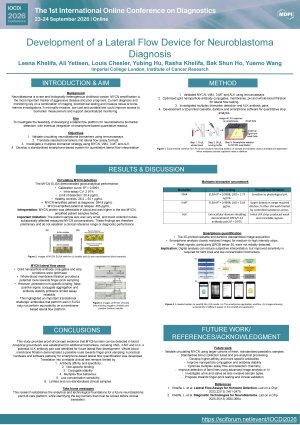
Neuroblastoma is the most common extracranial solid tumour of childhood. High-risk disease is frequently diagnosed at an advanced stage and is associated with poor clinical outcomes despite intensive treatment. Current diagnostic approaches rely on imaging, tissue biopsy, and laboratory-based molecular testing, which require specialised infrastructure and limit accessibility. This study aimed to develop a point-of-care diagnostic platform for neuroblastoma through the integration of lateral flow assay (LFA) technology with smartphone-based digital analysis.
Initial investigations focused on MYCN, the most clinically significant prognostic biomarker in neuroblastoma. ELISA studies demonstrated, for the first time, the presence of circulating MYCN protein in human blood, achieving a limit of detection of 30.4 pg/mL. While proof-of-concept MYCN LFAs were successfully fabricated, challenges relating to antibody specificity, conjugate stability, and low-abundance protein detection limited assay performance. To address these limitations, a multiplexed strategy was explored incorporating additional biomarkers associated with aggressive disease, including 3-methoxytyramine (3-MT), vanillylmandelic acid (VMA), and anaplastic lymphoma kinase (ALK). Biomarker suitability was assessed using ELISA, western blotting, and Meso Scale Discovery immunoassays, demonstrating favourable analytical performance for 3-MT and ALK and supporting their potential translation into LFA formats. To facilitate quantitative interpretation, a smartphone-based application incorporating automated image processing and signal quantification was developed and validated. The platform enabled objective analysis of test strip results without specialist equipment.
The findings of this study demonstrate the feasibility of integrating multiplexed lateral flow technology with portable digital analysis for neuroblastoma diagnosis. This work provides a foundation for future development of low-cost, decentralised diagnostic tools for paediatric oncology, and highlights the translational potential of point-of-care technologies for high-risk neuroblastoma screening, monitoring and disease management. The technologies, workflows, and optimisation strategies developed in this work provide a transferable framework for multiplexed point-of-care diagnostics in other cancers, supporting the broader development of low-cost, decentralised precision oncology tools.
Keywords
Neuroblastoma diagnosis
point-of-care
cancer screening
Poster
Poster.pdf
MNP-Enhanced Microwave Imaging for Bone Regeneration Monitoring: A 3D Numerical Validation
Decentralizing TB Diagnosis: Community Perspectives on Point-of-Care Testing for Tuberculosis Screening in a Resource-Limited Island Municipality in the Philippines