Event submissions
Published
This submission belongs to the session S4. Clinical Diagnosis and Prognosis of the event The 1st International Online Conference on Diagnostics
Published date
18 Sep, 2026
Academic Editor
'%3e%3cpath%20d='M12.6657%2010.9104C12.4185%2010.325%2012.0599%209.79327%2011.6097%209.34482C11.1609%208.89508%2010.6293%208.5365%2010.0442%208.28888C10.0389%208.28626%2010.0337%208.28495%2010.0285%208.28233C10.8446%207.69279%2011.3752%206.73249%2011.3752%205.64904C11.3752%203.8542%209.92103%202.39999%208.1262%202.39999C6.33136%202.39999%204.87715%203.8542%204.87715%205.64904C4.87715%206.73249%205.40774%207.69279%206.22393%208.28364C6.21869%208.28626%206.21345%208.28757%206.20821%208.29019C5.62129%208.5378%205.09463%208.89284%204.64265%209.34613C4.1929%209.79493%203.83432%2010.3266%203.58671%2010.9117C3.34345%2011.4845%203.21226%2012.0987%203.20023%2012.7209C3.19988%2012.7349%203.20233%2012.7488%203.20744%2012.7619C3.21255%2012.7749%203.22022%2012.7867%203.22998%2012.7968C3.23975%2012.8068%203.25142%2012.8147%203.26431%2012.8202C3.2772%2012.8256%203.29105%2012.8284%203.30504%2012.8284H4.09109C4.14874%2012.8284%204.19459%2012.7825%204.1959%2012.7262C4.2221%2011.7148%204.62823%2010.7676%205.34617%2010.0497C6.08899%209.30683%207.0755%208.89808%208.1262%208.89808C9.17689%208.89808%2010.1634%209.30683%2010.9062%2010.0497C11.6242%2010.7676%2012.0303%2011.7148%2012.0565%2012.7262C12.0578%2012.7838%2012.1037%2012.8284%2012.1613%2012.8284H12.9474C12.9613%2012.8284%2012.9752%2012.8256%2012.9881%2012.8202C13.001%2012.8147%2013.0126%2012.8068%2013.0224%2012.7968C13.0322%2012.7867%2013.0398%2012.7749%2013.0449%2012.7619C13.0501%2012.7488%2013.0525%2012.7349%2013.0522%2012.7209C13.0391%2012.0947%2012.9094%2011.4855%2012.6657%2010.9104ZM8.1262%207.9024C7.52486%207.9024%206.9589%207.6679%206.53312%207.24211C6.10733%206.81633%205.87283%206.25037%205.87283%205.64904C5.87283%205.0477%206.10733%204.48174%206.53312%204.05596C6.9589%203.63018%207.52486%203.39567%208.1262%203.39567C8.72753%203.39567%209.29349%203.63018%209.71927%204.05596C10.1451%204.48174%2010.3796%205.0477%2010.3796%205.64904C10.3796%206.25037%2010.1451%206.81633%209.71927%207.24211C9.29349%207.6679%208.72753%207.9024%208.1262%207.9024Z'%20fill='%235D1EE1'/%3e%3c/g%3e%3c/svg%3e) Elad Asher
Elad AsherCitation
Catarina Pinho, José Pedro Castro, Maria Céu Lamas, Maria Manuela Sousa, Prenatal Inflammatory Dysregulation as an Early Predictor of Chronic Disease Susceptibility: A Systematic Review, in Proceedings of The 1st International Online Conference on Diagnostics, 23 September–24 September 2026, MDPI: Basel, Switzerland
Share
Email
Facebook
Twitter
LinkedIn
Prenatal Inflammatory Dysregulation as an Early Predictor of Chronic Disease Susceptibility: A Systematic Review
'%3e%3cpath%20d='M12.6647%2010.9104C12.4176%2010.325%2012.0589%209.7933%2011.6088%209.34485C11.16%208.89511%2010.6283%208.53653%2010.0432%208.28891C10.038%208.28629%2010.0327%208.28498%2010.0275%208.28236C10.8437%207.69282%2011.3743%206.73252%2011.3743%205.64907C11.3743%203.85423%209.92005%202.40002%208.12522%202.40002C6.33038%202.40002%204.87618%203.85423%204.87618%205.64907C4.87618%206.73252%205.40677%207.69282%206.22296%208.28367C6.21772%208.28629%206.21248%208.2876%206.20724%208.29022C5.62031%208.53783%205.09365%208.89287%204.64167%209.34616C4.19192%209.79496%203.83334%2010.3266%203.58573%2010.9117C3.34247%2011.4846%203.21128%2012.0987%203.19925%2012.721C3.1989%2012.735%203.20135%2012.7489%203.20646%2012.7619C3.21157%2012.7749%203.21924%2012.7868%203.22901%2012.7968C3.23877%2012.8068%203.25045%2012.8148%203.26334%2012.8202C3.27623%2012.8256%203.29007%2012.8284%203.30406%2012.8284H4.09012C4.14776%2012.8284%204.19362%2012.7825%204.19493%2012.7262C4.22113%2011.7148%204.62726%2010.7676%205.34519%2010.0497C6.08802%209.30686%207.07452%208.89811%208.12522%208.89811C9.17592%208.89811%2010.1624%209.30686%2010.9052%2010.0497C11.6232%2010.7676%2012.0293%2011.7148%2012.0555%2012.7262C12.0568%2012.7839%2012.1027%2012.8284%2012.1603%2012.8284H12.9464C12.9604%2012.8284%2012.9742%2012.8256%2012.9871%2012.8202C13%2012.8148%2013.0117%2012.8068%2013.0214%2012.7968C13.0312%2012.7868%2013.0389%2012.7749%2013.044%2012.7619C13.0491%2012.7489%2013.0515%2012.735%2013.0512%2012.721C13.0381%2012.0947%2012.9084%2011.4856%2012.6647%2010.9104ZM8.12522%207.90243C7.52388%207.90243%206.95792%207.66793%206.53214%207.24215C6.10636%206.81636%205.87185%206.2504%205.87185%205.64907C5.87185%205.04773%206.10636%204.48177%206.53214%204.05599C6.95792%203.63021%207.52388%203.3957%208.12522%203.3957C8.72655%203.3957%209.29252%203.63021%209.7183%204.05599C10.1441%204.48177%2010.3786%205.04773%2010.3786%205.64907C10.3786%206.2504%2010.1441%206.81636%209.7183%207.24215C9.29252%207.66793%208.72655%207.90243%208.12522%207.90243Z'%20fill='%235D1EE1'/%3e%3c/g%3e%3c/svg%3e)
Catarina Pinho 1
José Pedro Castro 2
Maria Céu Lamas 3
Maria Manuela Sousa 3
1. Escola Superior de Saúde, Instituto Politécnico do Porto, Rua Dr. António Bernardino de Almeida, 4249-015 Porto
2. i3S, Instituto de Investigação e Inovação em Saúde, Universidade do Porto and Aging and Aneuploidy Laboratory, IBMC, Instituto de Biologia Molecular e Celular, Universidade do Porto, 4200-135 Porto
3. LAQV/REQUIMTE, Escola Superior de Saúde, Instituto Politécnico do Porto, Rua Dr. António Bernardino de Almeida, 4249-015 Porto
Abstract
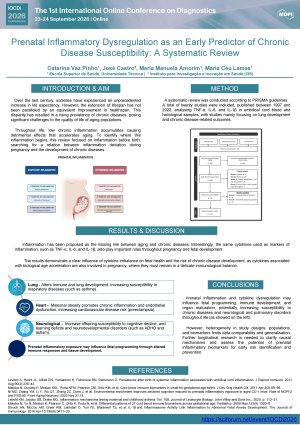
In the last century, it has been reported an unprecedented increase in life expectancy, linked to a significant rise in the prevalence of chronic diseases. The global increase in chronic diseases has been associated with accelerated biological aging, a process characterized by immunological dysregulation, chronic inflammation and decreased cellular repair capacity, which together contribute to a greater vulnerability of organisms for dysfunction and chronic disease.
Inflammation represents a key link between the molecular and cellular processes in chronic diseases and accelerated biological age. The accumulation of chronic low-grade inflammation is a crucial factor associated with earlier onset of age-related dysfunction and disease, and can contribute to cellular damage and immune system dysregulation. In search for a relation between inflammation dysregultion during pregnancy and the development of chronic disease, this review focused on the sustained prenatal inflammatory biomarkers and their association with future susceptibility to chronic diseases..
The search was conducted in the PubMed, Embase and Web of Science databases, and PRISMA guidelines were implemented.
The most emphasized biomarkers found were IL-6, IL-1β and TNF-α, but external stimuli, such as lifestyle, infections, tobacco consumption, alcohol intake and dietary patterns can influence inflammation patterns and interfere with the embryonic development.
The results show a clear influence of cytokines imbalance in the health of the fetus on the risk of chronic diseases development, mainly because cytokines that are commonly linked to biological age acceleration are also found in the pregnancy development in a delicate immunologic balance.
Understanding the molecular and cellular mechanisms involved in a balanced immunological microenvironment could potentially help to develop biomarker-based strategies for early disease prediction, risk stratification and preventive healthcare.
Keywords
Aging
Prenatal inflammation
Chronic Diseases
Cytokines
Prenatal Exposure Delayed Effects.
Poster
Poster - Prenatal Inflammatory Dysregulation as an Early Predictor of Chronic Disease Susceptibility A Systematic Review.pdf
Decentralizing TB Diagnosis: Community Perspectives on Point-of-Care Testing for Tuberculosis Screening in a Resource-Limited Island Municipality in the Philippines
Optimization of Radial Basis Function Using Metaheuristic Algorithms for Medical Diagnosis Applications