Event submissions
Published
This submission belongs to the session S6. Artificial Intelligence in Diagnostics of the event The 1st International Online Conference on Diagnostics
Published date
18 Sep, 2026
Academic Editor
'%3e%3cpath%20d='M12.6657%2010.9104C12.4185%2010.325%2012.0599%209.79327%2011.6097%209.34482C11.1609%208.89508%2010.6293%208.5365%2010.0442%208.28888C10.0389%208.28626%2010.0337%208.28495%2010.0285%208.28233C10.8446%207.69279%2011.3752%206.73249%2011.3752%205.64904C11.3752%203.8542%209.92103%202.39999%208.1262%202.39999C6.33136%202.39999%204.87715%203.8542%204.87715%205.64904C4.87715%206.73249%205.40774%207.69279%206.22393%208.28364C6.21869%208.28626%206.21345%208.28757%206.20821%208.29019C5.62129%208.5378%205.09463%208.89284%204.64265%209.34613C4.1929%209.79493%203.83432%2010.3266%203.58671%2010.9117C3.34345%2011.4845%203.21226%2012.0987%203.20023%2012.7209C3.19988%2012.7349%203.20233%2012.7488%203.20744%2012.7619C3.21255%2012.7749%203.22022%2012.7867%203.22998%2012.7968C3.23975%2012.8068%203.25142%2012.8147%203.26431%2012.8202C3.2772%2012.8256%203.29105%2012.8284%203.30504%2012.8284H4.09109C4.14874%2012.8284%204.19459%2012.7825%204.1959%2012.7262C4.2221%2011.7148%204.62823%2010.7676%205.34617%2010.0497C6.08899%209.30683%207.0755%208.89808%208.1262%208.89808C9.17689%208.89808%2010.1634%209.30683%2010.9062%2010.0497C11.6242%2010.7676%2012.0303%2011.7148%2012.0565%2012.7262C12.0578%2012.7838%2012.1037%2012.8284%2012.1613%2012.8284H12.9474C12.9613%2012.8284%2012.9752%2012.8256%2012.9881%2012.8202C13.001%2012.8147%2013.0126%2012.8068%2013.0224%2012.7968C13.0322%2012.7867%2013.0398%2012.7749%2013.0449%2012.7619C13.0501%2012.7488%2013.0525%2012.7349%2013.0522%2012.7209C13.0391%2012.0947%2012.9094%2011.4855%2012.6657%2010.9104ZM8.1262%207.9024C7.52486%207.9024%206.9589%207.6679%206.53312%207.24211C6.10733%206.81633%205.87283%206.25037%205.87283%205.64904C5.87283%205.0477%206.10733%204.48174%206.53312%204.05596C6.9589%203.63018%207.52486%203.39567%208.1262%203.39567C8.72753%203.39567%209.29349%203.63018%209.71927%204.05596C10.1451%204.48174%2010.3796%205.0477%2010.3796%205.64904C10.3796%206.25037%2010.1451%206.81633%209.71927%207.24211C9.29349%207.6679%208.72753%207.9024%208.1262%207.9024Z'%20fill='%235D1EE1'/%3e%3c/g%3e%3c/svg%3e) Giorgio Treglia
Giorgio TregliaCitation
Alaa Fathy Sheta, Seif Mohamed Abd El-Hai, Optimization of Radial Basis Function Using Metaheuristic Algorithms for Medical Diagnosis Applications, in Proceedings of The 1st International Online Conference on Diagnostics, 23 September–24 September 2026, MDPI: Basel, Switzerland
Share
Email
Facebook
Twitter
LinkedIn
Optimization of Radial Basis Function Using Metaheuristic Algorithms for Medical Diagnosis Applications
'%3e%3cpath%20d='M12.6647%2010.9104C12.4176%2010.325%2012.0589%209.7933%2011.6088%209.34485C11.16%208.89511%2010.6283%208.53653%2010.0432%208.28891C10.038%208.28629%2010.0327%208.28498%2010.0275%208.28236C10.8437%207.69282%2011.3743%206.73252%2011.3743%205.64907C11.3743%203.85423%209.92005%202.40002%208.12522%202.40002C6.33038%202.40002%204.87618%203.85423%204.87618%205.64907C4.87618%206.73252%205.40677%207.69282%206.22296%208.28367C6.21772%208.28629%206.21248%208.2876%206.20724%208.29022C5.62031%208.53783%205.09365%208.89287%204.64167%209.34616C4.19192%209.79496%203.83334%2010.3266%203.58573%2010.9117C3.34247%2011.4846%203.21128%2012.0987%203.19925%2012.721C3.1989%2012.735%203.20135%2012.7489%203.20646%2012.7619C3.21157%2012.7749%203.21924%2012.7868%203.22901%2012.7968C3.23877%2012.8068%203.25045%2012.8148%203.26334%2012.8202C3.27623%2012.8256%203.29007%2012.8284%203.30406%2012.8284H4.09012C4.14776%2012.8284%204.19362%2012.7825%204.19493%2012.7262C4.22113%2011.7148%204.62726%2010.7676%205.34519%2010.0497C6.08802%209.30686%207.07452%208.89811%208.12522%208.89811C9.17592%208.89811%2010.1624%209.30686%2010.9052%2010.0497C11.6232%2010.7676%2012.0293%2011.7148%2012.0555%2012.7262C12.0568%2012.7839%2012.1027%2012.8284%2012.1603%2012.8284H12.9464C12.9604%2012.8284%2012.9742%2012.8256%2012.9871%2012.8202C13%2012.8148%2013.0117%2012.8068%2013.0214%2012.7968C13.0312%2012.7868%2013.0389%2012.7749%2013.044%2012.7619C13.0491%2012.7489%2013.0515%2012.735%2013.0512%2012.721C13.0381%2012.0947%2012.9084%2011.4856%2012.6647%2010.9104ZM8.12522%207.90243C7.52388%207.90243%206.95792%207.66793%206.53214%207.24215C6.10636%206.81636%205.87185%206.2504%205.87185%205.64907C5.87185%205.04773%206.10636%204.48177%206.53214%204.05599C6.95792%203.63021%207.52388%203.3957%208.12522%203.3957C8.72655%203.3957%209.29252%203.63021%209.7183%204.05599C10.1441%204.48177%2010.3786%205.04773%2010.3786%205.64907C10.3786%206.2504%2010.1441%206.81636%209.7183%207.24215C9.29252%207.66793%208.72655%207.90243%208.12522%207.90243Z'%20fill='%235D1EE1'/%3e%3c/g%3e%3c/svg%3e)
Alaa Fathy Sheta 1,2
Seif Mohamed Abd El-Hai 3
1. Computer Science Department, School of Information Technology and Computer Science, Nile University, El Sheikh Zayed City 12677, Giza
2. Department of Computer Science, Southern Connecticut State University, New Haven, CT
3. School of Information Technology and Computer Science, Nile University, El Sheikh Zayed City 12677, Giza
Abstract
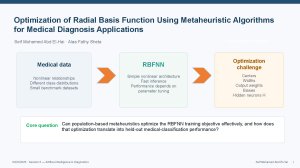
Accurate diagnosis from medical data increasingly depends on the design and implementation of machine learning models capable of discovering complex nonlinear associations in clinical data. One of these well-known models, Radial Basis Function Neural Networks (RBFNNs), has demonstrated effective classification capabilities owing to its simple architecture. Meanwhile, tuning the parameters of RBFNNs remains challenging. RBFNN performance depends on appropriately optimizing radial basis centers, widths, output weights, and biases and selecting a suitable number of hidden neurons (H). Traditional training methods are often sensitive to initialization, may converge slowly, and can become highly trapped in local optima. This research explores the competence of three population-based metaheuristic algorithms Biogeography-Based Optimizer (BBO), Genetic Algorithm (GA), and Symbiotic Organisms Search (SOS) for optimizing RBFNNs in medical diagnosis applications. We utilized three benchmark UCI medical datasets: Breast Cancer (699 instances, 9 features), Parkinson’s Disease (195 instances, 22 features), and Heart Disease (303 instances, 13 features) to evaluate the proposed optimization framework. Our experimental setup explored several configurations, including the number of hidden-layer neurons of the proposed search algorithms using Min–Max normalization, stratified hold-out validation, and 10 independent optimization runs, to investigate the robustness of our results via independent optimization runs. BBO accomplished the highest mean test accuracy (H6: 0.9597 ± 0.0049) for breast cancer, SOS produced the best results (H8: 0.8776 ± 0.0137) for Parkinson’s disease, and GA performed best (H4: 0.8452 ± 0.0124) on the heart disease dataset. Statistical analysis using Friedman and Holm tests indicated no consistent superiority of one optimizer across all evaluation metrics and datasets. Our results show that the proposed algorithms are suitable for optimizing RBFNN training to address medical diagnosis problems. The proposed comparative framework provides a sound framework for selecting suitable metaheuristic optimization strategies for designing RBFNN-based clinical decision support systems.
Keywords
Medical classification; Radial Basis Function Neural Network; RBFNN; Metaheuristic optimization; Biogeography-Based Optimizer; Genetic Algorithm; Symbiotic Organisms Search; Breast Cancer; Parkinson’s Disease; Heart Disease; Machine learning
Poster
Sciforum-199656-Optimization of Radial Basis Function Using Metaheuristic Algorithms for Medical Diagnosis Applications.pdf
Prenatal Inflammatory Dysregulation as an Early Predictor of Chronic Disease Susceptibility: A Systematic Review
Development of a Knowledge-Based AI System for Automated ECG Signal Classification and Clinical Risk Stratification