Event submissions
Published
This submission belongs to the session S6. Artificial Intelligence in Diagnostics of the event The 1st International Online Conference on Diagnostics
Published date
18 Sep, 2026
Academic Editor
'%3e%3cpath%20d='M12.6657%2010.9104C12.4185%2010.325%2012.0599%209.79327%2011.6097%209.34482C11.1609%208.89508%2010.6293%208.5365%2010.0442%208.28888C10.0389%208.28626%2010.0337%208.28495%2010.0285%208.28233C10.8446%207.69279%2011.3752%206.73249%2011.3752%205.64904C11.3752%203.8542%209.92103%202.39999%208.1262%202.39999C6.33136%202.39999%204.87715%203.8542%204.87715%205.64904C4.87715%206.73249%205.40774%207.69279%206.22393%208.28364C6.21869%208.28626%206.21345%208.28757%206.20821%208.29019C5.62129%208.5378%205.09463%208.89284%204.64265%209.34613C4.1929%209.79493%203.83432%2010.3266%203.58671%2010.9117C3.34345%2011.4845%203.21226%2012.0987%203.20023%2012.7209C3.19988%2012.7349%203.20233%2012.7488%203.20744%2012.7619C3.21255%2012.7749%203.22022%2012.7867%203.22998%2012.7968C3.23975%2012.8068%203.25142%2012.8147%203.26431%2012.8202C3.2772%2012.8256%203.29105%2012.8284%203.30504%2012.8284H4.09109C4.14874%2012.8284%204.19459%2012.7825%204.1959%2012.7262C4.2221%2011.7148%204.62823%2010.7676%205.34617%2010.0497C6.08899%209.30683%207.0755%208.89808%208.1262%208.89808C9.17689%208.89808%2010.1634%209.30683%2010.9062%2010.0497C11.6242%2010.7676%2012.0303%2011.7148%2012.0565%2012.7262C12.0578%2012.7838%2012.1037%2012.8284%2012.1613%2012.8284H12.9474C12.9613%2012.8284%2012.9752%2012.8256%2012.9881%2012.8202C13.001%2012.8147%2013.0126%2012.8068%2013.0224%2012.7968C13.0322%2012.7867%2013.0398%2012.7749%2013.0449%2012.7619C13.0501%2012.7488%2013.0525%2012.7349%2013.0522%2012.7209C13.0391%2012.0947%2012.9094%2011.4855%2012.6657%2010.9104ZM8.1262%207.9024C7.52486%207.9024%206.9589%207.6679%206.53312%207.24211C6.10733%206.81633%205.87283%206.25037%205.87283%205.64904C5.87283%205.0477%206.10733%204.48174%206.53312%204.05596C6.9589%203.63018%207.52486%203.39567%208.1262%203.39567C8.72753%203.39567%209.29349%203.63018%209.71927%204.05596C10.1451%204.48174%2010.3796%205.0477%2010.3796%205.64904C10.3796%206.25037%2010.1451%206.81633%209.71927%207.24211C9.29349%207.6679%208.72753%207.9024%208.1262%207.9024Z'%20fill='%235D1EE1'/%3e%3c/g%3e%3c/svg%3e) Zhongheng Zhang
Zhongheng ZhangCitation
Mateusz Fornalski, Piotr Wójcik, Cezary Borysiuk, Oliwia Andrzejewska, Michał Woś, Oliwia Bogusz, Patrycja Kościńska, AI-Enhanced Caries Detection Using Multi-View Radiographs and Intraoral Scans, in Proceedings of The 1st International Online Conference on Diagnostics, 23 September–24 September 2026, MDPI: Basel, Switzerland
Share
Email
Facebook
Twitter
LinkedIn
AI-Enhanced Caries Detection Using Multi-View Radiographs and Intraoral Scans
'%3e%3cpath%20d='M12.6647%2010.9104C12.4176%2010.325%2012.0589%209.7933%2011.6088%209.34485C11.16%208.89511%2010.6283%208.53653%2010.0432%208.28891C10.038%208.28629%2010.0327%208.28498%2010.0275%208.28236C10.8437%207.69282%2011.3743%206.73252%2011.3743%205.64907C11.3743%203.85423%209.92005%202.40002%208.12522%202.40002C6.33038%202.40002%204.87618%203.85423%204.87618%205.64907C4.87618%206.73252%205.40677%207.69282%206.22296%208.28367C6.21772%208.28629%206.21248%208.2876%206.20724%208.29022C5.62031%208.53783%205.09365%208.89287%204.64167%209.34616C4.19192%209.79496%203.83334%2010.3266%203.58573%2010.9117C3.34247%2011.4846%203.21128%2012.0987%203.19925%2012.721C3.1989%2012.735%203.20135%2012.7489%203.20646%2012.7619C3.21157%2012.7749%203.21924%2012.7868%203.22901%2012.7968C3.23877%2012.8068%203.25045%2012.8148%203.26334%2012.8202C3.27623%2012.8256%203.29007%2012.8284%203.30406%2012.8284H4.09012C4.14776%2012.8284%204.19362%2012.7825%204.19493%2012.7262C4.22113%2011.7148%204.62726%2010.7676%205.34519%2010.0497C6.08802%209.30686%207.07452%208.89811%208.12522%208.89811C9.17592%208.89811%2010.1624%209.30686%2010.9052%2010.0497C11.6232%2010.7676%2012.0293%2011.7148%2012.0555%2012.7262C12.0568%2012.7839%2012.1027%2012.8284%2012.1603%2012.8284H12.9464C12.9604%2012.8284%2012.9742%2012.8256%2012.9871%2012.8202C13%2012.8148%2013.0117%2012.8068%2013.0214%2012.7968C13.0312%2012.7868%2013.0389%2012.7749%2013.044%2012.7619C13.0491%2012.7489%2013.0515%2012.735%2013.0512%2012.721C13.0381%2012.0947%2012.9084%2011.4856%2012.6647%2010.9104ZM8.12522%207.90243C7.52388%207.90243%206.95792%207.66793%206.53214%207.24215C6.10636%206.81636%205.87185%206.2504%205.87185%205.64907C5.87185%205.04773%206.10636%204.48177%206.53214%204.05599C6.95792%203.63021%207.52388%203.3957%208.12522%203.3957C8.72655%203.3957%209.29252%203.63021%209.7183%204.05599C10.1441%204.48177%2010.3786%205.04773%2010.3786%205.64907C10.3786%206.2504%2010.1441%206.81636%209.7183%207.24215C9.29252%207.66793%208.72655%207.90243%208.12522%207.90243Z'%20fill='%235D1EE1'/%3e%3c/g%3e%3c/svg%3e)
Mateusz Fornalski 1
Piotr Wójcik 2
Cezary Borysiuk 1
Oliwia Andrzejewska 1
Michał Woś 1
Oliwia Bogusz 1
Patrycja Kościńska 1
1. Faculty of Dentistry, Medical University of Lublin, SKN MedAI, Lublin
2. Doctoral School, Medical University of Lublin, Lublin
Abstract
Background:
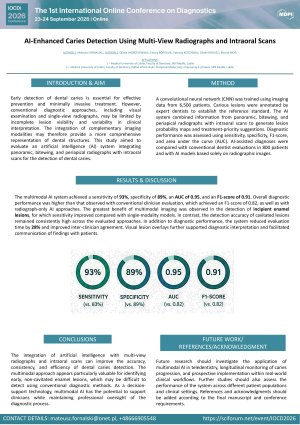
Early detection of dental caries is important. Traditional diagnostic methods, including visual examination and radiographs, are limited by lesion visibility and subjective interpretation. Combining radiographs with intraoral scans may improve diagnostic accuracy. This study evaluated an artificial intelligence (AI) system integrating panoramic, bitewing, and periapical radiographs with intraoral scans for caries detection.
Methodology:
A convolutional neural network (CNN) was trained on imaging data from 6,500 patients. Expert dentists annotated carious lesions to create reference standards. The model combined data from imaging modalities to generate lesion probability maps and priority suggestions. Performance was assessed using sensitivity, specificity, F1-score, and AUC. Multimodal performance was compared with radiograph-only AI models and conventional dentist evaluations in 800 patients.
Results:
The AI system achieved 93% sensitivity, 89% specificity, and an AUC of 0.95. Its F1-score reached 0.91, exceeding the average clinician score of 0.82. The multimodal approach significantly outperformed radiograph-only AI systems, particularly for incipient lesions, while cavitated lesions showed detection rates. As a decision-support tool, the system reduced evaluation time by 28% and improved agreement among clinicians. Visual lesion overlays enhanced diagnostic interpretation and patient communication.
Conclusions:
AI integration with multi-view radiographs and intraoral scans improves the accuracy, consistency, and efficiency of caries detection. Future research should evaluate its use in teledentistry and long-term monitoring of lesion progression.
Bibliography:
1. Lee, J.-H., Kim, D.-H., Jeong, S.-N., & Choi, S.-H. (2018). Detection and diagnosis of dental caries using deep learning algorithms. Journal of Dentistry.
2. Cantu, A. G., et al. (2020). A multi-modal deep learning approach for caries detection on bitewing radiographs. Scientific Reports.
3. Mertens, S., et al. (2021). Deep learning for caries detection: A systematic review. Caries Research.
4. Devlin, H., Horner, K. (2023). AI applications in digital dentistry: Current evidence and future directions. British Dental Journal.
5. Schwendicke, F., et al. (2024). Artificial intelligence in caries diagnosis: Results from a multi-center clinical evaluation. Journal of Dental Research.
Keywords
Caries
Artificial Intelligence
Early Diagnosis
Personalized Treatment
Poster
KONFERENCJA 2026.pdf
From Analytical Performance to Point-of-Care Readiness: A PRISMA 2020 Systematic Review of Wearable and Microneedle Electrochemical Biosensors for Disease-Related Biomarker Detection
Proactive Depression Screening via Human-Integrated AI: Synergizing Multimodal Smartphone Biomarkers and Game As Reality for the Global South