Event submissions
Published
This submission belongs to the session S5. Point-of-Care Diagnostics and Other Diagnostic Procedures of the event The 1st International Online Conference on Diagnostics
Published date
18 Sep, 2026
Academic Editor
'%3e%3cpath%20d='M12.6657%2010.9104C12.4185%2010.325%2012.0599%209.79327%2011.6097%209.34482C11.1609%208.89508%2010.6293%208.5365%2010.0442%208.28888C10.0389%208.28626%2010.0337%208.28495%2010.0285%208.28233C10.8446%207.69279%2011.3752%206.73249%2011.3752%205.64904C11.3752%203.8542%209.92103%202.39999%208.1262%202.39999C6.33136%202.39999%204.87715%203.8542%204.87715%205.64904C4.87715%206.73249%205.40774%207.69279%206.22393%208.28364C6.21869%208.28626%206.21345%208.28757%206.20821%208.29019C5.62129%208.5378%205.09463%208.89284%204.64265%209.34613C4.1929%209.79493%203.83432%2010.3266%203.58671%2010.9117C3.34345%2011.4845%203.21226%2012.0987%203.20023%2012.7209C3.19988%2012.7349%203.20233%2012.7488%203.20744%2012.7619C3.21255%2012.7749%203.22022%2012.7867%203.22998%2012.7968C3.23975%2012.8068%203.25142%2012.8147%203.26431%2012.8202C3.2772%2012.8256%203.29105%2012.8284%203.30504%2012.8284H4.09109C4.14874%2012.8284%204.19459%2012.7825%204.1959%2012.7262C4.2221%2011.7148%204.62823%2010.7676%205.34617%2010.0497C6.08899%209.30683%207.0755%208.89808%208.1262%208.89808C9.17689%208.89808%2010.1634%209.30683%2010.9062%2010.0497C11.6242%2010.7676%2012.0303%2011.7148%2012.0565%2012.7262C12.0578%2012.7838%2012.1037%2012.8284%2012.1613%2012.8284H12.9474C12.9613%2012.8284%2012.9752%2012.8256%2012.9881%2012.8202C13.001%2012.8147%2013.0126%2012.8068%2013.0224%2012.7968C13.0322%2012.7867%2013.0398%2012.7749%2013.0449%2012.7619C13.0501%2012.7488%2013.0525%2012.7349%2013.0522%2012.7209C13.0391%2012.0947%2012.9094%2011.4855%2012.6657%2010.9104ZM8.1262%207.9024C7.52486%207.9024%206.9589%207.6679%206.53312%207.24211C6.10733%206.81633%205.87283%206.25037%205.87283%205.64904C5.87283%205.0477%206.10733%204.48174%206.53312%204.05596C6.9589%203.63018%207.52486%203.39567%208.1262%203.39567C8.72753%203.39567%209.29349%203.63018%209.71927%204.05596C10.1451%204.48174%2010.3796%205.0477%2010.3796%205.64904C10.3796%206.25037%2010.1451%206.81633%209.71927%207.24211C9.29349%207.6679%208.72753%207.9024%208.1262%207.9024Z'%20fill='%235D1EE1'/%3e%3c/g%3e%3c/svg%3e) Gerald J. Kost
Gerald J. KostCitation
Sola Peter Ogunmodede, Elijah Kolawole Oladipo, Gladys Ayodele Adigun, Scalable AI-Driven Computational Modeling of Multi-Epitope Peptides for Diagnostic Innovation in Resource-Constrained Environments, in Proceedings of The 1st International Online Conference on Diagnostics, 23 September–24 September 2026, MDPI: Basel, Switzerland
Share
Email
Facebook
Twitter
LinkedIn
Scalable AI-Driven Computational Modeling of Multi-Epitope Peptides for Diagnostic Innovation in Resource-Constrained Environments
'%3e%3cpath%20d='M12.6647%2010.9104C12.4176%2010.325%2012.0589%209.7933%2011.6088%209.34485C11.16%208.89511%2010.6283%208.53653%2010.0432%208.28891C10.038%208.28629%2010.0327%208.28498%2010.0275%208.28236C10.8437%207.69282%2011.3743%206.73252%2011.3743%205.64907C11.3743%203.85423%209.92005%202.40002%208.12522%202.40002C6.33038%202.40002%204.87618%203.85423%204.87618%205.64907C4.87618%206.73252%205.40677%207.69282%206.22296%208.28367C6.21772%208.28629%206.21248%208.2876%206.20724%208.29022C5.62031%208.53783%205.09365%208.89287%204.64167%209.34616C4.19192%209.79496%203.83334%2010.3266%203.58573%2010.9117C3.34247%2011.4846%203.21128%2012.0987%203.19925%2012.721C3.1989%2012.735%203.20135%2012.7489%203.20646%2012.7619C3.21157%2012.7749%203.21924%2012.7868%203.22901%2012.7968C3.23877%2012.8068%203.25045%2012.8148%203.26334%2012.8202C3.27623%2012.8256%203.29007%2012.8284%203.30406%2012.8284H4.09012C4.14776%2012.8284%204.19362%2012.7825%204.19493%2012.7262C4.22113%2011.7148%204.62726%2010.7676%205.34519%2010.0497C6.08802%209.30686%207.07452%208.89811%208.12522%208.89811C9.17592%208.89811%2010.1624%209.30686%2010.9052%2010.0497C11.6232%2010.7676%2012.0293%2011.7148%2012.0555%2012.7262C12.0568%2012.7839%2012.1027%2012.8284%2012.1603%2012.8284H12.9464C12.9604%2012.8284%2012.9742%2012.8256%2012.9871%2012.8202C13%2012.8148%2013.0117%2012.8068%2013.0214%2012.7968C13.0312%2012.7868%2013.0389%2012.7749%2013.044%2012.7619C13.0491%2012.7489%2013.0515%2012.735%2013.0512%2012.721C13.0381%2012.0947%2012.9084%2011.4856%2012.6647%2010.9104ZM8.12522%207.90243C7.52388%207.90243%206.95792%207.66793%206.53214%207.24215C6.10636%206.81636%205.87185%206.2504%205.87185%205.64907C5.87185%205.04773%206.10636%204.48177%206.53214%204.05599C6.95792%203.63021%207.52388%203.3957%208.12522%203.3957C8.72655%203.3957%209.29252%203.63021%209.7183%204.05599C10.1441%204.48177%2010.3786%205.04773%2010.3786%205.64907C10.3786%206.2504%2010.1441%206.81636%209.7183%207.24215C9.29252%207.66793%208.72655%207.90243%208.12522%207.90243Z'%20fill='%235D1EE1'/%3e%3c/g%3e%3c/svg%3e)
Sola Peter Ogunmodede 1
Elijah Kolawole Oladipo 2
Gladys Ayodele Adigun 3
1. Division of Diagnostics Assay Development, and Medical Artificial Intelligence, Helix Biogen Institute, Ogbomoso, Oyo State
2. Division of Genome and Molecular Sciences, Helix Biogen Institute, Ogbomoso
3. Department of Biochemistry, Ladoke Akintola University of Technology, Ogbomoso
Abstract
Artificial intelligence and bioinformatics are increasingly critical for scalable health solutions in resource-limited settings. Crimean-Congo hemorrhagic fever (CCHF), a viral illness characterized by severe hemorrhagic manifestations, has provided a model system for computational peptide design. This study shows how AI-driven bioinformatics pipelines can accelerate biomarker discovery and diagnostic innovation, with broader applicability to neglected tropical diseases and rare disorders in Africa.
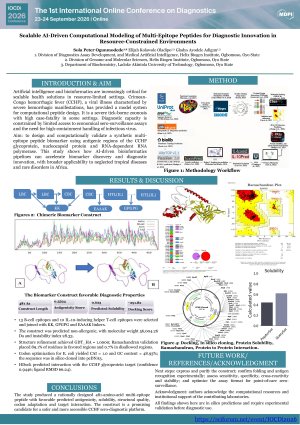
Protein sequences of CCHF glycoprotein, nucleocapsid protein, and RNA-dependent RNA polymerase were retrieved and screened for antigenicity. Linear and conformational B-cell epitopes, along with IL-10-inducing helper T-cell epitopes, were predicted and linked using peptide linkers. The construct was evaluated for antigenicity (0.5594), allergenicity (nonallergenic), solubility (protein-sol score: 0.623), and stability (instability index 28.33). Structural modeling (AlphaFold2), refinement (Galaxy Refine), and validation (Ramachandran plot: 89.1% residues in favored regions) confirmed construct integrity. Codon optimization achieved a CAI of 1.0, and molecular docking demonstrated strong binding affinity (score -291.82).
The multi-epitope construct exhibited favorable antigenicity, solubility, and stability, with validated structural integrity and strong docking interactions. These findings highlight the potential of computational pipelines to deliver scalable, cost-effective diagnostic solutions. Importantly, the framework is transferable to other diseases, enabling peptide-based biomarker discovery for neglected tropical diseases and rare bleeding disorders.
This work underscores the role of AI and bioinformatics in building scalable health technologies that address diagnostic gaps in resource-constrained environments, supporting equitable access to precision diagnostics across Africa.
Keywords
Conputational
Early detection
Diseases Diagnosis
Infectious Diseases
Epitopes
Peptides
Poster
Sola O CCHF diagnostic peptide poster.pdf
“When a Lump Is Not Just a Lump: Diagnostic Challenges in Chronic Elbow Mass Revealing Rare Nocardial Infection”
Verification of VITEK® Automated Antimicrobial Susceptibility Testing of Fosfomycin against Enterobacterales in Urine Culture