Event submissions
Published
This submission belongs to the session S3. Laboratory medicine of the event The 1st International Online Conference on Diagnostics
Published date
18 Sep, 2026
Academic Editor
'%3e%3cpath%20d='M12.6657%2010.9104C12.4185%2010.325%2012.0599%209.79327%2011.6097%209.34482C11.1609%208.89508%2010.6293%208.5365%2010.0442%208.28888C10.0389%208.28626%2010.0337%208.28495%2010.0285%208.28233C10.8446%207.69279%2011.3752%206.73249%2011.3752%205.64904C11.3752%203.8542%209.92103%202.39999%208.1262%202.39999C6.33136%202.39999%204.87715%203.8542%204.87715%205.64904C4.87715%206.73249%205.40774%207.69279%206.22393%208.28364C6.21869%208.28626%206.21345%208.28757%206.20821%208.29019C5.62129%208.5378%205.09463%208.89284%204.64265%209.34613C4.1929%209.79493%203.83432%2010.3266%203.58671%2010.9117C3.34345%2011.4845%203.21226%2012.0987%203.20023%2012.7209C3.19988%2012.7349%203.20233%2012.7488%203.20744%2012.7619C3.21255%2012.7749%203.22022%2012.7867%203.22998%2012.7968C3.23975%2012.8068%203.25142%2012.8147%203.26431%2012.8202C3.2772%2012.8256%203.29105%2012.8284%203.30504%2012.8284H4.09109C4.14874%2012.8284%204.19459%2012.7825%204.1959%2012.7262C4.2221%2011.7148%204.62823%2010.7676%205.34617%2010.0497C6.08899%209.30683%207.0755%208.89808%208.1262%208.89808C9.17689%208.89808%2010.1634%209.30683%2010.9062%2010.0497C11.6242%2010.7676%2012.0303%2011.7148%2012.0565%2012.7262C12.0578%2012.7838%2012.1037%2012.8284%2012.1613%2012.8284H12.9474C12.9613%2012.8284%2012.9752%2012.8256%2012.9881%2012.8202C13.001%2012.8147%2013.0126%2012.8068%2013.0224%2012.7968C13.0322%2012.7867%2013.0398%2012.7749%2013.0449%2012.7619C13.0501%2012.7488%2013.0525%2012.7349%2013.0522%2012.7209C13.0391%2012.0947%2012.9094%2011.4855%2012.6657%2010.9104ZM8.1262%207.9024C7.52486%207.9024%206.9589%207.6679%206.53312%207.24211C6.10733%206.81633%205.87283%206.25037%205.87283%205.64904C5.87283%205.0477%206.10733%204.48174%206.53312%204.05596C6.9589%203.63018%207.52486%203.39567%208.1262%203.39567C8.72753%203.39567%209.29349%203.63018%209.71927%204.05596C10.1451%204.48174%2010.3796%205.0477%2010.3796%205.64904C10.3796%206.25037%2010.1451%206.81633%209.71927%207.24211C9.29349%207.6679%208.72753%207.9024%208.1262%207.9024Z'%20fill='%235D1EE1'/%3e%3c/g%3e%3c/svg%3e) Marijn M. Speeckaert
Marijn M. SpeeckaertCitation
Eugene Y.H. Yeung, Rita Charan, Verification of VITEK® Automated Antimicrobial Susceptibility Testing of Fosfomycin against Enterobacterales in Urine Culture, in Proceedings of The 1st International Online Conference on Diagnostics, 23 September–24 September 2026, MDPI: Basel, Switzerland
Share
Email
Facebook
Twitter
LinkedIn
Verification of VITEK® Automated Antimicrobial Susceptibility Testing of Fosfomycin against Enterobacterales in Urine Culture
'%3e%3cpath%20d='M12.6647%2010.9104C12.4176%2010.325%2012.0589%209.7933%2011.6088%209.34485C11.16%208.89511%2010.6283%208.53653%2010.0432%208.28891C10.038%208.28629%2010.0327%208.28498%2010.0275%208.28236C10.8437%207.69282%2011.3743%206.73252%2011.3743%205.64907C11.3743%203.85423%209.92005%202.40002%208.12522%202.40002C6.33038%202.40002%204.87618%203.85423%204.87618%205.64907C4.87618%206.73252%205.40677%207.69282%206.22296%208.28367C6.21772%208.28629%206.21248%208.2876%206.20724%208.29022C5.62031%208.53783%205.09365%208.89287%204.64167%209.34616C4.19192%209.79496%203.83334%2010.3266%203.58573%2010.9117C3.34247%2011.4846%203.21128%2012.0987%203.19925%2012.721C3.1989%2012.735%203.20135%2012.7489%203.20646%2012.7619C3.21157%2012.7749%203.21924%2012.7868%203.22901%2012.7968C3.23877%2012.8068%203.25045%2012.8148%203.26334%2012.8202C3.27623%2012.8256%203.29007%2012.8284%203.30406%2012.8284H4.09012C4.14776%2012.8284%204.19362%2012.7825%204.19493%2012.7262C4.22113%2011.7148%204.62726%2010.7676%205.34519%2010.0497C6.08802%209.30686%207.07452%208.89811%208.12522%208.89811C9.17592%208.89811%2010.1624%209.30686%2010.9052%2010.0497C11.6232%2010.7676%2012.0293%2011.7148%2012.0555%2012.7262C12.0568%2012.7839%2012.1027%2012.8284%2012.1603%2012.8284H12.9464C12.9604%2012.8284%2012.9742%2012.8256%2012.9871%2012.8202C13%2012.8148%2013.0117%2012.8068%2013.0214%2012.7968C13.0312%2012.7868%2013.0389%2012.7749%2013.044%2012.7619C13.0491%2012.7489%2013.0515%2012.735%2013.0512%2012.721C13.0381%2012.0947%2012.9084%2011.4856%2012.6647%2010.9104ZM8.12522%207.90243C7.52388%207.90243%206.95792%207.66793%206.53214%207.24215C6.10636%206.81636%205.87185%206.2504%205.87185%205.64907C5.87185%205.04773%206.10636%204.48177%206.53214%204.05599C6.95792%203.63021%207.52388%203.3957%208.12522%203.3957C8.72655%203.3957%209.29252%203.63021%209.7183%204.05599C10.1441%204.48177%2010.3786%205.04773%2010.3786%205.64907C10.3786%206.2504%2010.1441%206.81636%209.7183%207.24215C9.29252%207.66793%208.72655%207.90243%208.12522%207.90243Z'%20fill='%235D1EE1'/%3e%3c/g%3e%3c/svg%3e)
Eugene Y.H. Yeung 1,2,3
Rita Charan 4
1. Department of Pathology and Laboratory Medicine, Faculty of Medicine, University of British Columbia, Vancouver, British Columbia V5Z 1M9, Canada
2. Continuing Pharmacy Professional Development, Faculty of Pharmaceutical Sciences, University of British Columbia, Vancouver, British Columbia V6T 1Z3, Canada
3. Clinical Faculty, School of Medicine, Simon Fraser University, Surrey, British Columbia V3T 0A3, Canada
4. LifeLabs, British Columbia, Canada
Abstract
Introduction
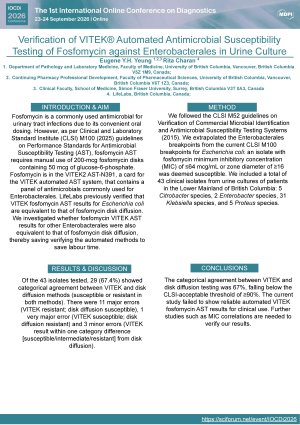
Fosfomycin is a commonly used antimicrobial for urinary tract infections due to its convenient oral dosing. However, as per Clinical and Laboratory Standard Institute (CLSI) M100 (2025) guidelines on Performance Standards for Antimicrobial Susceptibility Testing (AST), fosfomycin AST requires manual use of 200-mcg fosfomycin disks containing 50 mcg of glucose-6-phosphate. Fosfomycin is in the VITEK2 AST-N391, a card for the VITEK automated AST system, that contains a panel of antimicrobials commonly used for Enterobacterales. LifeLabs previously verified that VITEK fosfomycin AST results for Escherichia coli are equivalent to that of fosfomycin disk diffusion. We investigated whether fosfomycin VITEK AST results for other Enterobacterales were also equivalent to that of fosfomycin disk diffusion, thereby saving verifying the automated methods to save labour time.
Methods
We followed the CLSI M52 guidelines on Verification of Commercial Microbial Identification and Antimicrobial Susceptibility Testing Systems (2015). We extrapolated the Enterobacterales breakpoints from the current CLSI M100 breakpoints for Escherichia coli: an isolate with fosfomycin minimum inhibitory concentration (MIC) of ≤64 mcg/mL or zone diameter of ≥16 was deemed susceptible. We included a total of 43 clinical isolates from urine cultures of patients in the Lower Mainland of British Columbia: 5 Citrobacter species, 2 Enterobacter species, 31 Klebsiella species, and 5 Proteus species.
Results
Of the 43 isolates tested, 29 (67.4%) showed categorical agreement between VITEK and disk diffusion methods (susceptible or resistant in both methods). There were 11 major errors (VITEK resistant; disk diffusion susceptible), 1 very major error (VITEK susceptible; disk diffusion resistant) and 3 minor errors (VITEK result within one category difference [susceptible/intermediate/resistant] from disk diffusion).
Conclusions
The categorical agreement between VITEK and disk diffusion testing was 67%, falling below the CLSI-acceptable threshold of ≥90%. The current study failed to show reliable automated VITEK fosfomycin AST results for clinical use. Further studies such as MIC correlations are needed to verify our results.
Keywords
fosfomycin
Enterobacterales
Kirby Bauer disk diffusion
VITEK automated antimicrobial susceptibility testing systems
breakpoints
Clinical and Laboratory Standard Institute (CLSI)
verification
Citrobacter
Enterobacter
Klebsiella
Proteus
Poster
sciforum diagnostic VITEK fosfomycin.pptx.pdf
Scalable AI-Driven Computational Modeling of Multi-Epitope Peptides for Diagnostic Innovation in Resource-Constrained Environments
The Future of TB Diagnosis: Emerging Point-of-care Technologies in Limited-resource Settings