Event submissions
Published
This submission belongs to the session S5. Point-of-Care Diagnostics and Other Diagnostic Procedures of the event The 1st International Online Conference on Diagnostics
Published date
18 Sep, 2026
Academic Editor
'%3e%3cpath%20d='M12.6657%2010.9104C12.4185%2010.325%2012.0599%209.79327%2011.6097%209.34482C11.1609%208.89508%2010.6293%208.5365%2010.0442%208.28888C10.0389%208.28626%2010.0337%208.28495%2010.0285%208.28233C10.8446%207.69279%2011.3752%206.73249%2011.3752%205.64904C11.3752%203.8542%209.92103%202.39999%208.1262%202.39999C6.33136%202.39999%204.87715%203.8542%204.87715%205.64904C4.87715%206.73249%205.40774%207.69279%206.22393%208.28364C6.21869%208.28626%206.21345%208.28757%206.20821%208.29019C5.62129%208.5378%205.09463%208.89284%204.64265%209.34613C4.1929%209.79493%203.83432%2010.3266%203.58671%2010.9117C3.34345%2011.4845%203.21226%2012.0987%203.20023%2012.7209C3.19988%2012.7349%203.20233%2012.7488%203.20744%2012.7619C3.21255%2012.7749%203.22022%2012.7867%203.22998%2012.7968C3.23975%2012.8068%203.25142%2012.8147%203.26431%2012.8202C3.2772%2012.8256%203.29105%2012.8284%203.30504%2012.8284H4.09109C4.14874%2012.8284%204.19459%2012.7825%204.1959%2012.7262C4.2221%2011.7148%204.62823%2010.7676%205.34617%2010.0497C6.08899%209.30683%207.0755%208.89808%208.1262%208.89808C9.17689%208.89808%2010.1634%209.30683%2010.9062%2010.0497C11.6242%2010.7676%2012.0303%2011.7148%2012.0565%2012.7262C12.0578%2012.7838%2012.1037%2012.8284%2012.1613%2012.8284H12.9474C12.9613%2012.8284%2012.9752%2012.8256%2012.9881%2012.8202C13.001%2012.8147%2013.0126%2012.8068%2013.0224%2012.7968C13.0322%2012.7867%2013.0398%2012.7749%2013.0449%2012.7619C13.0501%2012.7488%2013.0525%2012.7349%2013.0522%2012.7209C13.0391%2012.0947%2012.9094%2011.4855%2012.6657%2010.9104ZM8.1262%207.9024C7.52486%207.9024%206.9589%207.6679%206.53312%207.24211C6.10733%206.81633%205.87283%206.25037%205.87283%205.64904C5.87283%205.0477%206.10733%204.48174%206.53312%204.05596C6.9589%203.63018%207.52486%203.39567%208.1262%203.39567C8.72753%203.39567%209.29349%203.63018%209.71927%204.05596C10.1451%204.48174%2010.3796%205.0477%2010.3796%205.64904C10.3796%206.25037%2010.1451%206.81633%209.71927%207.24211C9.29349%207.6679%208.72753%207.9024%208.1262%207.9024Z'%20fill='%235D1EE1'/%3e%3c/g%3e%3c/svg%3e) Giorgio Treglia
Giorgio TregliaCitation
Veda Srinivasan, Gerald Kost, Samantha Tinsay, The Future of TB Diagnosis: Emerging Point-of-care Technologies in Limited-resource Settings, in Proceedings of The 1st International Online Conference on Diagnostics, 23 September–24 September 2026, MDPI: Basel, Switzerland
Share
Email
Facebook
Twitter
LinkedIn
The Future of TB Diagnosis: Emerging Point-of-care Technologies in Limited-resource Settings
'%3e%3cpath%20d='M12.6647%2010.9104C12.4176%2010.325%2012.0589%209.7933%2011.6088%209.34485C11.16%208.89511%2010.6283%208.53653%2010.0432%208.28891C10.038%208.28629%2010.0327%208.28498%2010.0275%208.28236C10.8437%207.69282%2011.3743%206.73252%2011.3743%205.64907C11.3743%203.85423%209.92005%202.40002%208.12522%202.40002C6.33038%202.40002%204.87618%203.85423%204.87618%205.64907C4.87618%206.73252%205.40677%207.69282%206.22296%208.28367C6.21772%208.28629%206.21248%208.2876%206.20724%208.29022C5.62031%208.53783%205.09365%208.89287%204.64167%209.34616C4.19192%209.79496%203.83334%2010.3266%203.58573%2010.9117C3.34247%2011.4846%203.21128%2012.0987%203.19925%2012.721C3.1989%2012.735%203.20135%2012.7489%203.20646%2012.7619C3.21157%2012.7749%203.21924%2012.7868%203.22901%2012.7968C3.23877%2012.8068%203.25045%2012.8148%203.26334%2012.8202C3.27623%2012.8256%203.29007%2012.8284%203.30406%2012.8284H4.09012C4.14776%2012.8284%204.19362%2012.7825%204.19493%2012.7262C4.22113%2011.7148%204.62726%2010.7676%205.34519%2010.0497C6.08802%209.30686%207.07452%208.89811%208.12522%208.89811C9.17592%208.89811%2010.1624%209.30686%2010.9052%2010.0497C11.6232%2010.7676%2012.0293%2011.7148%2012.0555%2012.7262C12.0568%2012.7839%2012.1027%2012.8284%2012.1603%2012.8284H12.9464C12.9604%2012.8284%2012.9742%2012.8256%2012.9871%2012.8202C13%2012.8148%2013.0117%2012.8068%2013.0214%2012.7968C13.0312%2012.7868%2013.0389%2012.7749%2013.044%2012.7619C13.0491%2012.7489%2013.0515%2012.735%2013.0512%2012.721C13.0381%2012.0947%2012.9084%2011.4856%2012.6647%2010.9104ZM8.12522%207.90243C7.52388%207.90243%206.95792%207.66793%206.53214%207.24215C6.10636%206.81636%205.87185%206.2504%205.87185%205.64907C5.87185%205.04773%206.10636%204.48177%206.53214%204.05599C6.95792%203.63021%207.52388%203.3957%208.12522%203.3957C8.72655%203.3957%209.29252%203.63021%209.7183%204.05599C10.1441%204.48177%2010.3786%205.04773%2010.3786%205.64907C10.3786%206.2504%2010.1441%206.81636%209.7183%207.24215C9.29252%207.66793%208.72655%207.90243%208.12522%207.90243Z'%20fill='%235D1EE1'/%3e%3c/g%3e%3c/svg%3e)
Veda Srinivasan 1

Gerald Kost 1
Samantha Tinsay 2
1. Point-of-Care Testing Center for Teaching and Research (POCT•CTR™), School of Medicine, University of California, Davis, Sacramento, California
2. Cebu Doctors University, College of Medicine, Cebu City
Abstract
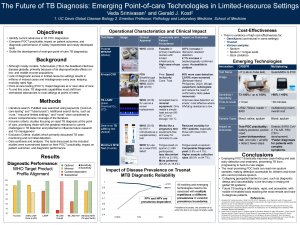
Background: Tuberculosis (TB) remains the deadliest infectious disease globally, primarily because of its disproportionate effects on low- and middle-income populations. Lack of diagnostic access results in millions of missed cases every year. Point-of-care testing (POCT) enables rapid diagnosis at or near sites of care. To end this crisis, TB diagnostic capabilities must shift from centralized laboratories to rural settings.
Methods: This systematic review identified TB diagnostic innovations using a PubMed search (keywords: “point-of-care-testing,” “tuberculosis,” “resource-limited settings”). Included studies addressed rapid TB diagnosis at the point-of-care and demonstrated significant potential to influence TB management. Studies focused on case-monitoring rather than initial detection were excluded.
Results: Advances in POCT include improved practicality, better patient outcomes, and enhanced diagnostic performance. Truenat MTB Plus (Molbio) achieves 80% sensitivity and 96% specificity. Qure.ai qXR demonstrates sensitivities over 90% and specificities ranging from around 80%, and because of inability to distinguish TB from other pulmonary diseases, as low as 32%. MiniDock MTB (Pluslife) shows 85.7% sensitivity and up to 100% specificity with tongue swabs. Notably, the TB prevalence of a population affects the diagnostic utility of a test. POCT significantly improves case-finding, enables early treatment, and prevents progression to difficult-to-treat stages. The most promising POCT platforms can analyze non-sputum samples, increasing access for children and those unable to produce sputum.
Conclusions: Removal of geospatial barriers will reduce diagnostic delays and improve accessibility – essential in ending the global TB epidemic. Rapid turnaround POCT has potential to lower costs and facilitate targeted treatment. When adopting POCT for TB programs, policymakers should prioritize affordability, speed, and accessibility, while considering community TB prevalence. As emerging POCT technologies become more cost-effective, policymakers can more readily implement them. To prevent further transmission from loss to follow-up, screening programs should integrate molecular testing and AI-interpreted portable chest x-rays with on-site, same-visit treatment initiation.
Keywords
Point of Care Testing
Tuberculosis
Limited-Resource Settings
Poster
Srinivasan_Veda_URSCA_Poster.pdf
Verification of VITEK® Automated Antimicrobial Susceptibility Testing of Fosfomycin against Enterobacterales in Urine Culture
Remote Electrocardiography in the Diagnosis of Acute Coronary Syndromes at the Point of Care