Event submissions
Published
This submission belongs to the session S5. Point-of-Care Diagnostics and Other Diagnostic Procedures of the event The 1st International Online Conference on Diagnostics
Published date
18 Sep, 2026
Academic Editor
'%3e%3cpath%20d='M12.6657%2010.9104C12.4185%2010.325%2012.0599%209.79327%2011.6097%209.34482C11.1609%208.89508%2010.6293%208.5365%2010.0442%208.28888C10.0389%208.28626%2010.0337%208.28495%2010.0285%208.28233C10.8446%207.69279%2011.3752%206.73249%2011.3752%205.64904C11.3752%203.8542%209.92103%202.39999%208.1262%202.39999C6.33136%202.39999%204.87715%203.8542%204.87715%205.64904C4.87715%206.73249%205.40774%207.69279%206.22393%208.28364C6.21869%208.28626%206.21345%208.28757%206.20821%208.29019C5.62129%208.5378%205.09463%208.89284%204.64265%209.34613C4.1929%209.79493%203.83432%2010.3266%203.58671%2010.9117C3.34345%2011.4845%203.21226%2012.0987%203.20023%2012.7209C3.19988%2012.7349%203.20233%2012.7488%203.20744%2012.7619C3.21255%2012.7749%203.22022%2012.7867%203.22998%2012.7968C3.23975%2012.8068%203.25142%2012.8147%203.26431%2012.8202C3.2772%2012.8256%203.29105%2012.8284%203.30504%2012.8284H4.09109C4.14874%2012.8284%204.19459%2012.7825%204.1959%2012.7262C4.2221%2011.7148%204.62823%2010.7676%205.34617%2010.0497C6.08899%209.30683%207.0755%208.89808%208.1262%208.89808C9.17689%208.89808%2010.1634%209.30683%2010.9062%2010.0497C11.6242%2010.7676%2012.0303%2011.7148%2012.0565%2012.7262C12.0578%2012.7838%2012.1037%2012.8284%2012.1613%2012.8284H12.9474C12.9613%2012.8284%2012.9752%2012.8256%2012.9881%2012.8202C13.001%2012.8147%2013.0126%2012.8068%2013.0224%2012.7968C13.0322%2012.7867%2013.0398%2012.7749%2013.0449%2012.7619C13.0501%2012.7488%2013.0525%2012.7349%2013.0522%2012.7209C13.0391%2012.0947%2012.9094%2011.4855%2012.6657%2010.9104ZM8.1262%207.9024C7.52486%207.9024%206.9589%207.6679%206.53312%207.24211C6.10733%206.81633%205.87283%206.25037%205.87283%205.64904C5.87283%205.0477%206.10733%204.48174%206.53312%204.05596C6.9589%203.63018%207.52486%203.39567%208.1262%203.39567C8.72753%203.39567%209.29349%203.63018%209.71927%204.05596C10.1451%204.48174%2010.3796%205.0477%2010.3796%205.64904C10.3796%206.25037%2010.1451%206.81633%209.71927%207.24211C9.29349%207.6679%208.72753%207.9024%208.1262%207.9024Z'%20fill='%235D1EE1'/%3e%3c/g%3e%3c/svg%3e) Gerald J. Kost
Gerald J. KostCitation
Kristina Aleksandrovna Shumara, Elmira Faritovna Almukhambetova, Murat Kadyrovich Almukhambetov, Remote Electrocardiography in the Diagnosis of Acute Coronary Syndromes at the Point of Care, in Proceedings of The 1st International Online Conference on Diagnostics, 23 September–24 September 2026, MDPI: Basel, Switzerland
Share
Email
Facebook
Twitter
LinkedIn
Remote Electrocardiography in the Diagnosis of Acute Coronary Syndromes at the Point of Care
'%3e%3cpath%20d='M12.6647%2010.9104C12.4176%2010.325%2012.0589%209.7933%2011.6088%209.34485C11.16%208.89511%2010.6283%208.53653%2010.0432%208.28891C10.038%208.28629%2010.0327%208.28498%2010.0275%208.28236C10.8437%207.69282%2011.3743%206.73252%2011.3743%205.64907C11.3743%203.85423%209.92005%202.40002%208.12522%202.40002C6.33038%202.40002%204.87618%203.85423%204.87618%205.64907C4.87618%206.73252%205.40677%207.69282%206.22296%208.28367C6.21772%208.28629%206.21248%208.2876%206.20724%208.29022C5.62031%208.53783%205.09365%208.89287%204.64167%209.34616C4.19192%209.79496%203.83334%2010.3266%203.58573%2010.9117C3.34247%2011.4846%203.21128%2012.0987%203.19925%2012.721C3.1989%2012.735%203.20135%2012.7489%203.20646%2012.7619C3.21157%2012.7749%203.21924%2012.7868%203.22901%2012.7968C3.23877%2012.8068%203.25045%2012.8148%203.26334%2012.8202C3.27623%2012.8256%203.29007%2012.8284%203.30406%2012.8284H4.09012C4.14776%2012.8284%204.19362%2012.7825%204.19493%2012.7262C4.22113%2011.7148%204.62726%2010.7676%205.34519%2010.0497C6.08802%209.30686%207.07452%208.89811%208.12522%208.89811C9.17592%208.89811%2010.1624%209.30686%2010.9052%2010.0497C11.6232%2010.7676%2012.0293%2011.7148%2012.0555%2012.7262C12.0568%2012.7839%2012.1027%2012.8284%2012.1603%2012.8284H12.9464C12.9604%2012.8284%2012.9742%2012.8256%2012.9871%2012.8202C13%2012.8148%2013.0117%2012.8068%2013.0214%2012.7968C13.0312%2012.7868%2013.0389%2012.7749%2013.044%2012.7619C13.0491%2012.7489%2013.0515%2012.735%2013.0512%2012.721C13.0381%2012.0947%2012.9084%2011.4856%2012.6647%2010.9104ZM8.12522%207.90243C7.52388%207.90243%206.95792%207.66793%206.53214%207.24215C6.10636%206.81636%205.87185%206.2504%205.87185%205.64907C5.87185%205.04773%206.10636%204.48177%206.53214%204.05599C6.95792%203.63021%207.52388%203.3957%208.12522%203.3957C8.72655%203.3957%209.29252%203.63021%209.7183%204.05599C10.1441%204.48177%2010.3786%205.04773%2010.3786%205.64907C10.3786%206.2504%2010.1441%206.81636%209.7183%207.24215C9.29252%207.66793%208.72655%207.90243%208.12522%207.90243Z'%20fill='%235D1EE1'/%3e%3c/g%3e%3c/svg%3e)
Kristina Aleksandrovna Shumara 1
Elmira Faritovna Almukhambetova 2
Murat Kadyrovich Almukhambetov 2
1. S.D. Asfendiyarov Kazakh National Medical University, 2nd-Year Resident in Adult and Pediatric Emergency Medicine, Almaty 050012, Kazakhstan
2. S.D. Asfendiyarov Kazakh National Medical University, Department of Emergency and Urgent Medical Care, Almaty 050012, Kazakhstan
Abstract
Introduction
Acute coronary syndromes (ACS) require timely detection at thepoint of care. In the prehospital setting, electrocardiography(ECG) is essential but limited by delays, variable recordingquality, and lack of immediate expert assessment. Remote ECG interpretation enables rapid expert review and may improvediagnostic accuracy and triage.
Objective
To assess the diagnostic accuracy and operational performanceof automated prehospital ECG interpretation with mandatoryexpert over-read.
Materials and Methods
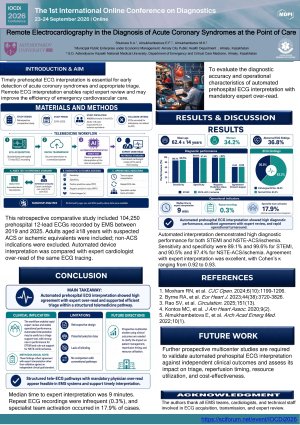
The retrospective study included 104,250 prehospital 12-lead ECGs recorded between 2019 and 2025 by emergency medicalservices. ECGs were obtained in adults (≥18 years) withsuspected ACS; nonACS indications were excluded. The indextest was automated device-generated ECG interpretation atacquisition. The reference standard was expert cardiologistinterpretation of the same tracing. Diagnostic performance(sensitivity, specificity, predictive values), agreement (Cohen’sκ), and operational indicators (time to expert interpretation, repeat ECG rate, specialist team activation) were assessed.
The telemedicine workflow included standardized acquisition, digital transmission, automated interpretation, and centralizedexpert review. Subgroup analyses by age, sex, and ECG qualitywere performed where data were available.
Results Mean age was 62.4 ± 14 years; 34.2% were women. Sensitivitywas 89.1%, specificity 99.6% for ST-segment elevationmyocardial infarction, and 90.5% and 97.4% for myocardialinfarction without ST elevation\ ischemia. Negative predictivevalues exceeded 99%. Agreement was high (κ = 0.92–0.93). Median time to expert interpretation was 9 minutes. Abnormalfindings occurred in 36.8% of ECGs. Repeat recordings wereinfrequent (0.3%). Specialist team activation occurred in 17.9% of cases, reflecting required expert-level management.
Conclusion
Automated ECG interpretation shows high agreement withexpert over-read and supports efficient triage. The findingsreflect agreement with expert interpretation rather thanvalidation against an independent clinical gold standard. Limitations include retrospective design, potential selectionbias, lack of blinding, and absence of comparison withconventional pathways. Prospective studies are needed.
Keywords
electrocardiography
remote diagnosis
acute coronary syndromes
telemedicine
point of care
prehospital phase
ischemia
myocardial infarction
Poster
Окончательный вариант постера.pdf
The Future of TB Diagnosis: Emerging Point-of-care Technologies in Limited-resource Settings
Utility of Truenat MTB Assay in the Diagnosis of Extrapulmonary Tuberculosis: A Retrospective Study