Event submissions
Published
This submission belongs to the session S2. Pathology and Molecular Diagnostics of the event The 1st International Online Conference on Diagnostics
Published date
18 Sep, 2026
Academic Editor
'%3e%3cpath%20d='M12.6657%2010.9104C12.4185%2010.325%2012.0599%209.79327%2011.6097%209.34482C11.1609%208.89508%2010.6293%208.5365%2010.0442%208.28888C10.0389%208.28626%2010.0337%208.28495%2010.0285%208.28233C10.8446%207.69279%2011.3752%206.73249%2011.3752%205.64904C11.3752%203.8542%209.92103%202.39999%208.1262%202.39999C6.33136%202.39999%204.87715%203.8542%204.87715%205.64904C4.87715%206.73249%205.40774%207.69279%206.22393%208.28364C6.21869%208.28626%206.21345%208.28757%206.20821%208.29019C5.62129%208.5378%205.09463%208.89284%204.64265%209.34613C4.1929%209.79493%203.83432%2010.3266%203.58671%2010.9117C3.34345%2011.4845%203.21226%2012.0987%203.20023%2012.7209C3.19988%2012.7349%203.20233%2012.7488%203.20744%2012.7619C3.21255%2012.7749%203.22022%2012.7867%203.22998%2012.7968C3.23975%2012.8068%203.25142%2012.8147%203.26431%2012.8202C3.2772%2012.8256%203.29105%2012.8284%203.30504%2012.8284H4.09109C4.14874%2012.8284%204.19459%2012.7825%204.1959%2012.7262C4.2221%2011.7148%204.62823%2010.7676%205.34617%2010.0497C6.08899%209.30683%207.0755%208.89808%208.1262%208.89808C9.17689%208.89808%2010.1634%209.30683%2010.9062%2010.0497C11.6242%2010.7676%2012.0303%2011.7148%2012.0565%2012.7262C12.0578%2012.7838%2012.1037%2012.8284%2012.1613%2012.8284H12.9474C12.9613%2012.8284%2012.9752%2012.8256%2012.9881%2012.8202C13.001%2012.8147%2013.0126%2012.8068%2013.0224%2012.7968C13.0322%2012.7867%2013.0398%2012.7749%2013.0449%2012.7619C13.0501%2012.7488%2013.0525%2012.7349%2013.0522%2012.7209C13.0391%2012.0947%2012.9094%2011.4855%2012.6657%2010.9104ZM8.1262%207.9024C7.52486%207.9024%206.9589%207.6679%206.53312%207.24211C6.10733%206.81633%205.87283%206.25037%205.87283%205.64904C5.87283%205.0477%206.10733%204.48174%206.53312%204.05596C6.9589%203.63018%207.52486%203.39567%208.1262%203.39567C8.72753%203.39567%209.29349%203.63018%209.71927%204.05596C10.1451%204.48174%2010.3796%205.0477%2010.3796%205.64904C10.3796%206.25037%2010.1451%206.81633%209.71927%207.24211C9.29349%207.6679%208.72753%207.9024%208.1262%207.9024Z'%20fill='%235D1EE1'/%3e%3c/g%3e%3c/svg%3e) Giorgio Treglia
Giorgio TregliaCitation
Vithiya Ganesan, Utility of Truenat MTB Assay in the Diagnosis of Extrapulmonary Tuberculosis: A Retrospective Study, in Proceedings of The 1st International Online Conference on Diagnostics, 23 September–24 September 2026, MDPI: Basel, Switzerland
Share
Email
Facebook
Twitter
LinkedIn
Utility of Truenat MTB Assay in the Diagnosis of Extrapulmonary Tuberculosis: A Retrospective Study
'%3e%3cpath%20d='M12.6647%2010.9104C12.4176%2010.325%2012.0589%209.7933%2011.6088%209.34485C11.16%208.89511%2010.6283%208.53653%2010.0432%208.28891C10.038%208.28629%2010.0327%208.28498%2010.0275%208.28236C10.8437%207.69282%2011.3743%206.73252%2011.3743%205.64907C11.3743%203.85423%209.92005%202.40002%208.12522%202.40002C6.33038%202.40002%204.87618%203.85423%204.87618%205.64907C4.87618%206.73252%205.40677%207.69282%206.22296%208.28367C6.21772%208.28629%206.21248%208.2876%206.20724%208.29022C5.62031%208.53783%205.09365%208.89287%204.64167%209.34616C4.19192%209.79496%203.83334%2010.3266%203.58573%2010.9117C3.34247%2011.4846%203.21128%2012.0987%203.19925%2012.721C3.1989%2012.735%203.20135%2012.7489%203.20646%2012.7619C3.21157%2012.7749%203.21924%2012.7868%203.22901%2012.7968C3.23877%2012.8068%203.25045%2012.8148%203.26334%2012.8202C3.27623%2012.8256%203.29007%2012.8284%203.30406%2012.8284H4.09012C4.14776%2012.8284%204.19362%2012.7825%204.19493%2012.7262C4.22113%2011.7148%204.62726%2010.7676%205.34519%2010.0497C6.08802%209.30686%207.07452%208.89811%208.12522%208.89811C9.17592%208.89811%2010.1624%209.30686%2010.9052%2010.0497C11.6232%2010.7676%2012.0293%2011.7148%2012.0555%2012.7262C12.0568%2012.7839%2012.1027%2012.8284%2012.1603%2012.8284H12.9464C12.9604%2012.8284%2012.9742%2012.8256%2012.9871%2012.8202C13%2012.8148%2013.0117%2012.8068%2013.0214%2012.7968C13.0312%2012.7868%2013.0389%2012.7749%2013.044%2012.7619C13.0491%2012.7489%2013.0515%2012.735%2013.0512%2012.721C13.0381%2012.0947%2012.9084%2011.4856%2012.6647%2010.9104ZM8.12522%207.90243C7.52388%207.90243%206.95792%207.66793%206.53214%207.24215C6.10636%206.81636%205.87185%206.2504%205.87185%205.64907C5.87185%205.04773%206.10636%204.48177%206.53214%204.05599C6.95792%203.63021%207.52388%203.3957%208.12522%203.3957C8.72655%203.3957%209.29252%203.63021%209.7183%204.05599C10.1441%204.48177%2010.3786%205.04773%2010.3786%205.64907C10.3786%206.2504%2010.1441%206.81636%209.7183%207.24215C9.29252%207.66793%208.72655%207.90243%208.12522%207.90243Z'%20fill='%235D1EE1'/%3e%3c/g%3e%3c/svg%3e)
Vithiya Ganesan 1
1. Department of Microbiology, All India Institute of Medical Sciences (AIIMS) Madurai, Madurai, Tamil Nadu, 625020, India
Abstract
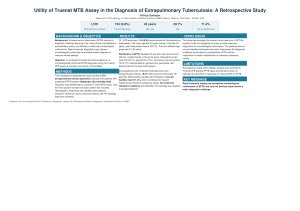
Extrapulmonary tuberculosis (EPTB) continues to pose a significant diagnostic challenge in tuberculosis-endemic countries because of its varied clinical manifestations, paucibacillary nature, and difficulty in obtaining microbiological confirmation. Despite advances in rapid molecular diagnostics, EPTB remains underdiagnosed and frequently treated empirically in resource-limited settings. This retrospective observational study was conducted to evaluate the trends and clinical spectrum of microbiologically confirmed EPTB diagnosed using the Truenat MTB assay at a tertiary care centre in Tamil Nadu between September 2019 and May 2025.
A total of 1,570 extrapulmonary clinical specimens received from patients with suspected EPTB were analysed. Diagnosis was established by a positive Truenat MTB assay result, with only the initial positive sample from each patient included. Of the total specimens, 154 (9.8%) tested positive for Mycobacterium tuberculosis. The mean age of affected individuals was 43 years (range: 4 months–87 years), with male predominance (59.7%). The most affected age group was 51–60 years. Skeletal TB was the most common form of EPTB (36.3%), predominantly involving the spine, followed by lymph node TB (20.7%), pleural TB (9.7%), and central nervous system TB (9.7%). Gastrointestinal, genitourinary, pericardial, and disseminated forms were less frequent. Concurrent pulmonary TB positivity was observed in 19.2% of patients who underwent both pulmonary and extrapulmonary testing.
Most positive samples demonstrated very low bacillary load (71.4%), resulting in indeterminate rifampicin resistance results in many cases; however, no confirmed rifampicin resistance was identified. HIV serology, available for most patients, was negative in all tested cases. The study highlights the evolving epidemiology and diverse presentation of EPTB in southern India and underscores the utility of rapid molecular diagnostics in improving microbiological confirmation and early diagnosis of EPTB.
Keywords
Extrapulmonary Tuberculosis
Truenat
Skeletal tuberculosis
Molecular diagnostics
Poster
Truenat_MTB_EPTB_Poster_AIIMS_Madurai.pdf
Remote Electrocardiography in the Diagnosis of Acute Coronary Syndromes at the Point of Care
ADVANCES IN MOLECULAR DIAGNOSTIC TECHNIQUES FOR DETECTING ANTIBIOTIC-RESISTANT BACTERIA IN WATER SOURCES: A SYSTEMATIC REVIEW