Event submissions
Published
This submission belongs to the session S2. Pathology and Molecular Diagnostics of the event The 1st International Online Conference on Diagnostics
Published date
18 Sep, 2026
Academic Editor
'%3e%3cpath%20d='M12.6657%2010.9104C12.4185%2010.325%2012.0599%209.79327%2011.6097%209.34482C11.1609%208.89508%2010.6293%208.5365%2010.0442%208.28888C10.0389%208.28626%2010.0337%208.28495%2010.0285%208.28233C10.8446%207.69279%2011.3752%206.73249%2011.3752%205.64904C11.3752%203.8542%209.92103%202.39999%208.1262%202.39999C6.33136%202.39999%204.87715%203.8542%204.87715%205.64904C4.87715%206.73249%205.40774%207.69279%206.22393%208.28364C6.21869%208.28626%206.21345%208.28757%206.20821%208.29019C5.62129%208.5378%205.09463%208.89284%204.64265%209.34613C4.1929%209.79493%203.83432%2010.3266%203.58671%2010.9117C3.34345%2011.4845%203.21226%2012.0987%203.20023%2012.7209C3.19988%2012.7349%203.20233%2012.7488%203.20744%2012.7619C3.21255%2012.7749%203.22022%2012.7867%203.22998%2012.7968C3.23975%2012.8068%203.25142%2012.8147%203.26431%2012.8202C3.2772%2012.8256%203.29105%2012.8284%203.30504%2012.8284H4.09109C4.14874%2012.8284%204.19459%2012.7825%204.1959%2012.7262C4.2221%2011.7148%204.62823%2010.7676%205.34617%2010.0497C6.08899%209.30683%207.0755%208.89808%208.1262%208.89808C9.17689%208.89808%2010.1634%209.30683%2010.9062%2010.0497C11.6242%2010.7676%2012.0303%2011.7148%2012.0565%2012.7262C12.0578%2012.7838%2012.1037%2012.8284%2012.1613%2012.8284H12.9474C12.9613%2012.8284%2012.9752%2012.8256%2012.9881%2012.8202C13.001%2012.8147%2013.0126%2012.8068%2013.0224%2012.7968C13.0322%2012.7867%2013.0398%2012.7749%2013.0449%2012.7619C13.0501%2012.7488%2013.0525%2012.7349%2013.0522%2012.7209C13.0391%2012.0947%2012.9094%2011.4855%2012.6657%2010.9104ZM8.1262%207.9024C7.52486%207.9024%206.9589%207.6679%206.53312%207.24211C6.10733%206.81633%205.87283%206.25037%205.87283%205.64904C5.87283%205.0477%206.10733%204.48174%206.53312%204.05596C6.9589%203.63018%207.52486%203.39567%208.1262%203.39567C8.72753%203.39567%209.29349%203.63018%209.71927%204.05596C10.1451%204.48174%2010.3796%205.0477%2010.3796%205.64904C10.3796%206.25037%2010.1451%206.81633%209.71927%207.24211C9.29349%207.6679%208.72753%207.9024%208.1262%207.9024Z'%20fill='%235D1EE1'/%3e%3c/g%3e%3c/svg%3e) Giorgio Treglia
Giorgio TregliaCitation
Abdulwaris Tijani, Gbenga Ayodele, ADVANCES IN MOLECULAR DIAGNOSTIC TECHNIQUES FOR DETECTING ANTIBIOTIC-RESISTANT BACTERIA IN WATER SOURCES: A SYSTEMATIC REVIEW, in Proceedings of The 1st International Online Conference on Diagnostics, 23 September–24 September 2026, MDPI: Basel, Switzerland
Share
Email
Facebook
Twitter
LinkedIn
ADVANCES IN MOLECULAR DIAGNOSTIC TECHNIQUES FOR DETECTING ANTIBIOTIC-RESISTANT BACTERIA IN WATER SOURCES: A SYSTEMATIC REVIEW
'%3e%3cpath%20d='M12.6647%2010.9104C12.4176%2010.325%2012.0589%209.7933%2011.6088%209.34485C11.16%208.89511%2010.6283%208.53653%2010.0432%208.28891C10.038%208.28629%2010.0327%208.28498%2010.0275%208.28236C10.8437%207.69282%2011.3743%206.73252%2011.3743%205.64907C11.3743%203.85423%209.92005%202.40002%208.12522%202.40002C6.33038%202.40002%204.87618%203.85423%204.87618%205.64907C4.87618%206.73252%205.40677%207.69282%206.22296%208.28367C6.21772%208.28629%206.21248%208.2876%206.20724%208.29022C5.62031%208.53783%205.09365%208.89287%204.64167%209.34616C4.19192%209.79496%203.83334%2010.3266%203.58573%2010.9117C3.34247%2011.4846%203.21128%2012.0987%203.19925%2012.721C3.1989%2012.735%203.20135%2012.7489%203.20646%2012.7619C3.21157%2012.7749%203.21924%2012.7868%203.22901%2012.7968C3.23877%2012.8068%203.25045%2012.8148%203.26334%2012.8202C3.27623%2012.8256%203.29007%2012.8284%203.30406%2012.8284H4.09012C4.14776%2012.8284%204.19362%2012.7825%204.19493%2012.7262C4.22113%2011.7148%204.62726%2010.7676%205.34519%2010.0497C6.08802%209.30686%207.07452%208.89811%208.12522%208.89811C9.17592%208.89811%2010.1624%209.30686%2010.9052%2010.0497C11.6232%2010.7676%2012.0293%2011.7148%2012.0555%2012.7262C12.0568%2012.7839%2012.1027%2012.8284%2012.1603%2012.8284H12.9464C12.9604%2012.8284%2012.9742%2012.8256%2012.9871%2012.8202C13%2012.8148%2013.0117%2012.8068%2013.0214%2012.7968C13.0312%2012.7868%2013.0389%2012.7749%2013.044%2012.7619C13.0491%2012.7489%2013.0515%2012.735%2013.0512%2012.721C13.0381%2012.0947%2012.9084%2011.4856%2012.6647%2010.9104ZM8.12522%207.90243C7.52388%207.90243%206.95792%207.66793%206.53214%207.24215C6.10636%206.81636%205.87185%206.2504%205.87185%205.64907C5.87185%205.04773%206.10636%204.48177%206.53214%204.05599C6.95792%203.63021%207.52388%203.3957%208.12522%203.3957C8.72655%203.3957%209.29252%203.63021%209.7183%204.05599C10.1441%204.48177%2010.3786%205.04773%2010.3786%205.64907C10.3786%206.2504%2010.1441%206.81636%209.7183%207.24215C9.29252%207.66793%208.72655%207.90243%208.12522%207.90243Z'%20fill='%235D1EE1'/%3e%3c/g%3e%3c/svg%3e)
Abdulwaris Tijani 1
Gbenga Ayodele 1
1. Department of Animal Production and Health, Federal University of Technology, Akure, Nigeria
Abstract
Introduction:
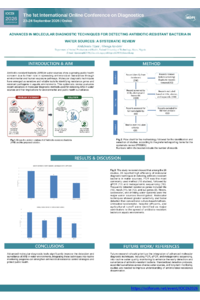
Antibiotic-resistant bacteria (ARB) in water sources show a growing public health concern due to their role in spreading antimicrobial resistance through environmental and human exposure pathways. Rapid and accurate detection of ARB is important for water quality monitoring and disease prevention. Molecular diagnostic techniques have emerged as sensitive and reliable tools for identifying resistance genes and resistant pathogens in aquatic environments. This systematic review evaluates recent advances in molecular diagnostic methods used for detecting ARB in water sources and their implications for environmental and public health surveillance.
Methods:
Following PRISMA 2020 guidelines, a systematic search was conducted in PubMed, Scopus, Web of Science, and Google Scholar for studies published between 2005 and 2025. Search terms included “antibiotic-resistant bacteria,” “molecular diagnostics,” “water sources,” “PCR,” “metagenomics,” and “antimicrobial resistance.” From 210 identified records, 168 remained after duplicate removal. Following screening and eligibility assessment, 28 studies met the inclusion criteria for qualitative synthesis.
Results:
Among the 28 studies, 24 reported high efficiency of molecular diagnostic techniques in detecting antibiotic-resistant bacteria in water sources. PCR was the most commonly used method (18 studies), followed by qPCR (15) and metagenomic sequencing (10). Frequently detected resistance genes included bla (16), mecA (11), tet (13), and sul genes (9). Rivers, wastewater, and drinking water systems were the major water sources investigated. Molecular techniques showed greater sensitivity and faster detection than conventional culture-based methods. Untreated wastewater, hospital effluents, and agricultural runoff were identified as major contributors to the spread of antibiotic-resistant bacteria in aquatic environments.
Conclusions:
Advanced molecular diagnostic tools significantly improve the detection and surveillance of ARB in water environments. Integrating these techniques into routine monitoring programs can strengthen antimicrobial resistance control strategies and protect public health.
Keywords
Antibiotic-resistant bacteria
molecular diagnostics
antimicrobial resistance
PCR
metagenomics
water sources
environmental surveillance.
Poster
POSTAL 3_045521.pdf
Utility of Truenat MTB Assay in the Diagnosis of Extrapulmonary Tuberculosis: A Retrospective Study
Next-generation sequencing as a complementary approach in prenatal diagnosis of fetal structural anomalies following normal karyotype and chromosomal microarray findings