Event submissions
Published
This submission belongs to the session S2. Pathology and Molecular Diagnostics of the event The 1st International Online Conference on Diagnostics
Published date
18 Sep, 2026
Academic Editor
'%3e%3cpath%20d='M12.6657%2010.9104C12.4185%2010.325%2012.0599%209.79327%2011.6097%209.34482C11.1609%208.89508%2010.6293%208.5365%2010.0442%208.28888C10.0389%208.28626%2010.0337%208.28495%2010.0285%208.28233C10.8446%207.69279%2011.3752%206.73249%2011.3752%205.64904C11.3752%203.8542%209.92103%202.39999%208.1262%202.39999C6.33136%202.39999%204.87715%203.8542%204.87715%205.64904C4.87715%206.73249%205.40774%207.69279%206.22393%208.28364C6.21869%208.28626%206.21345%208.28757%206.20821%208.29019C5.62129%208.5378%205.09463%208.89284%204.64265%209.34613C4.1929%209.79493%203.83432%2010.3266%203.58671%2010.9117C3.34345%2011.4845%203.21226%2012.0987%203.20023%2012.7209C3.19988%2012.7349%203.20233%2012.7488%203.20744%2012.7619C3.21255%2012.7749%203.22022%2012.7867%203.22998%2012.7968C3.23975%2012.8068%203.25142%2012.8147%203.26431%2012.8202C3.2772%2012.8256%203.29105%2012.8284%203.30504%2012.8284H4.09109C4.14874%2012.8284%204.19459%2012.7825%204.1959%2012.7262C4.2221%2011.7148%204.62823%2010.7676%205.34617%2010.0497C6.08899%209.30683%207.0755%208.89808%208.1262%208.89808C9.17689%208.89808%2010.1634%209.30683%2010.9062%2010.0497C11.6242%2010.7676%2012.0303%2011.7148%2012.0565%2012.7262C12.0578%2012.7838%2012.1037%2012.8284%2012.1613%2012.8284H12.9474C12.9613%2012.8284%2012.9752%2012.8256%2012.9881%2012.8202C13.001%2012.8147%2013.0126%2012.8068%2013.0224%2012.7968C13.0322%2012.7867%2013.0398%2012.7749%2013.0449%2012.7619C13.0501%2012.7488%2013.0525%2012.7349%2013.0522%2012.7209C13.0391%2012.0947%2012.9094%2011.4855%2012.6657%2010.9104ZM8.1262%207.9024C7.52486%207.9024%206.9589%207.6679%206.53312%207.24211C6.10733%206.81633%205.87283%206.25037%205.87283%205.64904C5.87283%205.0477%206.10733%204.48174%206.53312%204.05596C6.9589%203.63018%207.52486%203.39567%208.1262%203.39567C8.72753%203.39567%209.29349%203.63018%209.71927%204.05596C10.1451%204.48174%2010.3796%205.0477%2010.3796%205.64904C10.3796%206.25037%2010.1451%206.81633%209.71927%207.24211C9.29349%207.6679%208.72753%207.9024%208.1262%207.9024Z'%20fill='%235D1EE1'/%3e%3c/g%3e%3c/svg%3e) Giorgio Treglia
Giorgio TregliaCitation
Ivanka Bekavac Vlatkovic, Feodora Stipoljev, Maja Oroz, Ana Mustapić, Next-generation sequencing as a complementary approach in prenatal diagnosis of fetal structural anomalies following normal karyotype and chromosomal microarray findings, in Proceedings of The 1st International Online Conference on Diagnostics, 23 September–24 September 2026, MDPI: Basel, Switzerland
Share
Email
Facebook
Twitter
LinkedIn
Next-generation sequencing as a complementary approach in prenatal diagnosis of fetal structural anomalies following normal karyotype and chromosomal microarray findings
'%3e%3cpath%20d='M12.6647%2010.9104C12.4176%2010.325%2012.0589%209.7933%2011.6088%209.34485C11.16%208.89511%2010.6283%208.53653%2010.0432%208.28891C10.038%208.28629%2010.0327%208.28498%2010.0275%208.28236C10.8437%207.69282%2011.3743%206.73252%2011.3743%205.64907C11.3743%203.85423%209.92005%202.40002%208.12522%202.40002C6.33038%202.40002%204.87618%203.85423%204.87618%205.64907C4.87618%206.73252%205.40677%207.69282%206.22296%208.28367C6.21772%208.28629%206.21248%208.2876%206.20724%208.29022C5.62031%208.53783%205.09365%208.89287%204.64167%209.34616C4.19192%209.79496%203.83334%2010.3266%203.58573%2010.9117C3.34247%2011.4846%203.21128%2012.0987%203.19925%2012.721C3.1989%2012.735%203.20135%2012.7489%203.20646%2012.7619C3.21157%2012.7749%203.21924%2012.7868%203.22901%2012.7968C3.23877%2012.8068%203.25045%2012.8148%203.26334%2012.8202C3.27623%2012.8256%203.29007%2012.8284%203.30406%2012.8284H4.09012C4.14776%2012.8284%204.19362%2012.7825%204.19493%2012.7262C4.22113%2011.7148%204.62726%2010.7676%205.34519%2010.0497C6.08802%209.30686%207.07452%208.89811%208.12522%208.89811C9.17592%208.89811%2010.1624%209.30686%2010.9052%2010.0497C11.6232%2010.7676%2012.0293%2011.7148%2012.0555%2012.7262C12.0568%2012.7839%2012.1027%2012.8284%2012.1603%2012.8284H12.9464C12.9604%2012.8284%2012.9742%2012.8256%2012.9871%2012.8202C13%2012.8148%2013.0117%2012.8068%2013.0214%2012.7968C13.0312%2012.7868%2013.0389%2012.7749%2013.044%2012.7619C13.0491%2012.7489%2013.0515%2012.735%2013.0512%2012.721C13.0381%2012.0947%2012.9084%2011.4856%2012.6647%2010.9104ZM8.12522%207.90243C7.52388%207.90243%206.95792%207.66793%206.53214%207.24215C6.10636%206.81636%205.87185%206.2504%205.87185%205.64907C5.87185%205.04773%206.10636%204.48177%206.53214%204.05599C6.95792%203.63021%207.52388%203.3957%208.12522%203.3957C8.72655%203.3957%209.29252%203.63021%209.7183%204.05599C10.1441%204.48177%2010.3786%205.04773%2010.3786%205.64907C10.3786%206.2504%2010.1441%206.81636%209.7183%207.24215C9.29252%207.66793%208.72655%207.90243%208.12522%207.90243Z'%20fill='%235D1EE1'/%3e%3c/g%3e%3c/svg%3e)
Ivanka Bekavac Vlatkovic 1,2
Feodora Stipoljev 1,3
Maja Oroz 1
Ana Mustapić 1
1. Department of Obstetrics and Gynecology, Clinical Hospital “Sveti Duh”, 10000 Zagreb, Croatia
2. School of Medicine, University of Zagreb, Zagreb, Croatia
3. Faculty of Medicine, Josip Juraj Strossmayer University of Osijek, Osijek, Croatia
Abstract
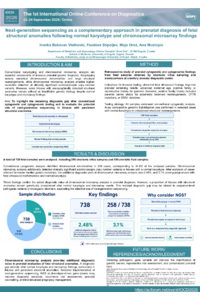
Introduction: Conventional karyotyping and chromosomal microarray analysis are key components of invasive prenatal genetic diagnosis. Karyotyping detects numerical chromosomal abnormalities and large structural rearrangements, while chromosomal microarray analysis enables higher-resolution identification of clinically significant submicroscopic copy number variants, such as 22q11.2 deletion syndrome and 16p11.2 microduplications. Despite this combined approach, some fetuses with sonographically detected structural anomalies remain without an identifiable genetic etiology.
Methods: This retrospective study evaluated prenatal cytogenetic and cytogenomic findings from fetal samples obtained by chorionic villus sampling and amniocentesis at a tertiary prenatal diagnostic centre. Indications for invasive testing included abnormal fetal ultrasound findings, high-risk prenatal screening results, advanced maternal age, and positive family or reproductive history for genomic disorders. Indication of positive family history included one parent being a carrier of a structurally apparently balanced rearrangement, CFTR mutations, or SMN1 deletions. All samples underwent conventional cytogenetic analysis, while array comparative genomic hybridization was performed in selected cases with normal karyotype or unbalanced structural rearrangements.
Results: A total of 738 fetal samples were analysed, including 208 chorionic villus and 530 amniotic fluid samples. Conventional cytogenetic analysis identified chromosomal abnormalities in 258 cases (34.9%). Chromosomal microarray analysis additionally detected clinically significant submicroscopic copy number variants in fetuses with a normal karyotype. After exclusion of cases referred for known familial genetic mutations, the additional diagnostic yield of chromosomal microarray analysis was 2.48%, and 3.1% among pregnancies with fetal ultrasound malformations and normal karyotype.
Conclusions: Chromosomal microarray analysis provides additional diagnostic value in prenatal evaluation, but a diagnostic gap persists after normal karyotype and microarray findings. In fetuses with persistent structural anomalies, the cause may involve sequence-level pathogenic variants or monogenic disorders. Selective implementation of next-generation sequencing, particularly trio-based exome sequencing or phenotype-driven gene panels, may improve diagnostic precision, recurrence risk assessment, prenatal counselling, and individualized pregnancy management.
Keywords
Comparative Genomic Hybridization
High-Throughput Nucleotide Sequencing
Karyotyping
Prenatal Diagnosis
Poster
bekavac vlatkovic sciforum poster 185614.pdf
ADVANCES IN MOLECULAR DIAGNOSTIC TECHNIQUES FOR DETECTING ANTIBIOTIC-RESISTANT BACTERIA IN WATER SOURCES: A SYSTEMATIC REVIEW
A Sodium Rhodizonate-Based Colorimetric Cassette for Point-of-Care Blood Lead Level Screening: Proof-of-Concept Validation in Synthetic Serum.