Event submissions
Published

This submission belongs to the session C. Manufacturing Processes and Systems of the event The 2nd International Electronic Conference on Materials
Published date
03 May, 2016
Citation
Zuzana Hutyrova, Jozef Zajac, Dusan Mital, Frantisek Botko, Marta Harnicarova, Jan Valicek, Wood filled plastics – machining and surface quality, in Proceedings of The 2nd International Electronic Conference on Materials, 2 May–16 May 2016, MDPI: Basel, Switzerland, doi: 10.3390/ecm-2-C001
Share
Email
Facebook
Twitter
LinkedIn
Wood filled plastics – machining and surface quality
'%3e%3cpath%20d='M12.6647%2010.9104C12.4176%2010.325%2012.0589%209.7933%2011.6088%209.34485C11.16%208.89511%2010.6283%208.53653%2010.0432%208.28891C10.038%208.28629%2010.0327%208.28498%2010.0275%208.28236C10.8437%207.69282%2011.3743%206.73252%2011.3743%205.64907C11.3743%203.85423%209.92005%202.40002%208.12522%202.40002C6.33038%202.40002%204.87618%203.85423%204.87618%205.64907C4.87618%206.73252%205.40677%207.69282%206.22296%208.28367C6.21772%208.28629%206.21248%208.2876%206.20724%208.29022C5.62031%208.53783%205.09365%208.89287%204.64167%209.34616C4.19192%209.79496%203.83334%2010.3266%203.58573%2010.9117C3.34247%2011.4846%203.21128%2012.0987%203.19925%2012.721C3.1989%2012.735%203.20135%2012.7489%203.20646%2012.7619C3.21157%2012.7749%203.21924%2012.7868%203.22901%2012.7968C3.23877%2012.8068%203.25045%2012.8148%203.26334%2012.8202C3.27623%2012.8256%203.29007%2012.8284%203.30406%2012.8284H4.09012C4.14776%2012.8284%204.19362%2012.7825%204.19493%2012.7262C4.22113%2011.7148%204.62726%2010.7676%205.34519%2010.0497C6.08802%209.30686%207.07452%208.89811%208.12522%208.89811C9.17592%208.89811%2010.1624%209.30686%2010.9052%2010.0497C11.6232%2010.7676%2012.0293%2011.7148%2012.0555%2012.7262C12.0568%2012.7839%2012.1027%2012.8284%2012.1603%2012.8284H12.9464C12.9604%2012.8284%2012.9742%2012.8256%2012.9871%2012.8202C13%2012.8148%2013.0117%2012.8068%2013.0214%2012.7968C13.0312%2012.7868%2013.0389%2012.7749%2013.044%2012.7619C13.0491%2012.7489%2013.0515%2012.735%2013.0512%2012.721C13.0381%2012.0947%2012.9084%2011.4856%2012.6647%2010.9104ZM8.12522%207.90243C7.52388%207.90243%206.95792%207.66793%206.53214%207.24215C6.10636%206.81636%205.87185%206.2504%205.87185%205.64907C5.87185%205.04773%206.10636%204.48177%206.53214%204.05599C6.95792%203.63021%207.52388%203.3957%208.12522%203.3957C8.72655%203.3957%209.29252%203.63021%209.7183%204.05599C10.1441%204.48177%2010.3786%205.04773%2010.3786%205.64907C10.3786%206.2504%2010.1441%206.81636%209.7183%207.24215C9.29252%207.66793%208.72655%207.90243%208.12522%207.90243Z'%20fill='%235D1EE1'/%3e%3c/g%3e%3c/svg%3e)
Zuzana Hutyrova 1
Jozef Zajac 1
Dusan Mital 1
Frantisek Botko 1

Marta Harnicarova 2
Jan Valicek 2
1. Faculty of Manufacturing Technologies Technical University of Kosice with a seat in Presov, Bayerova 1, 080 01 Presov, Slovakia
2. Institute of Physics, Faculty of Mining and technology, VSB-TU Ostrava, 17.Listopadu 15/2172, 708 33 Ostrava, Czech Republic
Abstract
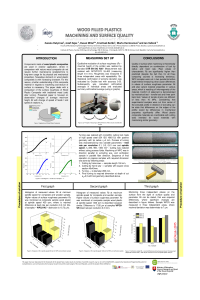
Components made of wood plastic composites are used in exterior application, where in comparison with nature wood composite do not require further maintenance (predetermine to long-term usage for its physical and mechanical properties). Adding wood to plastic significantly increases mechanical properties (utmost stiffness), reduces thermal expansion of the plastic and decreases of cost. Design of product is not limited by material and technology and is possible to product different types of profile and shapes. Nowadays demand on wood plastic composites is with increasing character. For this reason, a better understanding of this composite material in regards to machining and texture of surface is necessary. The paper deals with a comparison of the surface roughness of Wood Plastic Composite with traditional wood (oak) after turning. Presented paper is focused on observation changes of average maximum height Rz with change of speed of feeds f and speed of rotations nc (simultaneously compare predicted and real values of surface roughness parameter Rz). Experiment was realized with monolithic cutting tool made of high speed steel (EN ISO HS6-5-2) with positive geometry. Machining of WPC was in direction parallel to extruding axe, and verification sample in parallel fiber direction. Graphical evaluation of experimental values was realized using software OriginLab. Detecting surface quality was made using microscopic camera DigiMicro 2.0
Keywords
Wood-filled plastics
turning
mechanical properties
tensile test
three point bending test
surface texture.
Manuscript
sciforum-007171.pdf
Poster
poster_presentation_007171.pdf
Recent trends in development of self‐flowing mortar incorporating supplementary cementitious materials
Experimental testing of material Mosten GB 005 on various concertation of recycled material