Event submissions
Published
This submission belongs to the session S3. Laboratory medicine of the event The 1st International Online Conference on Diagnostics
Published date
18 Sep, 2026
Academic Editor
'%3e%3cpath%20d='M12.6657%2010.9104C12.4185%2010.325%2012.0599%209.79327%2011.6097%209.34482C11.1609%208.89508%2010.6293%208.5365%2010.0442%208.28888C10.0389%208.28626%2010.0337%208.28495%2010.0285%208.28233C10.8446%207.69279%2011.3752%206.73249%2011.3752%205.64904C11.3752%203.8542%209.92103%202.39999%208.1262%202.39999C6.33136%202.39999%204.87715%203.8542%204.87715%205.64904C4.87715%206.73249%205.40774%207.69279%206.22393%208.28364C6.21869%208.28626%206.21345%208.28757%206.20821%208.29019C5.62129%208.5378%205.09463%208.89284%204.64265%209.34613C4.1929%209.79493%203.83432%2010.3266%203.58671%2010.9117C3.34345%2011.4845%203.21226%2012.0987%203.20023%2012.7209C3.19988%2012.7349%203.20233%2012.7488%203.20744%2012.7619C3.21255%2012.7749%203.22022%2012.7867%203.22998%2012.7968C3.23975%2012.8068%203.25142%2012.8147%203.26431%2012.8202C3.2772%2012.8256%203.29105%2012.8284%203.30504%2012.8284H4.09109C4.14874%2012.8284%204.19459%2012.7825%204.1959%2012.7262C4.2221%2011.7148%204.62823%2010.7676%205.34617%2010.0497C6.08899%209.30683%207.0755%208.89808%208.1262%208.89808C9.17689%208.89808%2010.1634%209.30683%2010.9062%2010.0497C11.6242%2010.7676%2012.0303%2011.7148%2012.0565%2012.7262C12.0578%2012.7838%2012.1037%2012.8284%2012.1613%2012.8284H12.9474C12.9613%2012.8284%2012.9752%2012.8256%2012.9881%2012.8202C13.001%2012.8147%2013.0126%2012.8068%2013.0224%2012.7968C13.0322%2012.7867%2013.0398%2012.7749%2013.0449%2012.7619C13.0501%2012.7488%2013.0525%2012.7349%2013.0522%2012.7209C13.0391%2012.0947%2012.9094%2011.4855%2012.6657%2010.9104ZM8.1262%207.9024C7.52486%207.9024%206.9589%207.6679%206.53312%207.24211C6.10733%206.81633%205.87283%206.25037%205.87283%205.64904C5.87283%205.0477%206.10733%204.48174%206.53312%204.05596C6.9589%203.63018%207.52486%203.39567%208.1262%203.39567C8.72753%203.39567%209.29349%203.63018%209.71927%204.05596C10.1451%204.48174%2010.3796%205.0477%2010.3796%205.64904C10.3796%206.25037%2010.1451%206.81633%209.71927%207.24211C9.29349%207.6679%208.72753%207.9024%208.1262%207.9024Z'%20fill='%235D1EE1'/%3e%3c/g%3e%3c/svg%3e) Marijn M. Speeckaert
Marijn M. SpeeckaertCitation
Eugene Y.H. Yeung, Does speciation clinically matter for the genus Capnocytophaga?, in Proceedings of The 1st International Online Conference on Diagnostics, 23 September–24 September 2026, MDPI: Basel, Switzerland
Share
Email
Facebook
Twitter
LinkedIn
Does speciation clinically matter for the genus Capnocytophaga?
'%3e%3cpath%20d='M12.6647%2010.9104C12.4176%2010.325%2012.0589%209.7933%2011.6088%209.34485C11.16%208.89511%2010.6283%208.53653%2010.0432%208.28891C10.038%208.28629%2010.0327%208.28498%2010.0275%208.28236C10.8437%207.69282%2011.3743%206.73252%2011.3743%205.64907C11.3743%203.85423%209.92005%202.40002%208.12522%202.40002C6.33038%202.40002%204.87618%203.85423%204.87618%205.64907C4.87618%206.73252%205.40677%207.69282%206.22296%208.28367C6.21772%208.28629%206.21248%208.2876%206.20724%208.29022C5.62031%208.53783%205.09365%208.89287%204.64167%209.34616C4.19192%209.79496%203.83334%2010.3266%203.58573%2010.9117C3.34247%2011.4846%203.21128%2012.0987%203.19925%2012.721C3.1989%2012.735%203.20135%2012.7489%203.20646%2012.7619C3.21157%2012.7749%203.21924%2012.7868%203.22901%2012.7968C3.23877%2012.8068%203.25045%2012.8148%203.26334%2012.8202C3.27623%2012.8256%203.29007%2012.8284%203.30406%2012.8284H4.09012C4.14776%2012.8284%204.19362%2012.7825%204.19493%2012.7262C4.22113%2011.7148%204.62726%2010.7676%205.34519%2010.0497C6.08802%209.30686%207.07452%208.89811%208.12522%208.89811C9.17592%208.89811%2010.1624%209.30686%2010.9052%2010.0497C11.6232%2010.7676%2012.0293%2011.7148%2012.0555%2012.7262C12.0568%2012.7839%2012.1027%2012.8284%2012.1603%2012.8284H12.9464C12.9604%2012.8284%2012.9742%2012.8256%2012.9871%2012.8202C13%2012.8148%2013.0117%2012.8068%2013.0214%2012.7968C13.0312%2012.7868%2013.0389%2012.7749%2013.044%2012.7619C13.0491%2012.7489%2013.0515%2012.735%2013.0512%2012.721C13.0381%2012.0947%2012.9084%2011.4856%2012.6647%2010.9104ZM8.12522%207.90243C7.52388%207.90243%206.95792%207.66793%206.53214%207.24215C6.10636%206.81636%205.87185%206.2504%205.87185%205.64907C5.87185%205.04773%206.10636%204.48177%206.53214%204.05599C6.95792%203.63021%207.52388%203.3957%208.12522%203.3957C8.72655%203.3957%209.29252%203.63021%209.7183%204.05599C10.1441%204.48177%2010.3786%205.04773%2010.3786%205.64907C10.3786%206.2504%2010.1441%206.81636%209.7183%207.24215C9.29252%207.66793%208.72655%207.90243%208.12522%207.90243Z'%20fill='%235D1EE1'/%3e%3c/g%3e%3c/svg%3e)
Eugene Y.H. Yeung 1,2,3
1. Department of Pathology and Laboratory Medicine, Faculty of Medicine, University of British Columbia, Vancouver, British Columbia V5Z 1M9, Canada
2. Continuing Pharmacy Professional Development, Faculty of Pharmaceutical Sciences, University of British Columbia, Vancouver, British Columbia V6T 1Z3, Canada
3. Clinical Faculty, School of Medicine, Simon Fraser University, Surrey, British Columbia V3T 0A3, Canada
Abstract
Introduction
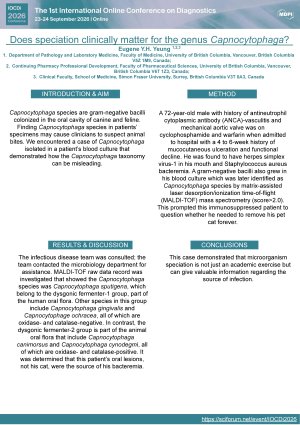
Capnocytophaga species are gram-negative bacilli colonized in the oral cavity of canine and feline. Finding Capnocytophaga species in patients’ specimens may cause clinicians to suspect animal bites. We encountered a case of Capnocytophaga isolated in a patient’s blood culture that demonstrated how the Capnocytophaga taxonomy can be misleading.
Methods
A 72-year-old male with history of antineutrophil cytoplasmic antibody (ANCA)-vasculitis and mechanical aortic valve was on cyclophosphamide and warfarin when admitted to hospital with a 4 to 6-week history of mucocutaneous ulceration and functional decline. He was found to have herpes simplex virus-1 in his mouth and Staphylococcus aureus bacteremia. A gram-negative bacilli also grew in his blood culture which was later identified as Capnocytophaga species by matrix-assisted laser desorption/ionization time-of-flight (MALDI-TOF) mass spectrometry (score>2.0). This prompted this immunosuppressed patient to question whether he needed to remove his pet cat forever.
Results
The infectious disease team was consulted; the team contacted the microbiology department for assistance. MALDI-TOF raw data record was investigated that showed the Capnocytophaga species was Capnocytophaga sputigena, which belong to the dysgonic fermenter-1 group, part of the human oral flora. Other species in this group include Capnocytophaga gingivalis and Capnocytophage ochracea, all of which are oxidase- and catalase-negative. In contrast, the dysgonic fermenter-2 group is part of the animal oral flora that include Capnocytophaga canimorsus and Capnocytophaga cynodegmi, all of which are oxidase- and catalase-positive. It was determined that this patient’s oral lesions, not his cat, were the source of his bacteremia.
Conclusions
This case demonstrated that microorganism speciation is not just an academic exercise but can give valuable information regarding the source of infection.
Keywords
Capnocytophaga
speciation
taxonomy
Capnocytophaga sputigena
Capnocytophaga gingivalis
Capnocytophage ochracea
Capnocytophaga canimorsus
Capnocytophaga cynodegmi
MALDI-TOF MS
Poster
sciforum diagnostic Capnocytophaga.pptx.pdf
A Sodium Rhodizonate-Based Colorimetric Cassette for Point-of-Care Blood Lead Level Screening: Proof-of-Concept Validation in Synthetic Serum.
Could Fusobacterium be a misnomer?