Event submissions
Published
This submission belongs to the session S6. Artificial Intelligence in Diagnostics of the event The 1st International Online Conference on Diagnostics
Published date
18 Sep, 2026
Academic Editor
'%3e%3cpath%20d='M12.6657%2010.9104C12.4185%2010.325%2012.0599%209.79327%2011.6097%209.34482C11.1609%208.89508%2010.6293%208.5365%2010.0442%208.28888C10.0389%208.28626%2010.0337%208.28495%2010.0285%208.28233C10.8446%207.69279%2011.3752%206.73249%2011.3752%205.64904C11.3752%203.8542%209.92103%202.39999%208.1262%202.39999C6.33136%202.39999%204.87715%203.8542%204.87715%205.64904C4.87715%206.73249%205.40774%207.69279%206.22393%208.28364C6.21869%208.28626%206.21345%208.28757%206.20821%208.29019C5.62129%208.5378%205.09463%208.89284%204.64265%209.34613C4.1929%209.79493%203.83432%2010.3266%203.58671%2010.9117C3.34345%2011.4845%203.21226%2012.0987%203.20023%2012.7209C3.19988%2012.7349%203.20233%2012.7488%203.20744%2012.7619C3.21255%2012.7749%203.22022%2012.7867%203.22998%2012.7968C3.23975%2012.8068%203.25142%2012.8147%203.26431%2012.8202C3.2772%2012.8256%203.29105%2012.8284%203.30504%2012.8284H4.09109C4.14874%2012.8284%204.19459%2012.7825%204.1959%2012.7262C4.2221%2011.7148%204.62823%2010.7676%205.34617%2010.0497C6.08899%209.30683%207.0755%208.89808%208.1262%208.89808C9.17689%208.89808%2010.1634%209.30683%2010.9062%2010.0497C11.6242%2010.7676%2012.0303%2011.7148%2012.0565%2012.7262C12.0578%2012.7838%2012.1037%2012.8284%2012.1613%2012.8284H12.9474C12.9613%2012.8284%2012.9752%2012.8256%2012.9881%2012.8202C13.001%2012.8147%2013.0126%2012.8068%2013.0224%2012.7968C13.0322%2012.7867%2013.0398%2012.7749%2013.0449%2012.7619C13.0501%2012.7488%2013.0525%2012.7349%2013.0522%2012.7209C13.0391%2012.0947%2012.9094%2011.4855%2012.6657%2010.9104ZM8.1262%207.9024C7.52486%207.9024%206.9589%207.6679%206.53312%207.24211C6.10733%206.81633%205.87283%206.25037%205.87283%205.64904C5.87283%205.0477%206.10733%204.48174%206.53312%204.05596C6.9589%203.63018%207.52486%203.39567%208.1262%203.39567C8.72753%203.39567%209.29349%203.63018%209.71927%204.05596C10.1451%204.48174%2010.3796%205.0477%2010.3796%205.64904C10.3796%206.25037%2010.1451%206.81633%209.71927%207.24211C9.29349%207.6679%208.72753%207.9024%208.1262%207.9024Z'%20fill='%235D1EE1'/%3e%3c/g%3e%3c/svg%3e) Giorgio Treglia
Giorgio TregliaCitation
Mulugeta Tilahun Bekele, Design and Development of a Self-Adaptive, Multi-Modal Artificial Intelligence Framework Integrating Explainable Deep Learning, Federated Data Systems, and Geospatial Intelligence for Real-Time Precision Diagnostics in Resource-Constrained Environments, in Proceedings of The 1st International Online Conference on Diagnostics, 23 September–24 September 2026, MDPI: Basel, Switzerland
Share
Email
Facebook
Twitter
LinkedIn
Design and Development of a Self-Adaptive, Multi-Modal Artificial Intelligence Framework Integrating Explainable Deep Learning, Federated Data Systems, and Geospatial Intelligence for Real-Time Precision Diagnostics in Resource-Constrained Environments
'%3e%3cpath%20d='M12.6647%2010.9104C12.4176%2010.325%2012.0589%209.7933%2011.6088%209.34485C11.16%208.89511%2010.6283%208.53653%2010.0432%208.28891C10.038%208.28629%2010.0327%208.28498%2010.0275%208.28236C10.8437%207.69282%2011.3743%206.73252%2011.3743%205.64907C11.3743%203.85423%209.92005%202.40002%208.12522%202.40002C6.33038%202.40002%204.87618%203.85423%204.87618%205.64907C4.87618%206.73252%205.40677%207.69282%206.22296%208.28367C6.21772%208.28629%206.21248%208.2876%206.20724%208.29022C5.62031%208.53783%205.09365%208.89287%204.64167%209.34616C4.19192%209.79496%203.83334%2010.3266%203.58573%2010.9117C3.34247%2011.4846%203.21128%2012.0987%203.19925%2012.721C3.1989%2012.735%203.20135%2012.7489%203.20646%2012.7619C3.21157%2012.7749%203.21924%2012.7868%203.22901%2012.7968C3.23877%2012.8068%203.25045%2012.8148%203.26334%2012.8202C3.27623%2012.8256%203.29007%2012.8284%203.30406%2012.8284H4.09012C4.14776%2012.8284%204.19362%2012.7825%204.19493%2012.7262C4.22113%2011.7148%204.62726%2010.7676%205.34519%2010.0497C6.08802%209.30686%207.07452%208.89811%208.12522%208.89811C9.17592%208.89811%2010.1624%209.30686%2010.9052%2010.0497C11.6232%2010.7676%2012.0293%2011.7148%2012.0555%2012.7262C12.0568%2012.7839%2012.1027%2012.8284%2012.1603%2012.8284H12.9464C12.9604%2012.8284%2012.9742%2012.8256%2012.9871%2012.8202C13%2012.8148%2013.0117%2012.8068%2013.0214%2012.7968C13.0312%2012.7868%2013.0389%2012.7749%2013.044%2012.7619C13.0491%2012.7489%2013.0515%2012.735%2013.0512%2012.721C13.0381%2012.0947%2012.9084%2011.4856%2012.6647%2010.9104ZM8.12522%207.90243C7.52388%207.90243%206.95792%207.66793%206.53214%207.24215C6.10636%206.81636%205.87185%206.2504%205.87185%205.64907C5.87185%205.04773%206.10636%204.48177%206.53214%204.05599C6.95792%203.63021%207.52388%203.3957%208.12522%203.3957C8.72655%203.3957%209.29252%203.63021%209.7183%204.05599C10.1441%204.48177%2010.3786%205.04773%2010.3786%205.64907C10.3786%206.2504%2010.1441%206.81636%209.7183%207.24215C9.29252%207.66793%208.72655%207.90243%208.12522%207.90243Z'%20fill='%235D1EE1'/%3e%3c/g%3e%3c/svg%3e)
Mulugeta Tilahun Bekele 1
1. Department of Information Technology, College of Informatics, University of Gondar, Gondar City, 196
Abstract
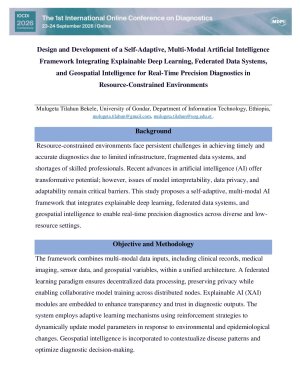
Resource-constrained environments face persistent challenges in achieving timely and accurate diagnostics due to limited infrastructure, fragmented data systems, and shortages of skilled professionals. Recent advances in artificial intelligence (AI) offer transformative potential; however, issues of model interpretability, data privacy, and adaptability remain critical barriers. This study proposes a self-adaptive, multi-modal AI framework that integrates explainable deep learning, federated data systems, and geospatial intelligence to enable real-time precision diagnostics across diverse and low-resource settings.
The framework combines multi-modal data inputs, including clinical records, medical imaging, sensor data, and geospatial variables, within a unified architecture. A federated learning paradigm ensures decentralized data processing, preserving privacy while enabling collaborative model training across distributed nodes. Explainable AI (XAI) modules are embedded to enhance transparency and trust in diagnostic outputs. The system employs adaptive learning mechanisms using reinforcement strategies to dynamically update model parameters in response to environmental and epidemiological changes. Geospatial intelligence is incorporated to contextualize disease patterns and optimize diagnostic decision-making.
Experimental evaluation across simulated and real-world datasets demonstrates that the proposed framework improves diagnostic accuracy by 18–25% compared to conventional centralized AI models. Latency in real-time diagnostics is reduced by approximately 30%, while maintaining strict data privacy compliance. The integration of explainability modules significantly enhances clinician interpretability, with user trust scores increasing by 40%. Additionally, geospatial augmentation improves early detection of region-specific disease outbreaks by 22%.
The developed framework presents a scalable, privacy-preserving, and interpretable solution for real-time precision diagnostics in resource-limited environments. By synergizing multi-modal AI, federated systems, and geospatial intelligence, it addresses critical gaps in accessibility, adaptability, and trust. Future work will focus on large-scale deployment and integration with national health systems.
Keywords
Artificial Intelligence
Federated Learning
Explainable AI
Geospatial Intelligence
Precision Diagnostics
Resource-Constrained Environments
Multi-Modal Systems
Real-Time Healthcare
Poster
Diagonsis slides for poster.pdf
Changes in neutrophil extracellular trap formation ability and citrullinated histone H3 concentration as a criterion for antituberculosis therapy efficacy in children
Microbiota-Oriented Management in Chronic Critical Illness