Event submissions
Published
This submission belongs to the session S4. Clinical Diagnosis and Prognosis of the event The 1st International Online Conference on Diagnostics
Published date
18 Sep, 2026
Academic Editor
'%3e%3cpath%20d='M12.6657%2010.9104C12.4185%2010.325%2012.0599%209.79327%2011.6097%209.34482C11.1609%208.89508%2010.6293%208.5365%2010.0442%208.28888C10.0389%208.28626%2010.0337%208.28495%2010.0285%208.28233C10.8446%207.69279%2011.3752%206.73249%2011.3752%205.64904C11.3752%203.8542%209.92103%202.39999%208.1262%202.39999C6.33136%202.39999%204.87715%203.8542%204.87715%205.64904C4.87715%206.73249%205.40774%207.69279%206.22393%208.28364C6.21869%208.28626%206.21345%208.28757%206.20821%208.29019C5.62129%208.5378%205.09463%208.89284%204.64265%209.34613C4.1929%209.79493%203.83432%2010.3266%203.58671%2010.9117C3.34345%2011.4845%203.21226%2012.0987%203.20023%2012.7209C3.19988%2012.7349%203.20233%2012.7488%203.20744%2012.7619C3.21255%2012.7749%203.22022%2012.7867%203.22998%2012.7968C3.23975%2012.8068%203.25142%2012.8147%203.26431%2012.8202C3.2772%2012.8256%203.29105%2012.8284%203.30504%2012.8284H4.09109C4.14874%2012.8284%204.19459%2012.7825%204.1959%2012.7262C4.2221%2011.7148%204.62823%2010.7676%205.34617%2010.0497C6.08899%209.30683%207.0755%208.89808%208.1262%208.89808C9.17689%208.89808%2010.1634%209.30683%2010.9062%2010.0497C11.6242%2010.7676%2012.0303%2011.7148%2012.0565%2012.7262C12.0578%2012.7838%2012.1037%2012.8284%2012.1613%2012.8284H12.9474C12.9613%2012.8284%2012.9752%2012.8256%2012.9881%2012.8202C13.001%2012.8147%2013.0126%2012.8068%2013.0224%2012.7968C13.0322%2012.7867%2013.0398%2012.7749%2013.0449%2012.7619C13.0501%2012.7488%2013.0525%2012.7349%2013.0522%2012.7209C13.0391%2012.0947%2012.9094%2011.4855%2012.6657%2010.9104ZM8.1262%207.9024C7.52486%207.9024%206.9589%207.6679%206.53312%207.24211C6.10733%206.81633%205.87283%206.25037%205.87283%205.64904C5.87283%205.0477%206.10733%204.48174%206.53312%204.05596C6.9589%203.63018%207.52486%203.39567%208.1262%203.39567C8.72753%203.39567%209.29349%203.63018%209.71927%204.05596C10.1451%204.48174%2010.3796%205.0477%2010.3796%205.64904C10.3796%206.25037%2010.1451%206.81633%209.71927%207.24211C9.29349%207.6679%208.72753%207.9024%208.1262%207.9024Z'%20fill='%235D1EE1'/%3e%3c/g%3e%3c/svg%3e) Elad Asher
Elad AsherCitation
Alexander Shatskiy, Vadim Tseylikman, Mikhail Alshibaya †, Predictors of Arrhythmias Following the Dor Procedure in Patients with Left Ventricular Aneurysms, in Proceedings of The 1st International Online Conference on Diagnostics, 23 September–24 September 2026, MDPI: Basel, Switzerland
Share
Email
Facebook
Twitter
LinkedIn
Predictors of Arrhythmias Following the Dor Procedure in Patients with Left Ventricular Aneurysms
'%3e%3cpath%20d='M12.6647%2010.9104C12.4176%2010.325%2012.0589%209.7933%2011.6088%209.34485C11.16%208.89511%2010.6283%208.53653%2010.0432%208.28891C10.038%208.28629%2010.0327%208.28498%2010.0275%208.28236C10.8437%207.69282%2011.3743%206.73252%2011.3743%205.64907C11.3743%203.85423%209.92005%202.40002%208.12522%202.40002C6.33038%202.40002%204.87618%203.85423%204.87618%205.64907C4.87618%206.73252%205.40677%207.69282%206.22296%208.28367C6.21772%208.28629%206.21248%208.2876%206.20724%208.29022C5.62031%208.53783%205.09365%208.89287%204.64167%209.34616C4.19192%209.79496%203.83334%2010.3266%203.58573%2010.9117C3.34247%2011.4846%203.21128%2012.0987%203.19925%2012.721C3.1989%2012.735%203.20135%2012.7489%203.20646%2012.7619C3.21157%2012.7749%203.21924%2012.7868%203.22901%2012.7968C3.23877%2012.8068%203.25045%2012.8148%203.26334%2012.8202C3.27623%2012.8256%203.29007%2012.8284%203.30406%2012.8284H4.09012C4.14776%2012.8284%204.19362%2012.7825%204.19493%2012.7262C4.22113%2011.7148%204.62726%2010.7676%205.34519%2010.0497C6.08802%209.30686%207.07452%208.89811%208.12522%208.89811C9.17592%208.89811%2010.1624%209.30686%2010.9052%2010.0497C11.6232%2010.7676%2012.0293%2011.7148%2012.0555%2012.7262C12.0568%2012.7839%2012.1027%2012.8284%2012.1603%2012.8284H12.9464C12.9604%2012.8284%2012.9742%2012.8256%2012.9871%2012.8202C13%2012.8148%2013.0117%2012.8068%2013.0214%2012.7968C13.0312%2012.7868%2013.0389%2012.7749%2013.044%2012.7619C13.0491%2012.7489%2013.0515%2012.735%2013.0512%2012.721C13.0381%2012.0947%2012.9084%2011.4856%2012.6647%2010.9104ZM8.12522%207.90243C7.52388%207.90243%206.95792%207.66793%206.53214%207.24215C6.10636%206.81636%205.87185%206.2504%205.87185%205.64907C5.87185%205.04773%206.10636%204.48177%206.53214%204.05599C6.95792%203.63021%207.52388%203.3957%208.12522%203.3957C8.72655%203.3957%209.29252%203.63021%209.7183%204.05599C10.1441%204.48177%2010.3786%205.04773%2010.3786%205.64907C10.3786%206.2504%2010.1441%206.81636%209.7183%207.24215C9.29252%207.66793%208.72655%207.90243%208.12522%207.90243Z'%20fill='%235D1EE1'/%3e%3c/g%3e%3c/svg%3e)
Alexander Shatskiy 1,2
Vadim Tseylikman 1
Mikhail Alshibaya † 2
1. Faculty of Fundamental Medicine, Chelyabinsk State University, Chelyabinsk, Russia
2. Bakulev Scientific Center of Cardiovascular Surgery, Moscow, Russia
Abstract
Introduction
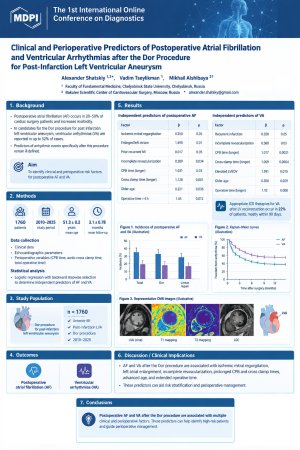
Postoperative atrial fibrillation (AF) occurs in 20–50% of cardiac surgery patients and increases morbidity. In candidates for the Dor procedure for post infarction left ventricular aneurysm, ventricular arrhythmias (VA) are reported in up to 52% of cases. However, predictors of arrhythmic events specifically after this procedure remain ill defined. We aimed to identify clinical and perioperative risk factors for postoperative AF and VA.
Methods
We included 1760 patients who underwent the Dor procedure between 2010 and 2025. Mean age was 51.3±0.2 years; mean follow up was 3.1±0.78 months. We analyzed clinical data, echocardiographic parameters, and perioperative variables—including cardiopulmonary bypass (CPB) time, aortic cross clamp time, and total operative time. We used logistic regression with backward stepwise selection to determine independent predictors of AF and VA.
Results
Independent predictors of postoperative AF were: ischemic mitral regurgitation (β=0.250, p=0.05), enlarged left atrium (β=1.490, p=0.01), prior recurrent myocardial infarction (β=0.017, p=0.05), incomplete revascularization (β=0.289, p=0.034), longer CPB time (β=1.031, p=0.03), longer aortic cross clamp time (β=1.128, p=0.001), older age (β=0.221, p=0.036), and prolonged total operative time (>4 h) (β=1.65, p=0.012).
For VA, predictors were: recurrent infarction (β=0.320, p=0.05), incomplete revascularization (β=0.580, p=0.03), longer CPB time (β=1.017, p=0.0021), longer cross clamp time (β=1.059, p=0.0004), elevated LV end diastolic volume (β=1.591, p=0.015), older age (β=0.350, p=0.029), and prolonged operative time (β=1.92, p=0.008). Appropriate ICD therapies for VA after LV reconstruction occur in 22% of patients, mostly within 90 days.
Conclusions
Postoperative AF and VA after the Dor procedure are associated with ischemic mitral regurgitation, left atrial enlargement, incomplete revascularization, prolonged CPB and cross clamp times, advanced age, and extended operative time. These predictors can aid risk stratification and perioperative management.
Keywords
Dor procedure
left ventricular aneurysm
atrial fibrillation
ventricular arrhythmias
risk factors
Poster
MDPI_Diagnostics_poster_Shatskiy et al.pdf
Microbiota-Oriented Management in Chronic Critical Illness
Prediction of Risk for Life-Threatening Cancers and Chronic Diseases Using Machine Learning Driven by Routine Blood Markers