Event submissions
Published
This submission belongs to the session S6. Artificial Intelligence in Diagnostics of the event The 1st International Online Conference on Diagnostics
Published date
18 Sep, 2026
Academic Editor
'%3e%3cpath%20d='M12.6657%2010.9104C12.4185%2010.325%2012.0599%209.79327%2011.6097%209.34482C11.1609%208.89508%2010.6293%208.5365%2010.0442%208.28888C10.0389%208.28626%2010.0337%208.28495%2010.0285%208.28233C10.8446%207.69279%2011.3752%206.73249%2011.3752%205.64904C11.3752%203.8542%209.92103%202.39999%208.1262%202.39999C6.33136%202.39999%204.87715%203.8542%204.87715%205.64904C4.87715%206.73249%205.40774%207.69279%206.22393%208.28364C6.21869%208.28626%206.21345%208.28757%206.20821%208.29019C5.62129%208.5378%205.09463%208.89284%204.64265%209.34613C4.1929%209.79493%203.83432%2010.3266%203.58671%2010.9117C3.34345%2011.4845%203.21226%2012.0987%203.20023%2012.7209C3.19988%2012.7349%203.20233%2012.7488%203.20744%2012.7619C3.21255%2012.7749%203.22022%2012.7867%203.22998%2012.7968C3.23975%2012.8068%203.25142%2012.8147%203.26431%2012.8202C3.2772%2012.8256%203.29105%2012.8284%203.30504%2012.8284H4.09109C4.14874%2012.8284%204.19459%2012.7825%204.1959%2012.7262C4.2221%2011.7148%204.62823%2010.7676%205.34617%2010.0497C6.08899%209.30683%207.0755%208.89808%208.1262%208.89808C9.17689%208.89808%2010.1634%209.30683%2010.9062%2010.0497C11.6242%2010.7676%2012.0303%2011.7148%2012.0565%2012.7262C12.0578%2012.7838%2012.1037%2012.8284%2012.1613%2012.8284H12.9474C12.9613%2012.8284%2012.9752%2012.8256%2012.9881%2012.8202C13.001%2012.8147%2013.0126%2012.8068%2013.0224%2012.7968C13.0322%2012.7867%2013.0398%2012.7749%2013.0449%2012.7619C13.0501%2012.7488%2013.0525%2012.7349%2013.0522%2012.7209C13.0391%2012.0947%2012.9094%2011.4855%2012.6657%2010.9104ZM8.1262%207.9024C7.52486%207.9024%206.9589%207.6679%206.53312%207.24211C6.10733%206.81633%205.87283%206.25037%205.87283%205.64904C5.87283%205.0477%206.10733%204.48174%206.53312%204.05596C6.9589%203.63018%207.52486%203.39567%208.1262%203.39567C8.72753%203.39567%209.29349%203.63018%209.71927%204.05596C10.1451%204.48174%2010.3796%205.0477%2010.3796%205.64904C10.3796%206.25037%2010.1451%206.81633%209.71927%207.24211C9.29349%207.6679%208.72753%207.9024%208.1262%207.9024Z'%20fill='%235D1EE1'/%3e%3c/g%3e%3c/svg%3e) Zhongheng Zhang
Zhongheng ZhangCitation
Oussama El Othmani, Cross-Modal Attention Fusion for Objective Pain Assessment in Neonatal Intensive Care: A Real-Time Deep Learning Framework, in Proceedings of The 1st International Online Conference on Diagnostics, 23 September–24 September 2026, MDPI: Basel, Switzerland
Share
Email
Facebook
Twitter
LinkedIn
Cross-Modal Attention Fusion for Objective Pain Assessment in Neonatal Intensive Care: A Real-Time Deep Learning Framework
'%3e%3cpath%20d='M12.6647%2010.9104C12.4176%2010.325%2012.0589%209.7933%2011.6088%209.34485C11.16%208.89511%2010.6283%208.53653%2010.0432%208.28891C10.038%208.28629%2010.0327%208.28498%2010.0275%208.28236C10.8437%207.69282%2011.3743%206.73252%2011.3743%205.64907C11.3743%203.85423%209.92005%202.40002%208.12522%202.40002C6.33038%202.40002%204.87618%203.85423%204.87618%205.64907C4.87618%206.73252%205.40677%207.69282%206.22296%208.28367C6.21772%208.28629%206.21248%208.2876%206.20724%208.29022C5.62031%208.53783%205.09365%208.89287%204.64167%209.34616C4.19192%209.79496%203.83334%2010.3266%203.58573%2010.9117C3.34247%2011.4846%203.21128%2012.0987%203.19925%2012.721C3.1989%2012.735%203.20135%2012.7489%203.20646%2012.7619C3.21157%2012.7749%203.21924%2012.7868%203.22901%2012.7968C3.23877%2012.8068%203.25045%2012.8148%203.26334%2012.8202C3.27623%2012.8256%203.29007%2012.8284%203.30406%2012.8284H4.09012C4.14776%2012.8284%204.19362%2012.7825%204.19493%2012.7262C4.22113%2011.7148%204.62726%2010.7676%205.34519%2010.0497C6.08802%209.30686%207.07452%208.89811%208.12522%208.89811C9.17592%208.89811%2010.1624%209.30686%2010.9052%2010.0497C11.6232%2010.7676%2012.0293%2011.7148%2012.0555%2012.7262C12.0568%2012.7839%2012.1027%2012.8284%2012.1603%2012.8284H12.9464C12.9604%2012.8284%2012.9742%2012.8256%2012.9871%2012.8202C13%2012.8148%2013.0117%2012.8068%2013.0214%2012.7968C13.0312%2012.7868%2013.0389%2012.7749%2013.044%2012.7619C13.0491%2012.7489%2013.0515%2012.735%2013.0512%2012.721C13.0381%2012.0947%2012.9084%2011.4856%2012.6647%2010.9104ZM8.12522%207.90243C7.52388%207.90243%206.95792%207.66793%206.53214%207.24215C6.10636%206.81636%205.87185%206.2504%205.87185%205.64907C5.87185%205.04773%206.10636%204.48177%206.53214%204.05599C6.95792%203.63021%207.52388%203.3957%208.12522%203.3957C8.72655%203.3957%209.29252%203.63021%209.7183%204.05599C10.1441%204.48177%2010.3786%205.04773%2010.3786%205.64907C10.3786%206.2504%2010.1441%206.81636%209.7183%207.24215C9.29252%207.66793%208.72655%207.90243%208.12522%207.90243Z'%20fill='%235D1EE1'/%3e%3c/g%3e%3c/svg%3e)
Oussama El Othmani 1,2
1. Computer Science Department, Military Academy of Fondouk Jedid, Nabeul, 8012
2. Military Research Center, Polytechnic School of Tunisia, University of Carthage, La Marsa, 2078
Abstract
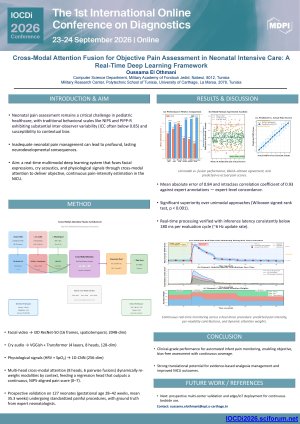
Introduction: Neonatal pain assessment remains a critical challenge in pediatric healthcare, with traditional behavioral scales like NIPS and PIPP-R exhibiting substantial inter-observer variability (ICC often below 0.85) and susceptibility to contextual bias. Inadequate pain management during the neonatal period can lead to profound neurodevelopmental consequences. This study introduces a novel real-time multimodal deep learning system that integrates facial expressions, cry acoustics, and physiological signals through advanced cross-modal attention mechanisms to achieve objective, continuous pain intensity estimation in clinical NICU environments.
Methods: Our framework employs three specialized deep neural encoders: an Inflated 3D-ResNet-50 architecture processing 16-frame video sequences for spatiotemporal facial analysis, a VGGish-Transformer hybrid extracting acoustic features from cry spectrograms, and a 1D convolutional network analyzing heart rate variability and oxygen saturation patterns. A novel multi-head cross-modal attention module dynamically weighs and fuses heterogeneous feature representations before final regression to continuous pain scores aligned with clinical NIPS assessments. We conducted prospective validation on 127 neonates (gestational age range: 28-42 weeks, mean: 35.3 weeks) undergoing standardized painful procedures, with ground truth established by expert neonatologists demonstrating high inter-rater reliability.
Results: The integrated system achieved mean absolute error of 0.84 and intraclass correlation coefficient of 0.93 versus expert annotations, representing expert-level concordance. Statistical testing confirmed significant superiority over unimodal approaches (Wilcoxon signed-rank, p < 0.001). Real-time processing capability was verified with inference latency consistently below 180 milliseconds per evaluation cycle.
Conclusions: This cross-modal attention framework demonstrates clinical-grade performance for automated infant pain monitoring, enabling objective, bias-free assessment with continuous monitoring capability. The system shows strong translational potential for evidence-based analgesia management and improved patient outcomes in neonatal intensive care.
Keywords
neonatal pain monitoring
cross-modal attention
multimodal deep learning
real-time AI diagnostics
NICU clinical applications
objective pain assessment
Poster
IOCDi2026_Poster_Sciforum-165290.pdf
Generating clinical cases for diagnosing urgent conditions using artificial intelligence: opportunities for clinical practice
Integrative Genetic, Transcriptomic, and Clinical Hematological Determinants of Portal Vein Tumor Thrombus in HCC-Integrative Analysis of Multi-Omics Data and Clinical Hematology Reveals Molecular Mechanisms and Biomarkers for Portal Vein Tumor Thrombus in Hepatocellular Carcinoma.