Event submissions
Published
This submission belongs to the session S3. Laboratory medicine of the event The 1st International Online Conference on Diagnostics
Published date
18 Sep, 2026
Academic Editor
'%3e%3cpath%20d='M12.6657%2010.9104C12.4185%2010.325%2012.0599%209.79327%2011.6097%209.34482C11.1609%208.89508%2010.6293%208.5365%2010.0442%208.28888C10.0389%208.28626%2010.0337%208.28495%2010.0285%208.28233C10.8446%207.69279%2011.3752%206.73249%2011.3752%205.64904C11.3752%203.8542%209.92103%202.39999%208.1262%202.39999C6.33136%202.39999%204.87715%203.8542%204.87715%205.64904C4.87715%206.73249%205.40774%207.69279%206.22393%208.28364C6.21869%208.28626%206.21345%208.28757%206.20821%208.29019C5.62129%208.5378%205.09463%208.89284%204.64265%209.34613C4.1929%209.79493%203.83432%2010.3266%203.58671%2010.9117C3.34345%2011.4845%203.21226%2012.0987%203.20023%2012.7209C3.19988%2012.7349%203.20233%2012.7488%203.20744%2012.7619C3.21255%2012.7749%203.22022%2012.7867%203.22998%2012.7968C3.23975%2012.8068%203.25142%2012.8147%203.26431%2012.8202C3.2772%2012.8256%203.29105%2012.8284%203.30504%2012.8284H4.09109C4.14874%2012.8284%204.19459%2012.7825%204.1959%2012.7262C4.2221%2011.7148%204.62823%2010.7676%205.34617%2010.0497C6.08899%209.30683%207.0755%208.89808%208.1262%208.89808C9.17689%208.89808%2010.1634%209.30683%2010.9062%2010.0497C11.6242%2010.7676%2012.0303%2011.7148%2012.0565%2012.7262C12.0578%2012.7838%2012.1037%2012.8284%2012.1613%2012.8284H12.9474C12.9613%2012.8284%2012.9752%2012.8256%2012.9881%2012.8202C13.001%2012.8147%2013.0126%2012.8068%2013.0224%2012.7968C13.0322%2012.7867%2013.0398%2012.7749%2013.0449%2012.7619C13.0501%2012.7488%2013.0525%2012.7349%2013.0522%2012.7209C13.0391%2012.0947%2012.9094%2011.4855%2012.6657%2010.9104ZM8.1262%207.9024C7.52486%207.9024%206.9589%207.6679%206.53312%207.24211C6.10733%206.81633%205.87283%206.25037%205.87283%205.64904C5.87283%205.0477%206.10733%204.48174%206.53312%204.05596C6.9589%203.63018%207.52486%203.39567%208.1262%203.39567C8.72753%203.39567%209.29349%203.63018%209.71927%204.05596C10.1451%204.48174%2010.3796%205.0477%2010.3796%205.64904C10.3796%206.25037%2010.1451%206.81633%209.71927%207.24211C9.29349%207.6679%208.72753%207.9024%208.1262%207.9024Z'%20fill='%235D1EE1'/%3e%3c/g%3e%3c/svg%3e) Marijn M. Speeckaert
Marijn M. SpeeckaertCitation
Xiumei Lin, Yanling Liu, Guowei He, Integrative Genetic, Transcriptomic, and Clinical Hematological Determinants of Portal Vein Tumor Thrombus in HCC-Integrative Analysis of Multi-Omics Data and Clinical Hematology Reveals Molecular Mechanisms and Biomarkers for Portal Vein Tumor Thrombus in Hepatocellular Carcinoma., in Proceedings of The 1st International Online Conference on Diagnostics, 23 September–24 September 2026, MDPI: Basel, Switzerland
Share
Email
Facebook
Twitter
LinkedIn
Integrative Genetic, Transcriptomic, and Clinical Hematological Determinants of Portal Vein Tumor Thrombus in HCC-Integrative Analysis of Multi-Omics Data and Clinical Hematology Reveals Molecular Mechanisms and Biomarkers for Portal Vein Tumor Thrombus in Hepatocellular Carcinoma.
'%3e%3cpath%20d='M12.6647%2010.9104C12.4176%2010.325%2012.0589%209.7933%2011.6088%209.34485C11.16%208.89511%2010.6283%208.53653%2010.0432%208.28891C10.038%208.28629%2010.0327%208.28498%2010.0275%208.28236C10.8437%207.69282%2011.3743%206.73252%2011.3743%205.64907C11.3743%203.85423%209.92005%202.40002%208.12522%202.40002C6.33038%202.40002%204.87618%203.85423%204.87618%205.64907C4.87618%206.73252%205.40677%207.69282%206.22296%208.28367C6.21772%208.28629%206.21248%208.2876%206.20724%208.29022C5.62031%208.53783%205.09365%208.89287%204.64167%209.34616C4.19192%209.79496%203.83334%2010.3266%203.58573%2010.9117C3.34247%2011.4846%203.21128%2012.0987%203.19925%2012.721C3.1989%2012.735%203.20135%2012.7489%203.20646%2012.7619C3.21157%2012.7749%203.21924%2012.7868%203.22901%2012.7968C3.23877%2012.8068%203.25045%2012.8148%203.26334%2012.8202C3.27623%2012.8256%203.29007%2012.8284%203.30406%2012.8284H4.09012C4.14776%2012.8284%204.19362%2012.7825%204.19493%2012.7262C4.22113%2011.7148%204.62726%2010.7676%205.34519%2010.0497C6.08802%209.30686%207.07452%208.89811%208.12522%208.89811C9.17592%208.89811%2010.1624%209.30686%2010.9052%2010.0497C11.6232%2010.7676%2012.0293%2011.7148%2012.0555%2012.7262C12.0568%2012.7839%2012.1027%2012.8284%2012.1603%2012.8284H12.9464C12.9604%2012.8284%2012.9742%2012.8256%2012.9871%2012.8202C13%2012.8148%2013.0117%2012.8068%2013.0214%2012.7968C13.0312%2012.7868%2013.0389%2012.7749%2013.044%2012.7619C13.0491%2012.7489%2013.0515%2012.735%2013.0512%2012.721C13.0381%2012.0947%2012.9084%2011.4856%2012.6647%2010.9104ZM8.12522%207.90243C7.52388%207.90243%206.95792%207.66793%206.53214%207.24215C6.10636%206.81636%205.87185%206.2504%205.87185%205.64907C5.87185%205.04773%206.10636%204.48177%206.53214%204.05599C6.95792%203.63021%207.52388%203.3957%208.12522%203.3957C8.72655%203.3957%209.29252%203.63021%209.7183%204.05599C10.1441%204.48177%2010.3786%205.04773%2010.3786%205.64907C10.3786%206.2504%2010.1441%206.81636%209.7183%207.24215C9.29252%207.66793%208.72655%207.90243%208.12522%207.90243Z'%20fill='%235D1EE1'/%3e%3c/g%3e%3c/svg%3e)
Xiumei Lin 1
Yanling Liu 1
Guowei He 1
1. The Third Affiliated Hospital, Sun Yat-sen University, Guangzhou, China
Abstract
Abstract
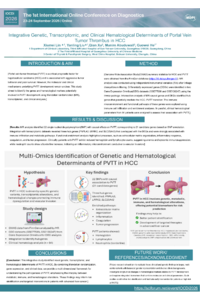
Background: Portal vein tumor thrombus (PVTT) is a critical prognostic factor in hepatocellular carcinoma (HCC), associated with aggressive tumor behavior and poor survival. However, the molecular and clinical mechanisms underlying PVTT formation remain unclear. This study aimed to identify genes and hematological markers potentially involved in PVTT development using Mendelian randomization (MR), transcriptomic, and clinical analyses.
Methods: GWAS summary statistics for HCC and PVTT were obtained from the FinnGen database (https://r9.risteys.finngen.fi/). MR analysis was conducted using independent instrumental variables (IVs) after linkage disequilibrium filtering. Differentially expressed genes (DEGs) were identified from two GEO datasets (GSE77509 and GSE136247) using the limma package. Intersection analysis of MR-causal genes and DEGs identified hub genes potentially mediating the HCC–PVTT transition. Immune microenvironment and functional pathways of these genes were explored using immune infiltration and enrichment analyses. In parallel, clinical hematological parameters from 94 patients were analyzed to assess their association with PVTT.
Results: MR analysis identified 22 SNPs with causal effects of HCC on PVTT, corresponding to 21 candidate genes based on SNP annotation. Integration with transcriptomic datasets revealed three hub genes—PNPLA3, LRRK2, and SLC25A42—that overlapped with DEGs and were strongly associated with immune infiltration and metabolic pathways. Functional enrichment analysis highlighted processes such as extracellular matrix organization, inflammatory response, coagulation, and tumor progression. Clinically, patients with PVTT exhibited reduced hemoglobin and lymphocyte counts, suggesting anemia and systemic immunosuppression, while neutrophil counts showed a borderline increase, indicating an inflammatory microenvironment conducive to vascular invasion.
Conclusion: This integrative study identifies novel genetic, transcriptomic, and hematological determinants of PVTT in HCC. By combining Mendelian randomization, gene expression, and clinical data, we provide a multidimensional framework for understanding PVTT pathogenesis, emphasizing the interplay between metabolic, immune, and hematological alterations. These findings may inform risk stratification and targeted interventions for patients with advanced liver cancer.
Keywords
Hepatocellular carcinoma
Portal vein tumor thrombus
Mendelian randomization
Transcriptomics
Hematological markers
Immune infiltration
Poster
HCC0622-post.pdf
Cross-Modal Attention Fusion for Objective Pain Assessment in Neonatal Intensive Care: A Real-Time Deep Learning Framework
Computational and Experimental Antibody Affinity Quantification of SARS-CoV-2 SD2 Major Disulfide Loop