Event submissions
Published
This submission belongs to the session S3. Energy, Electronics, and Magnetic Materials of the event The 6th International Conference on Materials
Published date
21 Sep, 2026
Academic Editor
'%3e%3cpath%20d='M12.6657%2010.9104C12.4185%2010.325%2012.0599%209.79327%2011.6097%209.34482C11.1609%208.89508%2010.6293%208.5365%2010.0442%208.28888C10.0389%208.28626%2010.0337%208.28495%2010.0285%208.28233C10.8446%207.69279%2011.3752%206.73249%2011.3752%205.64904C11.3752%203.8542%209.92103%202.39999%208.1262%202.39999C6.33136%202.39999%204.87715%203.8542%204.87715%205.64904C4.87715%206.73249%205.40774%207.69279%206.22393%208.28364C6.21869%208.28626%206.21345%208.28757%206.20821%208.29019C5.62129%208.5378%205.09463%208.89284%204.64265%209.34613C4.1929%209.79493%203.83432%2010.3266%203.58671%2010.9117C3.34345%2011.4845%203.21226%2012.0987%203.20023%2012.7209C3.19988%2012.7349%203.20233%2012.7488%203.20744%2012.7619C3.21255%2012.7749%203.22022%2012.7867%203.22998%2012.7968C3.23975%2012.8068%203.25142%2012.8147%203.26431%2012.8202C3.2772%2012.8256%203.29105%2012.8284%203.30504%2012.8284H4.09109C4.14874%2012.8284%204.19459%2012.7825%204.1959%2012.7262C4.2221%2011.7148%204.62823%2010.7676%205.34617%2010.0497C6.08899%209.30683%207.0755%208.89808%208.1262%208.89808C9.17689%208.89808%2010.1634%209.30683%2010.9062%2010.0497C11.6242%2010.7676%2012.0303%2011.7148%2012.0565%2012.7262C12.0578%2012.7838%2012.1037%2012.8284%2012.1613%2012.8284H12.9474C12.9613%2012.8284%2012.9752%2012.8256%2012.9881%2012.8202C13.001%2012.8147%2013.0126%2012.8068%2013.0224%2012.7968C13.0322%2012.7867%2013.0398%2012.7749%2013.0449%2012.7619C13.0501%2012.7488%2013.0525%2012.7349%2013.0522%2012.7209C13.0391%2012.0947%2012.9094%2011.4855%2012.6657%2010.9104ZM8.1262%207.9024C7.52486%207.9024%206.9589%207.6679%206.53312%207.24211C6.10733%206.81633%205.87283%206.25037%205.87283%205.64904C5.87283%205.0477%206.10733%204.48174%206.53312%204.05596C6.9589%203.63018%207.52486%203.39567%208.1262%203.39567C8.72753%203.39567%209.29349%203.63018%209.71927%204.05596C10.1451%204.48174%2010.3796%205.0477%2010.3796%205.64904C10.3796%206.25037%2010.1451%206.81633%209.71927%207.24211C9.29349%207.6679%208.72753%207.9024%208.1262%207.9024Z'%20fill='%235D1EE1'/%3e%3c/g%3e%3c/svg%3e) Ingo Dierking
Ingo DierkingCitation
Luqman O Animasahun, Saheed A Adewinbi, Omar H Abd-Elkader, Vusani M Maphiri, Haekyonug Kim, Bidini A Taleatu, Some protonated mixed metal oxide electrodes for charge storage enhancement in ASSSC devices, in Proceedings of The 6th International Conference on Materials, Manchester, 16 September–18 September 2026, MDPI: Basel, Switzerland
Share
Email
Facebook
Twitter
LinkedIn
Some protonated mixed metal oxide electrodes for charge storage enhancement in ASSSC devices
'%3e%3cpath%20d='M12.6647%2010.9104C12.4176%2010.325%2012.0589%209.7933%2011.6088%209.34485C11.16%208.89511%2010.6283%208.53653%2010.0432%208.28891C10.038%208.28629%2010.0327%208.28498%2010.0275%208.28236C10.8437%207.69282%2011.3743%206.73252%2011.3743%205.64907C11.3743%203.85423%209.92005%202.40002%208.12522%202.40002C6.33038%202.40002%204.87618%203.85423%204.87618%205.64907C4.87618%206.73252%205.40677%207.69282%206.22296%208.28367C6.21772%208.28629%206.21248%208.2876%206.20724%208.29022C5.62031%208.53783%205.09365%208.89287%204.64167%209.34616C4.19192%209.79496%203.83334%2010.3266%203.58573%2010.9117C3.34247%2011.4846%203.21128%2012.0987%203.19925%2012.721C3.1989%2012.735%203.20135%2012.7489%203.20646%2012.7619C3.21157%2012.7749%203.21924%2012.7868%203.22901%2012.7968C3.23877%2012.8068%203.25045%2012.8148%203.26334%2012.8202C3.27623%2012.8256%203.29007%2012.8284%203.30406%2012.8284H4.09012C4.14776%2012.8284%204.19362%2012.7825%204.19493%2012.7262C4.22113%2011.7148%204.62726%2010.7676%205.34519%2010.0497C6.08802%209.30686%207.07452%208.89811%208.12522%208.89811C9.17592%208.89811%2010.1624%209.30686%2010.9052%2010.0497C11.6232%2010.7676%2012.0293%2011.7148%2012.0555%2012.7262C12.0568%2012.7839%2012.1027%2012.8284%2012.1603%2012.8284H12.9464C12.9604%2012.8284%2012.9742%2012.8256%2012.9871%2012.8202C13%2012.8148%2013.0117%2012.8068%2013.0214%2012.7968C13.0312%2012.7868%2013.0389%2012.7749%2013.044%2012.7619C13.0491%2012.7489%2013.0515%2012.735%2013.0512%2012.721C13.0381%2012.0947%2012.9084%2011.4856%2012.6647%2010.9104ZM8.12522%207.90243C7.52388%207.90243%206.95792%207.66793%206.53214%207.24215C6.10636%206.81636%205.87185%206.2504%205.87185%205.64907C5.87185%205.04773%206.10636%204.48177%206.53214%204.05599C6.95792%203.63021%207.52388%203.3957%208.12522%203.3957C8.72655%203.3957%209.29252%203.63021%209.7183%204.05599C10.1441%204.48177%2010.3786%205.04773%2010.3786%205.64907C10.3786%206.2504%2010.1441%206.81636%209.7183%207.24215C9.29252%207.66793%208.72655%207.90243%208.12522%207.90243Z'%20fill='%235D1EE1'/%3e%3c/g%3e%3c/svg%3e)
Luqman O Animasahun 1,2
Saheed A Adewinbi 3,4
Omar H Abd-Elkader 5
Vusani M Maphiri 6
Haekyonug Kim 4
Bidini A Taleatu 2
1. Department of Physics, Electronics and Earth Sciences, Fountain University Osogbo, Nigeria
2. Department of Physics and Engineering Physics, Obafemi Awolowo University, Ile-Ife, 220005, Nigeria
3. Department of Physics, Osun State University, Osogbo 210001, Nigeria
4. Instituto de Física, Facultad de Física, Pontificia Universidad Católica de Chile, Casilla 306, Santiago, Chile.
5. Department of Physics and Astronomy, College of Science, King Saud University, P.O. Box 2455, Riyadh 11451 Saudi Arabia
6. Department of Physics, Sefako Makgatho Health Science University, P. O. Box 94, Medunsa 0204 South Africa
Abstract
Proton batteries are promising and sustainable due to ease of electron intercalation in the active layer of its electrode materials. Therefore, we reported a defect-engineered WO3-x/WO3 pseudocapacitive electrode through scavenging of atomic sub-surface oxygen from WO3 film. The electrode combines improved mass load with enhanced ionic transport behavior. It demonstrates significantly lowered band energy of 2.11 eV and ability to absorb light more effectively in the visible spectrum. Binder-free coating of shear-structured Nb4+ implanted Nb2O5 (Nb2O5-x) sub-micron thin pseudocapacitive electrode with wide negative operating voltage (-1.20 V vs Ag/AgCl) was also obtained via low-temperature surface engineering process. The implanted electrode exhibits 3.5 mF/cm2 at 5 mV/s and 100% capacity retention after 3000 cycles, and 90 % of its capacity after 5000 cycles at constant charge-discharge test. We also developed a binder-free solution-grown Ni(OH)2/S@MnO2 heterostructured positrode via synergistic S@MnO2 pseudocapacitive and scaffolding Ni(OH)2 battery-type structure. A device encompassing the positrode and thermally reduced graphene oxide (TRGO) negatrode, exhibiting comparable areal capacitance (8.7 mF/cm2), high cell voltage (1.7 V) and areal energy density (3.542 μWh/cm2) at 0.1 mA/cm2 current density was fabricated. A good charge–discharge capacitance retention (87.1 % after 20,000 cycles) and voltage holding strength were also demonstrated. Transparent Ni-Co-Cu mixed metal oxide thin film was prepared by a facile electrodeposition process. Microstructural studies of the film revealed formation of seedlike nanosheet. It exhibits high specific capacitance and capacity of 1940.1 Fg-1 and 134.2 mAhg-1. It was utilized as positrode in a fabricated asymmetric solid state supercapattery (ASSSC) device with reduced graphene oxide (RGO) as negatrode. The device displayed good performance of cycling in high voltage window (0-1.6 V) over 20,000 charge-discharge cycles. Values of areal capacitance, energy and power density of 20.2 mF/cm2, 25.60 Wh/cm2 and 2344.42 W/cm2 are considerably high.
Keywords
Electrode
binder-less
pseudocapacitive
areal capacitance
charge–discharge
Poster
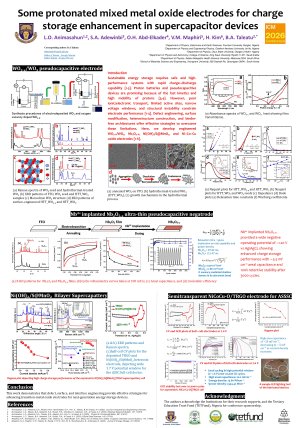
MMU B.A Taleatu Poster_091756.pdf
Laser-engineered PANI-derived Carbon TiO2 electrode for integrated photocharging µ-supercapacitor
Exploring the Versatile Roles of Inorganic Polyphosphate Materials in Biological Systems