Event submissions
Published
This submission belongs to the session S5. Periodontics and Implant Dentistry of the event The 1st International Online Conference on Dentistry
Published date
02 Oct, 2026
Academic Editor
'%3e%3cpath%20d='M12.6657%2010.9104C12.4185%2010.325%2012.0599%209.79327%2011.6097%209.34482C11.1609%208.89508%2010.6293%208.5365%2010.0442%208.28888C10.0389%208.28626%2010.0337%208.28495%2010.0285%208.28233C10.8446%207.69279%2011.3752%206.73249%2011.3752%205.64904C11.3752%203.8542%209.92103%202.39999%208.1262%202.39999C6.33136%202.39999%204.87715%203.8542%204.87715%205.64904C4.87715%206.73249%205.40774%207.69279%206.22393%208.28364C6.21869%208.28626%206.21345%208.28757%206.20821%208.29019C5.62129%208.5378%205.09463%208.89284%204.64265%209.34613C4.1929%209.79493%203.83432%2010.3266%203.58671%2010.9117C3.34345%2011.4845%203.21226%2012.0987%203.20023%2012.7209C3.19988%2012.7349%203.20233%2012.7488%203.20744%2012.7619C3.21255%2012.7749%203.22022%2012.7867%203.22998%2012.7968C3.23975%2012.8068%203.25142%2012.8147%203.26431%2012.8202C3.2772%2012.8256%203.29105%2012.8284%203.30504%2012.8284H4.09109C4.14874%2012.8284%204.19459%2012.7825%204.1959%2012.7262C4.2221%2011.7148%204.62823%2010.7676%205.34617%2010.0497C6.08899%209.30683%207.0755%208.89808%208.1262%208.89808C9.17689%208.89808%2010.1634%209.30683%2010.9062%2010.0497C11.6242%2010.7676%2012.0303%2011.7148%2012.0565%2012.7262C12.0578%2012.7838%2012.1037%2012.8284%2012.1613%2012.8284H12.9474C12.9613%2012.8284%2012.9752%2012.8256%2012.9881%2012.8202C13.001%2012.8147%2013.0126%2012.8068%2013.0224%2012.7968C13.0322%2012.7867%2013.0398%2012.7749%2013.0449%2012.7619C13.0501%2012.7488%2013.0525%2012.7349%2013.0522%2012.7209C13.0391%2012.0947%2012.9094%2011.4855%2012.6657%2010.9104ZM8.1262%207.9024C7.52486%207.9024%206.9589%207.6679%206.53312%207.24211C6.10733%206.81633%205.87283%206.25037%205.87283%205.64904C5.87283%205.0477%206.10733%204.48174%206.53312%204.05596C6.9589%203.63018%207.52486%203.39567%208.1262%203.39567C8.72753%203.39567%209.29349%203.63018%209.71927%204.05596C10.1451%204.48174%2010.3796%205.0477%2010.3796%205.64904C10.3796%206.25037%2010.1451%206.81633%209.71927%207.24211C9.29349%207.6679%208.72753%207.9024%208.1262%207.9024Z'%20fill='%235D1EE1'/%3e%3c/g%3e%3c/svg%3e) Fawad Javed
Fawad JavedCitation
Dimitar Dimitrov, Velitchka Dosseva-Panova, Ivanka Dimova, Dragomira Nikolova, Transcriptomic Signatures of Inflammation in Periodontitis: A Step Toward Molecular Markers of Disease Progression, in Proceedings of The 1st International Online Conference on Dentistry, 7 October–9 October 2026, MDPI: Basel, Switzerland
Share
Email
Facebook
Twitter
LinkedIn
Transcriptomic Signatures of Inflammation in Periodontitis: A Step Toward Molecular Markers of Disease Progression
'%3e%3cpath%20d='M12.6647%2010.9104C12.4176%2010.325%2012.0589%209.7933%2011.6088%209.34485C11.16%208.89511%2010.6283%208.53653%2010.0432%208.28891C10.038%208.28629%2010.0327%208.28498%2010.0275%208.28236C10.8437%207.69282%2011.3743%206.73252%2011.3743%205.64907C11.3743%203.85423%209.92005%202.40002%208.12522%202.40002C6.33038%202.40002%204.87618%203.85423%204.87618%205.64907C4.87618%206.73252%205.40677%207.69282%206.22296%208.28367C6.21772%208.28629%206.21248%208.2876%206.20724%208.29022C5.62031%208.53783%205.09365%208.89287%204.64167%209.34616C4.19192%209.79496%203.83334%2010.3266%203.58573%2010.9117C3.34247%2011.4846%203.21128%2012.0987%203.19925%2012.721C3.1989%2012.735%203.20135%2012.7489%203.20646%2012.7619C3.21157%2012.7749%203.21924%2012.7868%203.22901%2012.7968C3.23877%2012.8068%203.25045%2012.8148%203.26334%2012.8202C3.27623%2012.8256%203.29007%2012.8284%203.30406%2012.8284H4.09012C4.14776%2012.8284%204.19362%2012.7825%204.19493%2012.7262C4.22113%2011.7148%204.62726%2010.7676%205.34519%2010.0497C6.08802%209.30686%207.07452%208.89811%208.12522%208.89811C9.17592%208.89811%2010.1624%209.30686%2010.9052%2010.0497C11.6232%2010.7676%2012.0293%2011.7148%2012.0555%2012.7262C12.0568%2012.7839%2012.1027%2012.8284%2012.1603%2012.8284H12.9464C12.9604%2012.8284%2012.9742%2012.8256%2012.9871%2012.8202C13%2012.8148%2013.0117%2012.8068%2013.0214%2012.7968C13.0312%2012.7868%2013.0389%2012.7749%2013.044%2012.7619C13.0491%2012.7489%2013.0515%2012.735%2013.0512%2012.721C13.0381%2012.0947%2012.9084%2011.4856%2012.6647%2010.9104ZM8.12522%207.90243C7.52388%207.90243%206.95792%207.66793%206.53214%207.24215C6.10636%206.81636%205.87185%206.2504%205.87185%205.64907C5.87185%205.04773%206.10636%204.48177%206.53214%204.05599C6.95792%203.63021%207.52388%203.3957%208.12522%203.3957C8.72655%203.3957%209.29252%203.63021%209.7183%204.05599C10.1441%204.48177%2010.3786%205.04773%2010.3786%205.64907C10.3786%206.2504%2010.1441%206.81636%209.7183%207.24215C9.29252%207.66793%208.72655%207.90243%208.12522%207.90243Z'%20fill='%235D1EE1'/%3e%3c/g%3e%3c/svg%3e)
Dimitar Dimitrov 1
Velitchka Dosseva-Panova 1
Ivanka Dimova 2
Dragomira Nikolova 2
1. Department of Periodontology, Faculty of Dental Medicine, Medical University - Sofia, 1431 Sofia, Bulgaria
2. Department of Medical Genetics, Medical Faculty, Medical University – Sofia, 1431 Sofia, Bulgaria
Abstract
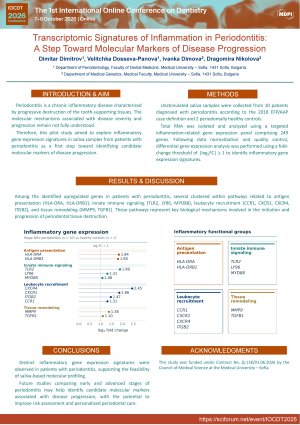
Introduction: Periodontitis is a chronic inflammatory disease characterized by progressive destruction of the tooth-supporting tissues. The molecular mechanisms associated with disease severity and progression remain not fully understood. Therefore, this pilot study aimed to explore inflammatory gene expression signatures in saliva samples from patients with periodontitis as a first step toward identifying candidate molecular markers of disease progression.
Methods: Unstimulated saliva samples were collected from 10 patients diagnosed with periodontitis according to the 2018 EFP/AAP case definition and
2 periodontally healthy controls. Total RNA was isolated and analyzed using a targeted inflammation-related gene expression panel comprising 249 genes. Following data normalization and quality control, differential gene expression analysis was performed using a fold-change threshold of |log2FC| ≥ 1 to identify inflammatory gene expression signatures.
Results: Among the identified upregulated genes in patients with periodontitis, several clustered within pathways related to antigen presentation (HLA-DRA, HLA-DRB1), innate immune signaling (TLR2, LY96, MYD88), leukocyte recruitment (CCR1, CXCR1, CXCR4, ITGB2), and tissue remodeling (MMP9, TGFB1). These pathways represent key biological mechanisms involved in the initiation and progression of periodontal tissue destruction.
Conclusions: Distinct inflammatory gene expression signatures were observed in patients with periodontitis, supporting the feasibility of saliva-based molecular profiling. Future studies comparing early and advanced stages of periodontitis may help identify candidate molecular markers associated with disease progression, with the potential to improve risk assessment and personalized periodontal care.
Acknowledgments: This study was funded under Contract No. Д-118/01.06.2026 by the Council of Medical Science at the Medical University – Sofia.
Keywords
Periodontitis
inflammation
gene expression profiling
disease progression
molecular markers
saliva
Poster
IOCDT2026-Poster_Transcriptomic signatures.pdf
Host-Dependent Modulation of Tinospora cordifolia and Its Antimicrobial Potential Against Oral Dysbiosis-Associated Microorganisms: An In Vitro Study
Knowledge and Attitudes Among Portuguese Dentists Regarding the Use of Safety Checklists