Event submissions
Published
This submission belongs to the session S4. Restorative Dentistry, Endodontics, and Dental Traumatology of the event The 1st International Online Conference on Dentistry
Published date
02 Oct, 2026
Academic Editor
'%3e%3cpath%20d='M12.6657%2010.9104C12.4185%2010.325%2012.0599%209.79327%2011.6097%209.34482C11.1609%208.89508%2010.6293%208.5365%2010.0442%208.28888C10.0389%208.28626%2010.0337%208.28495%2010.0285%208.28233C10.8446%207.69279%2011.3752%206.73249%2011.3752%205.64904C11.3752%203.8542%209.92103%202.39999%208.1262%202.39999C6.33136%202.39999%204.87715%203.8542%204.87715%205.64904C4.87715%206.73249%205.40774%207.69279%206.22393%208.28364C6.21869%208.28626%206.21345%208.28757%206.20821%208.29019C5.62129%208.5378%205.09463%208.89284%204.64265%209.34613C4.1929%209.79493%203.83432%2010.3266%203.58671%2010.9117C3.34345%2011.4845%203.21226%2012.0987%203.20023%2012.7209C3.19988%2012.7349%203.20233%2012.7488%203.20744%2012.7619C3.21255%2012.7749%203.22022%2012.7867%203.22998%2012.7968C3.23975%2012.8068%203.25142%2012.8147%203.26431%2012.8202C3.2772%2012.8256%203.29105%2012.8284%203.30504%2012.8284H4.09109C4.14874%2012.8284%204.19459%2012.7825%204.1959%2012.7262C4.2221%2011.7148%204.62823%2010.7676%205.34617%2010.0497C6.08899%209.30683%207.0755%208.89808%208.1262%208.89808C9.17689%208.89808%2010.1634%209.30683%2010.9062%2010.0497C11.6242%2010.7676%2012.0303%2011.7148%2012.0565%2012.7262C12.0578%2012.7838%2012.1037%2012.8284%2012.1613%2012.8284H12.9474C12.9613%2012.8284%2012.9752%2012.8256%2012.9881%2012.8202C13.001%2012.8147%2013.0126%2012.8068%2013.0224%2012.7968C13.0322%2012.7867%2013.0398%2012.7749%2013.0449%2012.7619C13.0501%2012.7488%2013.0525%2012.7349%2013.0522%2012.7209C13.0391%2012.0947%2012.9094%2011.4855%2012.6657%2010.9104ZM8.1262%207.9024C7.52486%207.9024%206.9589%207.6679%206.53312%207.24211C6.10733%206.81633%205.87283%206.25037%205.87283%205.64904C5.87283%205.0477%206.10733%204.48174%206.53312%204.05596C6.9589%203.63018%207.52486%203.39567%208.1262%203.39567C8.72753%203.39567%209.29349%203.63018%209.71927%204.05596C10.1451%204.48174%2010.3796%205.0477%2010.3796%205.64904C10.3796%206.25037%2010.1451%206.81633%209.71927%207.24211C9.29349%207.6679%208.72753%207.9024%208.1262%207.9024Z'%20fill='%235D1EE1'/%3e%3c/g%3e%3c/svg%3e) Claude Jaquiéry
Claude JaquiéryCitation
Smriti Aryal AC, Zuha Rizvi, K. G. Aghila Rani, Md Sofiqul Islam, Prostaglandin EP1 Receptor Antagonist Improves Human Dental Pulp Stem Cell Functions: A potential Therapeutic for Pulp Regeneration, in Proceedings of The 1st International Online Conference on Dentistry, 7 October–9 October 2026, MDPI: Basel, Switzerland
Share
Email
Facebook
Twitter
LinkedIn
Prostaglandin EP1 Receptor Antagonist Improves Human Dental Pulp Stem Cell Functions: A potential Therapeutic for Pulp Regeneration
Prostaglandin EP1 Receptor Antagonist Improves Human Dental Pulp Stem Cell Functions: A potential Therapeutic for Pulp Regeneration
'%3e%3cpath%20d='M12.6647%2010.9104C12.4176%2010.325%2012.0589%209.7933%2011.6088%209.34485C11.16%208.89511%2010.6283%208.53653%2010.0432%208.28891C10.038%208.28629%2010.0327%208.28498%2010.0275%208.28236C10.8437%207.69282%2011.3743%206.73252%2011.3743%205.64907C11.3743%203.85423%209.92005%202.40002%208.12522%202.40002C6.33038%202.40002%204.87618%203.85423%204.87618%205.64907C4.87618%206.73252%205.40677%207.69282%206.22296%208.28367C6.21772%208.28629%206.21248%208.2876%206.20724%208.29022C5.62031%208.53783%205.09365%208.89287%204.64167%209.34616C4.19192%209.79496%203.83334%2010.3266%203.58573%2010.9117C3.34247%2011.4846%203.21128%2012.0987%203.19925%2012.721C3.1989%2012.735%203.20135%2012.7489%203.20646%2012.7619C3.21157%2012.7749%203.21924%2012.7868%203.22901%2012.7968C3.23877%2012.8068%203.25045%2012.8148%203.26334%2012.8202C3.27623%2012.8256%203.29007%2012.8284%203.30406%2012.8284H4.09012C4.14776%2012.8284%204.19362%2012.7825%204.19493%2012.7262C4.22113%2011.7148%204.62726%2010.7676%205.34519%2010.0497C6.08802%209.30686%207.07452%208.89811%208.12522%208.89811C9.17592%208.89811%2010.1624%209.30686%2010.9052%2010.0497C11.6232%2010.7676%2012.0293%2011.7148%2012.0555%2012.7262C12.0568%2012.7839%2012.1027%2012.8284%2012.1603%2012.8284H12.9464C12.9604%2012.8284%2012.9742%2012.8256%2012.9871%2012.8202C13%2012.8148%2013.0117%2012.8068%2013.0214%2012.7968C13.0312%2012.7868%2013.0389%2012.7749%2013.044%2012.7619C13.0491%2012.7489%2013.0515%2012.735%2013.0512%2012.721C13.0381%2012.0947%2012.9084%2011.4856%2012.6647%2010.9104ZM8.12522%207.90243C7.52388%207.90243%206.95792%207.66793%206.53214%207.24215C6.10636%206.81636%205.87185%206.2504%205.87185%205.64907C5.87185%205.04773%206.10636%204.48177%206.53214%204.05599C6.95792%203.63021%207.52388%203.3957%208.12522%203.3957C8.72655%203.3957%209.29252%203.63021%209.7183%204.05599C10.1441%204.48177%2010.3786%205.04773%2010.3786%205.64907C10.3786%206.2504%2010.1441%206.81636%209.7183%207.24215C9.29252%207.66793%208.72655%207.90243%208.12522%207.90243Z'%20fill='%235D1EE1'/%3e%3c/g%3e%3c/svg%3e)
Smriti Aryal AC 1
Zuha Rizvi 2,3
K. G. Aghila Rani 3

Md Sofiqul Islam 4
1. Department of Oral and Craniofacial Health Sciences, College of Dental Medicine, University of Sharjah, Sharjah, 27272, United Arab Emirates
2. International Health Policy, London School of Economics, London, UK
3. Research Institute for Medical and Health Sciences, University of Sharjah, Sharjah, United Arab Emirates
4. Department of Operative Dentistry, RAK College of Dental Sciences, RAK Medical and Health Sciences University, Ras Al-Khaimah, 30248, United Arab Emirates
Abstract
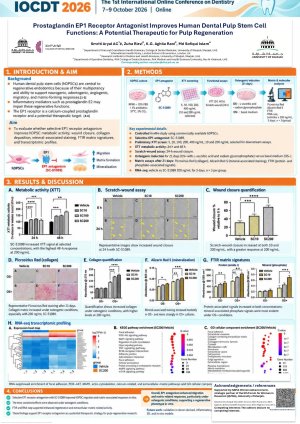
Background: Human dental pulp stem cells (hDPSCs) are essential for regenerative endodontics due to their multipotency and capacity for neurogenic, odontogenic, and angiogenic differentiation. However, inflammatory mediators such as prostaglandins, which signal through the EP1 receptor, can impair these regenerative functions.
Objective: This study aimed to investigate the effects of a prostaglandin EP1 receptor antagonist on the viability, migration (wound healing), collagen synthesis, and mineralization potential of hDPSCs.
Methods: Commercially available hDPSCs (CLS) were cultured in RPMI medium supplemented with 10% fetal bovine serum and 1% antibiotics under standard culture conditions (37°C, 5% CO₂). Cells were treated with vehicle control or an EP1 receptor antagonist at concentrations of 10 and 200 ng/mL, selected based on preliminary dose-response experiments. Cell viability and migration were evaluated using XTT and wound-healing assays.Osteogenic differentiation was induced using osteogenic medium (confluent hDPSCs cultured for 21 days in osteogenic induction medium containing L-ascorbic acid and sodium glycerophosphate), and collagen synthesis and mineral deposition were assessed by picrosirius red and alizarin red staining, respectively. Matrix composition was further characterized by Fourier-transform infrared (FTIR) spectroscopy, while RNA sequencing was performed to evaluate changes in gene expression.
Results: The EP1 antagonist significantly enhanced cell viability, migration, collagen synthesis, and mineralization in a dose-dependent manner. FTIR analysis confirmed increased protein and mineral matrix deposition. Gene expression analysis indicated notable changes associated with regenerative activity.
Conclusion: Inhibition of the EP1 receptor improves the regenerative potential of hDPSCs, highlighting its promise as a supportive therapeutic approach for pulp regeneration in regenerative endodontics.
Acknowledgements:
This research was supported by NAMA Women Advancement, who served as the strategic partner of the 5th Forum for Women in Research
(QUWA): Together Innovating to Shape the Future at the University of Sharjah.
Keywords
Human dental pulp stem cells (hDPSCs)
Prostaglandin EP1 receptor
EP1 receptor antagonist
Pulp regeneration
mineralization
Poster
Smriti poster.pdf
Knowledge and Attitudes Among Portuguese Dentists Regarding the Use of Safety Checklists
A Proposed Outcome Assessment Framework for Regenerative Endodontics: A Perspective for Future Collaboration