Event submissions
Published
This submission belongs to the session S4. Restorative Dentistry, Endodontics, and Dental Traumatology of the event The 1st International Online Conference on Dentistry
Published date
02 Oct, 2026
Academic Editor
'%3e%3cpath%20d='M12.6657%2010.9104C12.4185%2010.325%2012.0599%209.79327%2011.6097%209.34482C11.1609%208.89508%2010.6293%208.5365%2010.0442%208.28888C10.0389%208.28626%2010.0337%208.28495%2010.0285%208.28233C10.8446%207.69279%2011.3752%206.73249%2011.3752%205.64904C11.3752%203.8542%209.92103%202.39999%208.1262%202.39999C6.33136%202.39999%204.87715%203.8542%204.87715%205.64904C4.87715%206.73249%205.40774%207.69279%206.22393%208.28364C6.21869%208.28626%206.21345%208.28757%206.20821%208.29019C5.62129%208.5378%205.09463%208.89284%204.64265%209.34613C4.1929%209.79493%203.83432%2010.3266%203.58671%2010.9117C3.34345%2011.4845%203.21226%2012.0987%203.20023%2012.7209C3.19988%2012.7349%203.20233%2012.7488%203.20744%2012.7619C3.21255%2012.7749%203.22022%2012.7867%203.22998%2012.7968C3.23975%2012.8068%203.25142%2012.8147%203.26431%2012.8202C3.2772%2012.8256%203.29105%2012.8284%203.30504%2012.8284H4.09109C4.14874%2012.8284%204.19459%2012.7825%204.1959%2012.7262C4.2221%2011.7148%204.62823%2010.7676%205.34617%2010.0497C6.08899%209.30683%207.0755%208.89808%208.1262%208.89808C9.17689%208.89808%2010.1634%209.30683%2010.9062%2010.0497C11.6242%2010.7676%2012.0303%2011.7148%2012.0565%2012.7262C12.0578%2012.7838%2012.1037%2012.8284%2012.1613%2012.8284H12.9474C12.9613%2012.8284%2012.9752%2012.8256%2012.9881%2012.8202C13.001%2012.8147%2013.0126%2012.8068%2013.0224%2012.7968C13.0322%2012.7867%2013.0398%2012.7749%2013.0449%2012.7619C13.0501%2012.7488%2013.0525%2012.7349%2013.0522%2012.7209C13.0391%2012.0947%2012.9094%2011.4855%2012.6657%2010.9104ZM8.1262%207.9024C7.52486%207.9024%206.9589%207.6679%206.53312%207.24211C6.10733%206.81633%205.87283%206.25037%205.87283%205.64904C5.87283%205.0477%206.10733%204.48174%206.53312%204.05596C6.9589%203.63018%207.52486%203.39567%208.1262%203.39567C8.72753%203.39567%209.29349%203.63018%209.71927%204.05596C10.1451%204.48174%2010.3796%205.0477%2010.3796%205.64904C10.3796%206.25037%2010.1451%206.81633%209.71927%207.24211C9.29349%207.6679%208.72753%207.9024%208.1262%207.9024Z'%20fill='%235D1EE1'/%3e%3c/g%3e%3c/svg%3e) Gianrico Spagnuolo
Gianrico SpagnuoloCitation
Athina Niakou, Konstantinos Krommydas, Athanasios Stratos, Savvas Kamalakidis, Argirios Pissiotis, Dimitrios Tortopidis, Konstantinos Michalakis, Alexander Tsouknidas, “Biomechanical assessment of endocrown versus fiber post, composite core and conventional crown restorations in endodontically treated mandibular molars. A finite element analysis”, in Proceedings of The 1st International Online Conference on Dentistry, 7 October–9 October 2026, MDPI: Basel, Switzerland
Share
Email
Facebook
Twitter
LinkedIn
“Biomechanical assessment of endocrown versus fiber post, composite core and conventional crown restorations in endodontically treated mandibular molars. A finite element analysis”
'%3e%3cpath%20d='M12.6647%2010.9104C12.4176%2010.325%2012.0589%209.7933%2011.6088%209.34485C11.16%208.89511%2010.6283%208.53653%2010.0432%208.28891C10.038%208.28629%2010.0327%208.28498%2010.0275%208.28236C10.8437%207.69282%2011.3743%206.73252%2011.3743%205.64907C11.3743%203.85423%209.92005%202.40002%208.12522%202.40002C6.33038%202.40002%204.87618%203.85423%204.87618%205.64907C4.87618%206.73252%205.40677%207.69282%206.22296%208.28367C6.21772%208.28629%206.21248%208.2876%206.20724%208.29022C5.62031%208.53783%205.09365%208.89287%204.64167%209.34616C4.19192%209.79496%203.83334%2010.3266%203.58573%2010.9117C3.34247%2011.4846%203.21128%2012.0987%203.19925%2012.721C3.1989%2012.735%203.20135%2012.7489%203.20646%2012.7619C3.21157%2012.7749%203.21924%2012.7868%203.22901%2012.7968C3.23877%2012.8068%203.25045%2012.8148%203.26334%2012.8202C3.27623%2012.8256%203.29007%2012.8284%203.30406%2012.8284H4.09012C4.14776%2012.8284%204.19362%2012.7825%204.19493%2012.7262C4.22113%2011.7148%204.62726%2010.7676%205.34519%2010.0497C6.08802%209.30686%207.07452%208.89811%208.12522%208.89811C9.17592%208.89811%2010.1624%209.30686%2010.9052%2010.0497C11.6232%2010.7676%2012.0293%2011.7148%2012.0555%2012.7262C12.0568%2012.7839%2012.1027%2012.8284%2012.1603%2012.8284H12.9464C12.9604%2012.8284%2012.9742%2012.8256%2012.9871%2012.8202C13%2012.8148%2013.0117%2012.8068%2013.0214%2012.7968C13.0312%2012.7868%2013.0389%2012.7749%2013.044%2012.7619C13.0491%2012.7489%2013.0515%2012.735%2013.0512%2012.721C13.0381%2012.0947%2012.9084%2011.4856%2012.6647%2010.9104ZM8.12522%207.90243C7.52388%207.90243%206.95792%207.66793%206.53214%207.24215C6.10636%206.81636%205.87185%206.2504%205.87185%205.64907C5.87185%205.04773%206.10636%204.48177%206.53214%204.05599C6.95792%203.63021%207.52388%203.3957%208.12522%203.3957C8.72655%203.3957%209.29252%203.63021%209.7183%204.05599C10.1441%204.48177%2010.3786%205.04773%2010.3786%205.64907C10.3786%206.2504%2010.1441%206.81636%209.7183%207.24215C9.29252%207.66793%208.72655%207.90243%208.12522%207.90243Z'%20fill='%235D1EE1'/%3e%3c/g%3e%3c/svg%3e)
Athina Niakou 1
Konstantinos Krommydas 2
Athanasios Stratos 1
Savvas Kamalakidis 1,3
Argirios Pissiotis 1
Dimitrios Tortopidis 1

Konstantinos Michalakis 4,5

Alexander Tsouknidas 5,6
1. Department of Prosthodontics, Faculty of Dentistry, School of Health Sciences, Aristotle University of Thessaloniki, Thessaloniki, Greece
2. Laboratory of Biomaterials and Computational Mechanics, Department of Mechanical Engineering, University of Western Macedonia, Kozani, Greece
3. Department of Prosthodontics, School of Dental Medicine, Tufts University, Boston, USA
4. Department of Restorative Sciences & Biomaterials, Henry M. Goldman School of Dental Medicine, Boston University, Boston, Mass, USA
5. Boston University Center for Multiscale and Translational Mechanobiology, Boston, Mass, MA02118, USA
6. Laboratory for Applied Biomechanics, Department of Restorative Sciences & Biomaterials, Henry M. Goldman School of Dental Medicine, Boston University, Boston, Mass, USA
Abstract
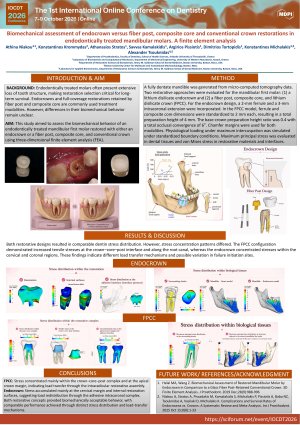
Introduction: Endodontically treated molars often present extensive loss of tooth structure, making restoration selection critical for long-term survival. Endocrowns and full-coverage restorations retained by fiber post and composite core are commonly used treatment modalities. However, differences in their biomechanical behavior remain unclear. This study aimed to assess the biomechanical behavior of an endodontically treated mandibular first molar restored with either an endocrown or a fiber post, composite core, and conventional crown using three-dimensional finite element analysis (FEA).
Methods: A fully dentate mandible was generated from micro-computed tomography data. Two restorative approaches were evaluated for the mandibular first molar: (1) a lithium disilicate endocrown and (2) a fiber post, composite core, and lithium disilicate crown (FPCC). For the endocrown design, a 2-mm ferrule and a 3-mm intracoronal extension were incorporated. In the FPCC model, ferrule and composite core dimensions were standardized to 2 mm each, resulting in a total preparation height of 4 mm. The base-crown preparation height ratio was 0.4 with a total occlusal convergence of 6°. Chamfer margins were used for both modalities. Physiological loading under maximum intercuspation was simulated under standardized boundary conditions. Maximum principal stress was evaluated in dental tissues and von Mises stress in restorative materials and interfaces.
Results: Both restorative designs resulted in comparable dentin stress distribution. However, stress concentration patterns differed. The FPCC configuration demonstrated increased tensile stresses at the crown–core–post interface and along the root canal, whereas the endocrown concentrated stresses within the cervical and coronal regions. These findings indicate different load transfer mechanisms and possible variation in failure initiation sites.
Conclusions: Restoration design affected stress localization and load transfer pathways. Both approaches exhibited distinct biomechanical behavior, which may explain different failure modes and aid treatment selection for endodontically treated molars.
Keywords
endodontically treated teeth
endocrown
fiber post
composite core
finite element analysis
fracture resistance
stress distribution
lithium disilicate
biomechanical behavior
adhesive dentistry
Poster
Biomechanical assessment of endocrown versus fiber post, composite core and conventional crown restorations in endodontically treated mandibular molars. A finite element analysis.pdf
A Proposed Outcome Assessment Framework for Regenerative Endodontics: A Perspective for Future Collaboration
Graph Attention Networks for Tooth-Level Periodontal Status Prediction via Inter-Tooth Spatial Dependency Modeling