Event submissions
Published
This submission belongs to the session S8. AI in Dentistry of the event The 1st International Online Conference on Dentistry
Published date
02 Oct, 2026
Academic Editor
'%3e%3cpath%20d='M12.6657%2010.9104C12.4185%2010.325%2012.0599%209.79327%2011.6097%209.34482C11.1609%208.89508%2010.6293%208.5365%2010.0442%208.28888C10.0389%208.28626%2010.0337%208.28495%2010.0285%208.28233C10.8446%207.69279%2011.3752%206.73249%2011.3752%205.64904C11.3752%203.8542%209.92103%202.39999%208.1262%202.39999C6.33136%202.39999%204.87715%203.8542%204.87715%205.64904C4.87715%206.73249%205.40774%207.69279%206.22393%208.28364C6.21869%208.28626%206.21345%208.28757%206.20821%208.29019C5.62129%208.5378%205.09463%208.89284%204.64265%209.34613C4.1929%209.79493%203.83432%2010.3266%203.58671%2010.9117C3.34345%2011.4845%203.21226%2012.0987%203.20023%2012.7209C3.19988%2012.7349%203.20233%2012.7488%203.20744%2012.7619C3.21255%2012.7749%203.22022%2012.7867%203.22998%2012.7968C3.23975%2012.8068%203.25142%2012.8147%203.26431%2012.8202C3.2772%2012.8256%203.29105%2012.8284%203.30504%2012.8284H4.09109C4.14874%2012.8284%204.19459%2012.7825%204.1959%2012.7262C4.2221%2011.7148%204.62823%2010.7676%205.34617%2010.0497C6.08899%209.30683%207.0755%208.89808%208.1262%208.89808C9.17689%208.89808%2010.1634%209.30683%2010.9062%2010.0497C11.6242%2010.7676%2012.0303%2011.7148%2012.0565%2012.7262C12.0578%2012.7838%2012.1037%2012.8284%2012.1613%2012.8284H12.9474C12.9613%2012.8284%2012.9752%2012.8256%2012.9881%2012.8202C13.001%2012.8147%2013.0126%2012.8068%2013.0224%2012.7968C13.0322%2012.7867%2013.0398%2012.7749%2013.0449%2012.7619C13.0501%2012.7488%2013.0525%2012.7349%2013.0522%2012.7209C13.0391%2012.0947%2012.9094%2011.4855%2012.6657%2010.9104ZM8.1262%207.9024C7.52486%207.9024%206.9589%207.6679%206.53312%207.24211C6.10733%206.81633%205.87283%206.25037%205.87283%205.64904C5.87283%205.0477%206.10733%204.48174%206.53312%204.05596C6.9589%203.63018%207.52486%203.39567%208.1262%203.39567C8.72753%203.39567%209.29349%203.63018%209.71927%204.05596C10.1451%204.48174%2010.3796%205.0477%2010.3796%205.64904C10.3796%206.25037%2010.1451%206.81633%209.71927%207.24211C9.29349%207.6679%208.72753%207.9024%208.1262%207.9024Z'%20fill='%235D1EE1'/%3e%3c/g%3e%3c/svg%3e) Christos Rahiotis
Christos RahiotisCitation
Younghwan Kil, Graph Attention Networks for Tooth-Level Periodontal Status Prediction via Inter-Tooth Spatial Dependency Modeling, in Proceedings of The 1st International Online Conference on Dentistry, 7 October–9 October 2026, MDPI: Basel, Switzerland
Share
Email
Facebook
Twitter
LinkedIn
Graph Attention Networks for Tooth-Level Periodontal Status Prediction via Inter-Tooth Spatial Dependency Modeling
'%3e%3cpath%20d='M12.6647%2010.9104C12.4176%2010.325%2012.0589%209.7933%2011.6088%209.34485C11.16%208.89511%2010.6283%208.53653%2010.0432%208.28891C10.038%208.28629%2010.0327%208.28498%2010.0275%208.28236C10.8437%207.69282%2011.3743%206.73252%2011.3743%205.64907C11.3743%203.85423%209.92005%202.40002%208.12522%202.40002C6.33038%202.40002%204.87618%203.85423%204.87618%205.64907C4.87618%206.73252%205.40677%207.69282%206.22296%208.28367C6.21772%208.28629%206.21248%208.2876%206.20724%208.29022C5.62031%208.53783%205.09365%208.89287%204.64167%209.34616C4.19192%209.79496%203.83334%2010.3266%203.58573%2010.9117C3.34247%2011.4846%203.21128%2012.0987%203.19925%2012.721C3.1989%2012.735%203.20135%2012.7489%203.20646%2012.7619C3.21157%2012.7749%203.21924%2012.7868%203.22901%2012.7968C3.23877%2012.8068%203.25045%2012.8148%203.26334%2012.8202C3.27623%2012.8256%203.29007%2012.8284%203.30406%2012.8284H4.09012C4.14776%2012.8284%204.19362%2012.7825%204.19493%2012.7262C4.22113%2011.7148%204.62726%2010.7676%205.34519%2010.0497C6.08802%209.30686%207.07452%208.89811%208.12522%208.89811C9.17592%208.89811%2010.1624%209.30686%2010.9052%2010.0497C11.6232%2010.7676%2012.0293%2011.7148%2012.0555%2012.7262C12.0568%2012.7839%2012.1027%2012.8284%2012.1603%2012.8284H12.9464C12.9604%2012.8284%2012.9742%2012.8256%2012.9871%2012.8202C13%2012.8148%2013.0117%2012.8068%2013.0214%2012.7968C13.0312%2012.7868%2013.0389%2012.7749%2013.044%2012.7619C13.0491%2012.7489%2013.0515%2012.735%2013.0512%2012.721C13.0381%2012.0947%2012.9084%2011.4856%2012.6647%2010.9104ZM8.12522%207.90243C7.52388%207.90243%206.95792%207.66793%206.53214%207.24215C6.10636%206.81636%205.87185%206.2504%205.87185%205.64907C5.87185%205.04773%206.10636%204.48177%206.53214%204.05599C6.95792%203.63021%207.52388%203.3957%208.12522%203.3957C8.72655%203.3957%209.29252%203.63021%209.7183%204.05599C10.1441%204.48177%2010.3786%205.04773%2010.3786%205.64907C10.3786%206.2504%2010.1441%206.81636%209.7183%207.24215C9.29252%207.66793%208.72655%207.90243%208.12522%207.90243Z'%20fill='%235D1EE1'/%3e%3c/g%3e%3c/svg%3e)
Younghwan Kil 1
1. Korea Advanced Institute of Science and Technology (KAIST), Daejeon, 34141, Republic of Korea
Abstract
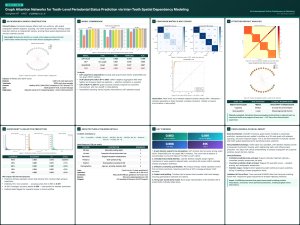
Periodontitis is staged tooth by tooth, yet severity is spatially structured: adjacent and opposing teeth share occlusal loading, plaque retention and alveolar bone support. We asked how much of a tooth's periodontal status is explained by its own measurements versus its position within the dentition.
Using full-mouth periodontal examinations from NHANES 2013-2014 (3,367 participants; 81,130 tooth-level samples), we represented each participant as a graph whose nodes are teeth and whose edges encode adjacency, opposing-arch contact and same-quadrant membership. Tooth-level severity was defined by CDC/AAP-style thresholds on the maximum probing depth (PD) and clinical attachment loss (CAL) across the six examined sites, giving Healthy 61.8%, Mild 21.8%, Moderate 12.7% and Severe 3.7%. Node features were the site-level mean and standard deviation of PD and CAL, a recession proxy, tooth position, and participant age, sex, smoking status, diabetes status and BMI; site maxima and threshold counts were excluded because the outcome is defined on them. A three-layer graph attention network (GAT) was trained with inverse-frequency class weighting and evaluated on a single stratified participant-level 80/20 hold-out split.
The GAT achieved 0.963 accuracy, 0.943 macro-F1 and 0.998 macro-AUC. A feature-matched multilayer perceptron using no graph structure reached 0.939 macro-F1, indicating that tooth-level status is dominated by the tooth's own site measurements and that inter-tooth structure contributes marginally; a GCN collapsed to 0.569 macro-F1, consistent with over-smoothing of a locally concentrated signal. Monte-Carlo-dropout uncertainty supported selective prediction: abstaining on the 10% most uncertain teeth raised accuracy to 0.991.
Because predictors and outcome derive from the same examination, these figures characterise aggregation of site measurements rather than independent prediction. We accordingly report the graph contribution explicitly and treat attention weights as descriptive spatial co-occurrence, not evidence of disease propagation.
Keywords
graph attention network
tooth-level prediction
periodontal disease
spatial dependency
Monte Carlo Dropout
uncertainty quantification
NHANES
dental graph
Poster
Sciforum-178947_poster_vector.pdf
“Biomechanical assessment of endocrown versus fiber post, composite core and conventional crown restorations in endodontically treated mandibular molars. A finite element analysis”
Temperature-Scaled Convolutional Neural Networks with Split Conformal Prediction for Reliable Dental Implant Type Classification from Panoramic Radiographs