Event submissions
Published
This submission belongs to the session S8. AI in Dentistry of the event The 1st International Online Conference on Dentistry
Published date
02 Oct, 2026
Academic Editor
'%3e%3cpath%20d='M12.6657%2010.9104C12.4185%2010.325%2012.0599%209.79327%2011.6097%209.34482C11.1609%208.89508%2010.6293%208.5365%2010.0442%208.28888C10.0389%208.28626%2010.0337%208.28495%2010.0285%208.28233C10.8446%207.69279%2011.3752%206.73249%2011.3752%205.64904C11.3752%203.8542%209.92103%202.39999%208.1262%202.39999C6.33136%202.39999%204.87715%203.8542%204.87715%205.64904C4.87715%206.73249%205.40774%207.69279%206.22393%208.28364C6.21869%208.28626%206.21345%208.28757%206.20821%208.29019C5.62129%208.5378%205.09463%208.89284%204.64265%209.34613C4.1929%209.79493%203.83432%2010.3266%203.58671%2010.9117C3.34345%2011.4845%203.21226%2012.0987%203.20023%2012.7209C3.19988%2012.7349%203.20233%2012.7488%203.20744%2012.7619C3.21255%2012.7749%203.22022%2012.7867%203.22998%2012.7968C3.23975%2012.8068%203.25142%2012.8147%203.26431%2012.8202C3.2772%2012.8256%203.29105%2012.8284%203.30504%2012.8284H4.09109C4.14874%2012.8284%204.19459%2012.7825%204.1959%2012.7262C4.2221%2011.7148%204.62823%2010.7676%205.34617%2010.0497C6.08899%209.30683%207.0755%208.89808%208.1262%208.89808C9.17689%208.89808%2010.1634%209.30683%2010.9062%2010.0497C11.6242%2010.7676%2012.0303%2011.7148%2012.0565%2012.7262C12.0578%2012.7838%2012.1037%2012.8284%2012.1613%2012.8284H12.9474C12.9613%2012.8284%2012.9752%2012.8256%2012.9881%2012.8202C13.001%2012.8147%2013.0126%2012.8068%2013.0224%2012.7968C13.0322%2012.7867%2013.0398%2012.7749%2013.0449%2012.7619C13.0501%2012.7488%2013.0525%2012.7349%2013.0522%2012.7209C13.0391%2012.0947%2012.9094%2011.4855%2012.6657%2010.9104ZM8.1262%207.9024C7.52486%207.9024%206.9589%207.6679%206.53312%207.24211C6.10733%206.81633%205.87283%206.25037%205.87283%205.64904C5.87283%205.0477%206.10733%204.48174%206.53312%204.05596C6.9589%203.63018%207.52486%203.39567%208.1262%203.39567C8.72753%203.39567%209.29349%203.63018%209.71927%204.05596C10.1451%204.48174%2010.3796%205.0477%2010.3796%205.64904C10.3796%206.25037%2010.1451%206.81633%209.71927%207.24211C9.29349%207.6679%208.72753%207.9024%208.1262%207.9024Z'%20fill='%235D1EE1'/%3e%3c/g%3e%3c/svg%3e) Christos Rahiotis
Christos RahiotisCitation
Younghwan Kil, Nakyung Kil, Temperature-Scaled Convolutional Neural Networks with Split Conformal Prediction for Reliable Dental Implant Type Classification from Panoramic Radiographs, in Proceedings of The 1st International Online Conference on Dentistry, 7 October–9 October 2026, MDPI: Basel, Switzerland
Share
Email
Facebook
Twitter
LinkedIn
Temperature-Scaled Convolutional Neural Networks with Split Conformal Prediction for Reliable Dental Implant Type Classification from Panoramic Radiographs
'%3e%3cpath%20d='M12.6647%2010.9104C12.4176%2010.325%2012.0589%209.7933%2011.6088%209.34485C11.16%208.89511%2010.6283%208.53653%2010.0432%208.28891C10.038%208.28629%2010.0327%208.28498%2010.0275%208.28236C10.8437%207.69282%2011.3743%206.73252%2011.3743%205.64907C11.3743%203.85423%209.92005%202.40002%208.12522%202.40002C6.33038%202.40002%204.87618%203.85423%204.87618%205.64907C4.87618%206.73252%205.40677%207.69282%206.22296%208.28367C6.21772%208.28629%206.21248%208.2876%206.20724%208.29022C5.62031%208.53783%205.09365%208.89287%204.64167%209.34616C4.19192%209.79496%203.83334%2010.3266%203.58573%2010.9117C3.34247%2011.4846%203.21128%2012.0987%203.19925%2012.721C3.1989%2012.735%203.20135%2012.7489%203.20646%2012.7619C3.21157%2012.7749%203.21924%2012.7868%203.22901%2012.7968C3.23877%2012.8068%203.25045%2012.8148%203.26334%2012.8202C3.27623%2012.8256%203.29007%2012.8284%203.30406%2012.8284H4.09012C4.14776%2012.8284%204.19362%2012.7825%204.19493%2012.7262C4.22113%2011.7148%204.62726%2010.7676%205.34519%2010.0497C6.08802%209.30686%207.07452%208.89811%208.12522%208.89811C9.17592%208.89811%2010.1624%209.30686%2010.9052%2010.0497C11.6232%2010.7676%2012.0293%2011.7148%2012.0555%2012.7262C12.0568%2012.7839%2012.1027%2012.8284%2012.1603%2012.8284H12.9464C12.9604%2012.8284%2012.9742%2012.8256%2012.9871%2012.8202C13%2012.8148%2013.0117%2012.8068%2013.0214%2012.7968C13.0312%2012.7868%2013.0389%2012.7749%2013.044%2012.7619C13.0491%2012.7489%2013.0515%2012.735%2013.0512%2012.721C13.0381%2012.0947%2012.9084%2011.4856%2012.6647%2010.9104ZM8.12522%207.90243C7.52388%207.90243%206.95792%207.66793%206.53214%207.24215C6.10636%206.81636%205.87185%206.2504%205.87185%205.64907C5.87185%205.04773%206.10636%204.48177%206.53214%204.05599C6.95792%203.63021%207.52388%203.3957%208.12522%203.3957C8.72655%203.3957%209.29252%203.63021%209.7183%204.05599C10.1441%204.48177%2010.3786%205.04773%2010.3786%205.64907C10.3786%206.2504%2010.1441%206.81636%209.7183%207.24215C9.29252%207.66793%208.72655%207.90243%208.12522%207.90243Z'%20fill='%235D1EE1'/%3e%3c/g%3e%3c/svg%3e)
Younghwan Kil 1
Nakyung Kil 2
1. Korea Advanced Institute of Science and Technology (KAIST), Daejeon, 34141, Republic of Korea
2. Yonsei University, Seoul 03722, Republic of Korea
Abstract
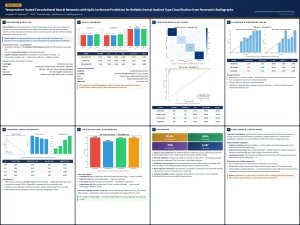
Accurate identification of dental implant types from panoramic radiographs is essential for prosthetic rehabilitation and maintenance of patients with pre-existing implants, yet automated classification systems provide only point predictions without formal reliability guarantees, limiting clinician trust in ambiguous cases. This study introduces ImplantXrayCP, a framework combining pretrained convolutional neural networks with post-hoc temperature scaling and split conformal prediction to deliver calibrated, set-valued predictions for implant type classification with finite-sample coverage guarantees. We systematically evaluated three CNN backbones — ResNet-50, EfficientNet-B0, and DenseNet-121 — all pretrained on ImageNet and fine-tuned on 5,107 panoramic dental X-ray images spanning four implant categories (Endosteal, Subperiosteal, Transosteal, Zygomatic) from the Mendeley Dental Implant Dataset. Each backbone is calibrated via temperature scaling on a held-out calibration set, after which Adaptive Prediction Sets provide distribution-free coverage guarantees satisfying P(Y ∈ C(X)) ≥ 1−α. Under a stratified train/validation/calibration/test split (60/15/10/15%), DenseNet-121 achieved the highest accuracy of 0.974 ± 0.008, weighted F1 of 0.974 ± 0.009, and AUC-ROC of 0.999 ± 0.001, while all three backbones exceeded 0.970 accuracy. Temperature scaling reduced expected calibration error from 0.051–0.074 to 0.015–0.016 across all backbones. Conformal prediction sets achieved 100% empirical coverage at the 90% target level across all models. Singleton prediction sets indicate confident implant identification enabling direct prosthetic component selection, while larger sets flag cases requiring additional diagnostic workup such as periapical radiographs or CBCT imaging, providing a principled triage mechanism for implant identification in clinical practice.
Keywords
dental implant classification
panoramic radiograph
convolutional neural network
conformal prediction
temperature scaling
adaptive prediction sets
transfer learning
uncertainty quantification
Poster
Sciforum-178946_poster_vector.pdf
Graph Attention Networks for Tooth-Level Periodontal Status Prediction via Inter-Tooth Spatial Dependency Modeling
Knowledge, Attitude, and Practice of Otolaryngologists Toward Their Role in Maxillary Sinus Elevation during Implant therapy - A Questionnaire based study