Event submissions
Published
This submission belongs to the session S4. Restorative Dentistry, Endodontics, and Dental Traumatology of the event The 1st International Online Conference on Dentistry
Published date
02 Oct, 2026
Academic Editor
'%3e%3cpath%20d='M12.6657%2010.9104C12.4185%2010.325%2012.0599%209.79327%2011.6097%209.34482C11.1609%208.89508%2010.6293%208.5365%2010.0442%208.28888C10.0389%208.28626%2010.0337%208.28495%2010.0285%208.28233C10.8446%207.69279%2011.3752%206.73249%2011.3752%205.64904C11.3752%203.8542%209.92103%202.39999%208.1262%202.39999C6.33136%202.39999%204.87715%203.8542%204.87715%205.64904C4.87715%206.73249%205.40774%207.69279%206.22393%208.28364C6.21869%208.28626%206.21345%208.28757%206.20821%208.29019C5.62129%208.5378%205.09463%208.89284%204.64265%209.34613C4.1929%209.79493%203.83432%2010.3266%203.58671%2010.9117C3.34345%2011.4845%203.21226%2012.0987%203.20023%2012.7209C3.19988%2012.7349%203.20233%2012.7488%203.20744%2012.7619C3.21255%2012.7749%203.22022%2012.7867%203.22998%2012.7968C3.23975%2012.8068%203.25142%2012.8147%203.26431%2012.8202C3.2772%2012.8256%203.29105%2012.8284%203.30504%2012.8284H4.09109C4.14874%2012.8284%204.19459%2012.7825%204.1959%2012.7262C4.2221%2011.7148%204.62823%2010.7676%205.34617%2010.0497C6.08899%209.30683%207.0755%208.89808%208.1262%208.89808C9.17689%208.89808%2010.1634%209.30683%2010.9062%2010.0497C11.6242%2010.7676%2012.0303%2011.7148%2012.0565%2012.7262C12.0578%2012.7838%2012.1037%2012.8284%2012.1613%2012.8284H12.9474C12.9613%2012.8284%2012.9752%2012.8256%2012.9881%2012.8202C13.001%2012.8147%2013.0126%2012.8068%2013.0224%2012.7968C13.0322%2012.7867%2013.0398%2012.7749%2013.0449%2012.7619C13.0501%2012.7488%2013.0525%2012.7349%2013.0522%2012.7209C13.0391%2012.0947%2012.9094%2011.4855%2012.6657%2010.9104ZM8.1262%207.9024C7.52486%207.9024%206.9589%207.6679%206.53312%207.24211C6.10733%206.81633%205.87283%206.25037%205.87283%205.64904C5.87283%205.0477%206.10733%204.48174%206.53312%204.05596C6.9589%203.63018%207.52486%203.39567%208.1262%203.39567C8.72753%203.39567%209.29349%203.63018%209.71927%204.05596C10.1451%204.48174%2010.3796%205.0477%2010.3796%205.64904C10.3796%206.25037%2010.1451%206.81633%209.71927%207.24211C9.29349%207.6679%208.72753%207.9024%208.1262%207.9024Z'%20fill='%235D1EE1'/%3e%3c/g%3e%3c/svg%3e) Claude Jaquiéry
Claude JaquiéryCitation
Ahlem Beji, Safa JEMLI, Jamila Jaouadi, Aesthetic Expectations of Completely Edentulous Patients: Sociodemographic Determinants from a North African Cross-Sectional Study, in Proceedings of The 1st International Online Conference on Dentistry, 7 October–9 October 2026, MDPI: Basel, Switzerland
Share
Email
Facebook
Twitter
LinkedIn
Aesthetic Expectations of Completely Edentulous Patients: Sociodemographic Determinants from a North African Cross-Sectional Study
'%3e%3cpath%20d='M12.6647%2010.9104C12.4176%2010.325%2012.0589%209.7933%2011.6088%209.34485C11.16%208.89511%2010.6283%208.53653%2010.0432%208.28891C10.038%208.28629%2010.0327%208.28498%2010.0275%208.28236C10.8437%207.69282%2011.3743%206.73252%2011.3743%205.64907C11.3743%203.85423%209.92005%202.40002%208.12522%202.40002C6.33038%202.40002%204.87618%203.85423%204.87618%205.64907C4.87618%206.73252%205.40677%207.69282%206.22296%208.28367C6.21772%208.28629%206.21248%208.2876%206.20724%208.29022C5.62031%208.53783%205.09365%208.89287%204.64167%209.34616C4.19192%209.79496%203.83334%2010.3266%203.58573%2010.9117C3.34247%2011.4846%203.21128%2012.0987%203.19925%2012.721C3.1989%2012.735%203.20135%2012.7489%203.20646%2012.7619C3.21157%2012.7749%203.21924%2012.7868%203.22901%2012.7968C3.23877%2012.8068%203.25045%2012.8148%203.26334%2012.8202C3.27623%2012.8256%203.29007%2012.8284%203.30406%2012.8284H4.09012C4.14776%2012.8284%204.19362%2012.7825%204.19493%2012.7262C4.22113%2011.7148%204.62726%2010.7676%205.34519%2010.0497C6.08802%209.30686%207.07452%208.89811%208.12522%208.89811C9.17592%208.89811%2010.1624%209.30686%2010.9052%2010.0497C11.6232%2010.7676%2012.0293%2011.7148%2012.0555%2012.7262C12.0568%2012.7839%2012.1027%2012.8284%2012.1603%2012.8284H12.9464C12.9604%2012.8284%2012.9742%2012.8256%2012.9871%2012.8202C13%2012.8148%2013.0117%2012.8068%2013.0214%2012.7968C13.0312%2012.7868%2013.0389%2012.7749%2013.044%2012.7619C13.0491%2012.7489%2013.0515%2012.735%2013.0512%2012.721C13.0381%2012.0947%2012.9084%2011.4856%2012.6647%2010.9104ZM8.12522%207.90243C7.52388%207.90243%206.95792%207.66793%206.53214%207.24215C6.10636%206.81636%205.87185%206.2504%205.87185%205.64907C5.87185%205.04773%206.10636%204.48177%206.53214%204.05599C6.95792%203.63021%207.52388%203.3957%208.12522%203.3957C8.72655%203.3957%209.29252%203.63021%209.7183%204.05599C10.1441%204.48177%2010.3786%205.04773%2010.3786%205.64907C10.3786%206.2504%2010.1441%206.81636%209.7183%207.24215C9.29252%207.66793%208.72655%207.90243%208.12522%207.90243Z'%20fill='%235D1EE1'/%3e%3c/g%3e%3c/svg%3e)
Ahlem Beji 1
Safa JEMLI 2
Jamila Jaouadi 1
1. Department of Prosthodontics, Faculty of Dental Medicine, University of Monastir, Research Laboratory of Oral Health and Buccofacial Rehabilitation (LR12ES11), 5000 Monastir, Tunisia
2. Department of Dental Medicine, Ben Arous Regional Hospital, Faculty of Dental Medicine, University of Monastir, Research Laboratory of Oral Health and Buccofacial Rehabilitation (LR12ES11), 5000 Monastir, Tunisia
Abstract
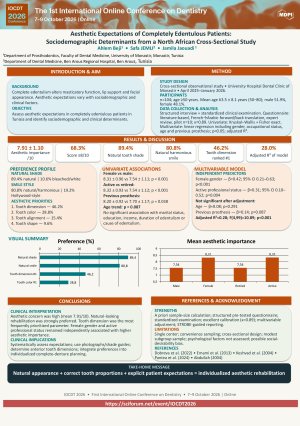
Introduction :Understanding patients' aesthetic expectations is essential for patient-centered complete denture therapy. This study evaluated the aesthetic expectations of completely edentulous Tunisian patients and identified the sociodemographic and clinical determinants influencing the importance attributed to dental aesthetics.
Methods :A cross-sectional study was conducted between April 2025 and January 2026 at the University Hospital Dental Clinic of Monastir, Tunisia. A total of 104 completely edentulous adults (mean age: 63.5 ± 8.1 years; range: 50–80 years) were consecutively recruited. Participants completed a 20-item structured, pre-tested questionnaire, developed from the literature, translated using a forward–backward method, and reviewed by three prosthodontic experts for content validity. The questionnaire assessed the perceived importance of dental aesthetics, preferred tooth shade, smile characteristics, and key aesthetic parameters. Standardized clinical examinations were performed by a calibrated examiner (κ = 0.89). Associations were assessed using Kruskal–Wallis and Fisher's exact tests, followed by multiple linear regression.
Results :Participants assigned a high importance to dental aesthetics (mean score: 7.91 ± 1.10/10). Natural tooth shade (89.4%) and a natural, harmonious smile (80.8%) were the most frequently preferred aesthetic features. Tooth dimensions were ranked as the most influential aesthetic parameter (46.2%). Multiple linear regression identified female sex (β = 0.42; 95% CI: 0.21–0.63; p < 0.001) and active professional status (β = 0.31; 95% CI: 0.10–0.52; p = 0.004) as independent predictors of greater aesthetic importance, whereas age and previous denture experience were not independently associated. The final model explained 28% of the variance (adjusted R² = 0.28).
Conclusions :Completely edentulous Tunisian patients place considerable importance on dental aesthetics and prefer natural-looking prosthetic outcomes. Female and professionally active patients demonstrate greater aesthetic expectations. As the first North African study on this topic, these findings support integrating patients' aesthetic expectations into complete denture treatment planning.
Keywords
Complete denture
Dental aesthetics
Edentulism
Patient-centered care
Prosthodontics.
Poster
Dr.Ahlem Beji-IOCDT_2026_Poster.pdf
Management of Maxillary Lateral Incisor Agenesis: A Multidisciplinary Approach in Two Clinical Cases
Metrological Accuracy of Conventional versus Digital Maxillomandibular Relationship Records in Implant-Supported Full-Arch Rehabilitations: A Systematic Review