Event submissions
Published
This submission belongs to the session S8. AI in Dentistry of the event The 1st International Online Conference on Dentistry
Published date
02 Oct, 2026
Academic Editor
'%3e%3cpath%20d='M12.6657%2010.9104C12.4185%2010.325%2012.0599%209.79327%2011.6097%209.34482C11.1609%208.89508%2010.6293%208.5365%2010.0442%208.28888C10.0389%208.28626%2010.0337%208.28495%2010.0285%208.28233C10.8446%207.69279%2011.3752%206.73249%2011.3752%205.64904C11.3752%203.8542%209.92103%202.39999%208.1262%202.39999C6.33136%202.39999%204.87715%203.8542%204.87715%205.64904C4.87715%206.73249%205.40774%207.69279%206.22393%208.28364C6.21869%208.28626%206.21345%208.28757%206.20821%208.29019C5.62129%208.5378%205.09463%208.89284%204.64265%209.34613C4.1929%209.79493%203.83432%2010.3266%203.58671%2010.9117C3.34345%2011.4845%203.21226%2012.0987%203.20023%2012.7209C3.19988%2012.7349%203.20233%2012.7488%203.20744%2012.7619C3.21255%2012.7749%203.22022%2012.7867%203.22998%2012.7968C3.23975%2012.8068%203.25142%2012.8147%203.26431%2012.8202C3.2772%2012.8256%203.29105%2012.8284%203.30504%2012.8284H4.09109C4.14874%2012.8284%204.19459%2012.7825%204.1959%2012.7262C4.2221%2011.7148%204.62823%2010.7676%205.34617%2010.0497C6.08899%209.30683%207.0755%208.89808%208.1262%208.89808C9.17689%208.89808%2010.1634%209.30683%2010.9062%2010.0497C11.6242%2010.7676%2012.0303%2011.7148%2012.0565%2012.7262C12.0578%2012.7838%2012.1037%2012.8284%2012.1613%2012.8284H12.9474C12.9613%2012.8284%2012.9752%2012.8256%2012.9881%2012.8202C13.001%2012.8147%2013.0126%2012.8068%2013.0224%2012.7968C13.0322%2012.7867%2013.0398%2012.7749%2013.0449%2012.7619C13.0501%2012.7488%2013.0525%2012.7349%2013.0522%2012.7209C13.0391%2012.0947%2012.9094%2011.4855%2012.6657%2010.9104ZM8.1262%207.9024C7.52486%207.9024%206.9589%207.6679%206.53312%207.24211C6.10733%206.81633%205.87283%206.25037%205.87283%205.64904C5.87283%205.0477%206.10733%204.48174%206.53312%204.05596C6.9589%203.63018%207.52486%203.39567%208.1262%203.39567C8.72753%203.39567%209.29349%203.63018%209.71927%204.05596C10.1451%204.48174%2010.3796%205.0477%2010.3796%205.64904C10.3796%206.25037%2010.1451%206.81633%209.71927%207.24211C9.29349%207.6679%208.72753%207.9024%208.1262%207.9024Z'%20fill='%235D1EE1'/%3e%3c/g%3e%3c/svg%3e) Christos Rahiotis
Christos RahiotisCitation
Vidhya Arumugam, Automated Forensic Age Estimation through Deep Learning Staging of Third Molar Maturation: A Cross-Sectional Study in a Pondicherry Population, in Proceedings of The 1st International Online Conference on Dentistry, 7 October–9 October 2026, MDPI: Basel, Switzerland
Share
Email
Facebook
Twitter
LinkedIn
Automated Forensic Age Estimation through Deep Learning Staging of Third Molar Maturation: A Cross-Sectional Study in a Pondicherry Population
'%3e%3cpath%20d='M12.6647%2010.9104C12.4176%2010.325%2012.0589%209.7933%2011.6088%209.34485C11.16%208.89511%2010.6283%208.53653%2010.0432%208.28891C10.038%208.28629%2010.0327%208.28498%2010.0275%208.28236C10.8437%207.69282%2011.3743%206.73252%2011.3743%205.64907C11.3743%203.85423%209.92005%202.40002%208.12522%202.40002C6.33038%202.40002%204.87618%203.85423%204.87618%205.64907C4.87618%206.73252%205.40677%207.69282%206.22296%208.28367C6.21772%208.28629%206.21248%208.2876%206.20724%208.29022C5.62031%208.53783%205.09365%208.89287%204.64167%209.34616C4.19192%209.79496%203.83334%2010.3266%203.58573%2010.9117C3.34247%2011.4846%203.21128%2012.0987%203.19925%2012.721C3.1989%2012.735%203.20135%2012.7489%203.20646%2012.7619C3.21157%2012.7749%203.21924%2012.7868%203.22901%2012.7968C3.23877%2012.8068%203.25045%2012.8148%203.26334%2012.8202C3.27623%2012.8256%203.29007%2012.8284%203.30406%2012.8284H4.09012C4.14776%2012.8284%204.19362%2012.7825%204.19493%2012.7262C4.22113%2011.7148%204.62726%2010.7676%205.34519%2010.0497C6.08802%209.30686%207.07452%208.89811%208.12522%208.89811C9.17592%208.89811%2010.1624%209.30686%2010.9052%2010.0497C11.6232%2010.7676%2012.0293%2011.7148%2012.0555%2012.7262C12.0568%2012.7839%2012.1027%2012.8284%2012.1603%2012.8284H12.9464C12.9604%2012.8284%2012.9742%2012.8256%2012.9871%2012.8202C13%2012.8148%2013.0117%2012.8068%2013.0214%2012.7968C13.0312%2012.7868%2013.0389%2012.7749%2013.044%2012.7619C13.0491%2012.7489%2013.0515%2012.735%2013.0512%2012.721C13.0381%2012.0947%2012.9084%2011.4856%2012.6647%2010.9104ZM8.12522%207.90243C7.52388%207.90243%206.95792%207.66793%206.53214%207.24215C6.10636%206.81636%205.87185%206.2504%205.87185%205.64907C5.87185%205.04773%206.10636%204.48177%206.53214%204.05599C6.95792%203.63021%207.52388%203.3957%208.12522%203.3957C8.72655%203.3957%209.29252%203.63021%209.7183%204.05599C10.1441%204.48177%2010.3786%205.04773%2010.3786%205.64907C10.3786%206.2504%2010.1441%206.81636%209.7183%207.24215C9.29252%207.66793%208.72655%207.90243%208.12522%207.90243Z'%20fill='%235D1EE1'/%3e%3c/g%3e%3c/svg%3e)
Vidhya Arumugam 1
1. Dept of Oral Pathology and Microbiology, IGIDS, Sri Balaji Vidyapeeth Deemed to be University, Puducherry, India
Abstract
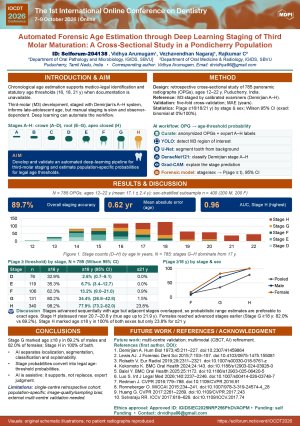
Aim: To develop and validate an automated deep learning pipeline for third-molar developmental staging using Demirjian’s eight-stage classification system and to estimate population-specific probabilities for legally relevant age thresholds.
Materials and Methods: A retrospective study was conducted using 785 digital panoramic radiographs from individuals aged 12–22 years in Puducherry, India. Mandibular third molars were manually staged according to Demirjian’s classification to generate reference annotations. A three-stage deep learning pipeline comprising YOLO for region-of-interest detection, U-Net for tooth segmentation, and a transfer-learning DenseNet121 convolutional neural network for developmental-stage classification was implemented. Model performance was evaluated using five-fold cross-validation. Chronological age estimates were derived from predicted developmental stages using stage-to-age conversion method. Mean absolute error was calculated from held-out predictions using the absolute difference between predicted and observed chronological age. Legal-age probabilities were estimated separately by sex and developmental stage for thresholds of 16, 18, and 21 years. Ninety-five percent confidence intervals were calculated using [exact binomial/Wilson/bootstrap] methods.
Results: The automated model achieved an overall staging accuracy of 89.7%, and Stage H demonstrated the highest diagnostic performance (AUC = 0.96). The mean absolute error for chronological age estimation was 0.62 years. The analytical sample included males and females. Stage G corresponded to an age of ≥18 years in 69.2% of males; 95% CI: and 82.0% of females; 95% CI. All observed Stage H cases were aged ≥18 years, regardless of sex. Results for the ≥16-year and ≥21-year thresholds were [insert probabilities, subgroup sizes, and 95% confidence intervals].
Conclusion: Automated deep learning-based third-molar staging demonstrated good classification performance and may improve the reproducibility of forensic dental age assessment. The probabilistic framework provides population-specific estimates relevant to legal age thresholds, particularly the 18-year threshold. However, these probabilities should be interpreted as sample-based estimates rather than definitive proof of chronological age.
Keywords
Keywords: Forensic odontology
Dental age estimation
Deep learning
Demirjian staging
Third molar development
Convolutional neural network
Legal age determination
Poster
Vidhya Arumugam-IOCDT2026_Poster_FINAL.pdf
Comparative Evaluation of Remineralization Potential and Antimicrobial Properties of Chitosan-Coated Bands and Conventional Bands: An In Vitro Study
GAME ON, PLAQUE OFF!
Development and Evaluation of an Interactive Board Game for Improving Oral Health Knowledge Among Preschool Children: A Child–Parent Acceptability Study