Event submissions
Published
This submission belongs to the session S3. Pediatric Dentistry and Orthodontics of the event The 1st International Online Conference on Dentistry
Published date
02 Oct, 2026
Academic Editor
'%3e%3cpath%20d='M12.6657%2010.9104C12.4185%2010.325%2012.0599%209.79327%2011.6097%209.34482C11.1609%208.89508%2010.6293%208.5365%2010.0442%208.28888C10.0389%208.28626%2010.0337%208.28495%2010.0285%208.28233C10.8446%207.69279%2011.3752%206.73249%2011.3752%205.64904C11.3752%203.8542%209.92103%202.39999%208.1262%202.39999C6.33136%202.39999%204.87715%203.8542%204.87715%205.64904C4.87715%206.73249%205.40774%207.69279%206.22393%208.28364C6.21869%208.28626%206.21345%208.28757%206.20821%208.29019C5.62129%208.5378%205.09463%208.89284%204.64265%209.34613C4.1929%209.79493%203.83432%2010.3266%203.58671%2010.9117C3.34345%2011.4845%203.21226%2012.0987%203.20023%2012.7209C3.19988%2012.7349%203.20233%2012.7488%203.20744%2012.7619C3.21255%2012.7749%203.22022%2012.7867%203.22998%2012.7968C3.23975%2012.8068%203.25142%2012.8147%203.26431%2012.8202C3.2772%2012.8256%203.29105%2012.8284%203.30504%2012.8284H4.09109C4.14874%2012.8284%204.19459%2012.7825%204.1959%2012.7262C4.2221%2011.7148%204.62823%2010.7676%205.34617%2010.0497C6.08899%209.30683%207.0755%208.89808%208.1262%208.89808C9.17689%208.89808%2010.1634%209.30683%2010.9062%2010.0497C11.6242%2010.7676%2012.0303%2011.7148%2012.0565%2012.7262C12.0578%2012.7838%2012.1037%2012.8284%2012.1613%2012.8284H12.9474C12.9613%2012.8284%2012.9752%2012.8256%2012.9881%2012.8202C13.001%2012.8147%2013.0126%2012.8068%2013.0224%2012.7968C13.0322%2012.7867%2013.0398%2012.7749%2013.0449%2012.7619C13.0501%2012.7488%2013.0525%2012.7349%2013.0522%2012.7209C13.0391%2012.0947%2012.9094%2011.4855%2012.6657%2010.9104ZM8.1262%207.9024C7.52486%207.9024%206.9589%207.6679%206.53312%207.24211C6.10733%206.81633%205.87283%206.25037%205.87283%205.64904C5.87283%205.0477%206.10733%204.48174%206.53312%204.05596C6.9589%203.63018%207.52486%203.39567%208.1262%203.39567C8.72753%203.39567%209.29349%203.63018%209.71927%204.05596C10.1451%204.48174%2010.3796%205.0477%2010.3796%205.64904C10.3796%206.25037%2010.1451%206.81633%209.71927%207.24211C9.29349%207.6679%208.72753%207.9024%208.1262%207.9024Z'%20fill='%235D1EE1'/%3e%3c/g%3e%3c/svg%3e) Gianrico Spagnuolo
Gianrico SpagnuoloCitation
Rani Paragannavar, Laghna Gowda, Jothi Kiruthika, GAME ON, PLAQUE OFF!
Development and Evaluation of an Interactive Board Game for Improving Oral Health Knowledge Among Preschool Children: A Child–Parent Acceptability Study, in Proceedings of The 1st International Online Conference on Dentistry, 7 October–9 October 2026, MDPI: Basel, Switzerland
Share
Email
Facebook
Twitter
LinkedIn
GAME ON, PLAQUE OFF!
Development and Evaluation of an Interactive Board Game for Improving Oral Health Knowledge Among Preschool Children: A Child–Parent Acceptability Study
'%3e%3cpath%20d='M12.6647%2010.9104C12.4176%2010.325%2012.0589%209.7933%2011.6088%209.34485C11.16%208.89511%2010.6283%208.53653%2010.0432%208.28891C10.038%208.28629%2010.0327%208.28498%2010.0275%208.28236C10.8437%207.69282%2011.3743%206.73252%2011.3743%205.64907C11.3743%203.85423%209.92005%202.40002%208.12522%202.40002C6.33038%202.40002%204.87618%203.85423%204.87618%205.64907C4.87618%206.73252%205.40677%207.69282%206.22296%208.28367C6.21772%208.28629%206.21248%208.2876%206.20724%208.29022C5.62031%208.53783%205.09365%208.89287%204.64167%209.34616C4.19192%209.79496%203.83334%2010.3266%203.58573%2010.9117C3.34247%2011.4846%203.21128%2012.0987%203.19925%2012.721C3.1989%2012.735%203.20135%2012.7489%203.20646%2012.7619C3.21157%2012.7749%203.21924%2012.7868%203.22901%2012.7968C3.23877%2012.8068%203.25045%2012.8148%203.26334%2012.8202C3.27623%2012.8256%203.29007%2012.8284%203.30406%2012.8284H4.09012C4.14776%2012.8284%204.19362%2012.7825%204.19493%2012.7262C4.22113%2011.7148%204.62726%2010.7676%205.34519%2010.0497C6.08802%209.30686%207.07452%208.89811%208.12522%208.89811C9.17592%208.89811%2010.1624%209.30686%2010.9052%2010.0497C11.6232%2010.7676%2012.0293%2011.7148%2012.0555%2012.7262C12.0568%2012.7839%2012.1027%2012.8284%2012.1603%2012.8284H12.9464C12.9604%2012.8284%2012.9742%2012.8256%2012.9871%2012.8202C13%2012.8148%2013.0117%2012.8068%2013.0214%2012.7968C13.0312%2012.7868%2013.0389%2012.7749%2013.044%2012.7619C13.0491%2012.7489%2013.0515%2012.735%2013.0512%2012.721C13.0381%2012.0947%2012.9084%2011.4856%2012.6647%2010.9104ZM8.12522%207.90243C7.52388%207.90243%206.95792%207.66793%206.53214%207.24215C6.10636%206.81636%205.87185%206.2504%205.87185%205.64907C5.87185%205.04773%206.10636%204.48177%206.53214%204.05599C6.95792%203.63021%207.52388%203.3957%208.12522%203.3957C8.72655%203.3957%209.29252%203.63021%209.7183%204.05599C10.1441%204.48177%2010.3786%205.04773%2010.3786%205.64907C10.3786%206.2504%2010.1441%206.81636%209.7183%207.24215C9.29252%207.66793%208.72655%207.90243%208.12522%207.90243Z'%20fill='%235D1EE1'/%3e%3c/g%3e%3c/svg%3e)
Rani Paragannavar 1
Laghna Gowda 1
Jothi Kiruthika 2
1. Department of Pediatric & Preventive Dentistry, M.R.Ambedkar Dental College & Hospital, RGUHS., India
2. Department of Preventive & Pediatric Dentistry, M.R.Ambedkar Dental college & Hospital, RGUHS, India
Abstract
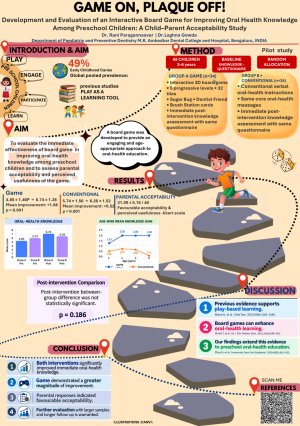
Preschool children have limited attention spans, making conventional oral health education less engaging and potentially limiting knowledge retention. Interactive, play-based learning may provide a more engaging and age-appropriate approach to delivering oral health education.
To evaluate the immediate effectiveness of a newly developed interactive board game in improving oral health knowledge among preschool children and to assess parental acceptability and perceived usefulness of the game as an oral health education tool.
A study was conducted among 68 preschool children aged 3–6 years attending their first dental visit. Participants were randomly allocated into two groups, with 34 children in each group. At baseline, oral health knowledge was assessed using a structured questionnaire. Group A received oral health education through a newly developed interactive board game, whereas Group B received conventional verbal oral health instructions. Following the intervention, the same oral health knowledge questionnaire was administered as an immediate post-intervention assessment. Parents of children in the board-game group were additionally invited to complete a Likert-scale questionnaire assessing child engagement, age appropriateness, perceived educational value, usefulness, willingness to use the game at home, and likelihood of recommending it.
Both groups demonstrated a statistically significant improvement in oral health knowledge scores following the intervention, with a greater magnitude of improvement observed in Group A, increasing from 4.85 ± 1.46 to 6.74 ± 1.38 (p=0.001), compared with an increase from 5.74 ± 1.56 to 6.26 ± 1.52 in Group B (p=0.001). Among parents in Group A, the mean Likert-scale score was 31.09 ± 5.18, indicating favourable acceptability and perceived usefulness of the game.
The board game demonstrated a greater immediate improvement in oral health knowledge compared with conventional verbal education. The favourable parental acceptability further suggests that it is a promising, engaging and age-appropriate tool for oral health education among preschool children.
Keywords
Board Game
oral health education
pre school children
pediatric
india
Poster
IOCDT_poster_204131.pdf
Automated Forensic Age Estimation through Deep Learning Staging of Third Molar Maturation: A Cross-Sectional Study in a Pondicherry Population
Functional Dentition and Body Mass Index and Adipose Tissue in Older Adults: A Cross-Sectional Study