Event submissions
Published
This submission belongs to the session S1. Preventive Dentistry and Oral Hygiene of the event The 1st International Online Conference on Dentistry
Published date
02 Oct, 2026
Academic Editor
'%3e%3cpath%20d='M12.6657%2010.9104C12.4185%2010.325%2012.0599%209.79327%2011.6097%209.34482C11.1609%208.89508%2010.6293%208.5365%2010.0442%208.28888C10.0389%208.28626%2010.0337%208.28495%2010.0285%208.28233C10.8446%207.69279%2011.3752%206.73249%2011.3752%205.64904C11.3752%203.8542%209.92103%202.39999%208.1262%202.39999C6.33136%202.39999%204.87715%203.8542%204.87715%205.64904C4.87715%206.73249%205.40774%207.69279%206.22393%208.28364C6.21869%208.28626%206.21345%208.28757%206.20821%208.29019C5.62129%208.5378%205.09463%208.89284%204.64265%209.34613C4.1929%209.79493%203.83432%2010.3266%203.58671%2010.9117C3.34345%2011.4845%203.21226%2012.0987%203.20023%2012.7209C3.19988%2012.7349%203.20233%2012.7488%203.20744%2012.7619C3.21255%2012.7749%203.22022%2012.7867%203.22998%2012.7968C3.23975%2012.8068%203.25142%2012.8147%203.26431%2012.8202C3.2772%2012.8256%203.29105%2012.8284%203.30504%2012.8284H4.09109C4.14874%2012.8284%204.19459%2012.7825%204.1959%2012.7262C4.2221%2011.7148%204.62823%2010.7676%205.34617%2010.0497C6.08899%209.30683%207.0755%208.89808%208.1262%208.89808C9.17689%208.89808%2010.1634%209.30683%2010.9062%2010.0497C11.6242%2010.7676%2012.0303%2011.7148%2012.0565%2012.7262C12.0578%2012.7838%2012.1037%2012.8284%2012.1613%2012.8284H12.9474C12.9613%2012.8284%2012.9752%2012.8256%2012.9881%2012.8202C13.001%2012.8147%2013.0126%2012.8068%2013.0224%2012.7968C13.0322%2012.7867%2013.0398%2012.7749%2013.0449%2012.7619C13.0501%2012.7488%2013.0525%2012.7349%2013.0522%2012.7209C13.0391%2012.0947%2012.9094%2011.4855%2012.6657%2010.9104ZM8.1262%207.9024C7.52486%207.9024%206.9589%207.6679%206.53312%207.24211C6.10733%206.81633%205.87283%206.25037%205.87283%205.64904C5.87283%205.0477%206.10733%204.48174%206.53312%204.05596C6.9589%203.63018%207.52486%203.39567%208.1262%203.39567C8.72753%203.39567%209.29349%203.63018%209.71927%204.05596C10.1451%204.48174%2010.3796%205.0477%2010.3796%205.64904C10.3796%206.25037%2010.1451%206.81633%209.71927%207.24211C9.29349%207.6679%208.72753%207.9024%208.1262%207.9024Z'%20fill='%235D1EE1'/%3e%3c/g%3e%3c/svg%3e) Chun Hung Chu
Chun Hung ChuCitation
Radosław Łojko, Sebastian Bobryk, Wojciech Łaguna, Inga Kamińska, Magdalena Zalewska, Magda Łapińska, Karol Kamiński, Joanna Bagińska, Functional Dentition and Body Mass Index and Adipose Tissue in Older Adults: A Cross-Sectional Study, in Proceedings of The 1st International Online Conference on Dentistry, 7 October–9 October 2026, MDPI: Basel, Switzerland
Share
Email
Facebook
Twitter
LinkedIn
Functional Dentition and Body Mass Index and Adipose Tissue in Older Adults: A Cross-Sectional Study
'%3e%3cpath%20d='M12.6647%2010.9104C12.4176%2010.325%2012.0589%209.7933%2011.6088%209.34485C11.16%208.89511%2010.6283%208.53653%2010.0432%208.28891C10.038%208.28629%2010.0327%208.28498%2010.0275%208.28236C10.8437%207.69282%2011.3743%206.73252%2011.3743%205.64907C11.3743%203.85423%209.92005%202.40002%208.12522%202.40002C6.33038%202.40002%204.87618%203.85423%204.87618%205.64907C4.87618%206.73252%205.40677%207.69282%206.22296%208.28367C6.21772%208.28629%206.21248%208.2876%206.20724%208.29022C5.62031%208.53783%205.09365%208.89287%204.64167%209.34616C4.19192%209.79496%203.83334%2010.3266%203.58573%2010.9117C3.34247%2011.4846%203.21128%2012.0987%203.19925%2012.721C3.1989%2012.735%203.20135%2012.7489%203.20646%2012.7619C3.21157%2012.7749%203.21924%2012.7868%203.22901%2012.7968C3.23877%2012.8068%203.25045%2012.8148%203.26334%2012.8202C3.27623%2012.8256%203.29007%2012.8284%203.30406%2012.8284H4.09012C4.14776%2012.8284%204.19362%2012.7825%204.19493%2012.7262C4.22113%2011.7148%204.62726%2010.7676%205.34519%2010.0497C6.08802%209.30686%207.07452%208.89811%208.12522%208.89811C9.17592%208.89811%2010.1624%209.30686%2010.9052%2010.0497C11.6232%2010.7676%2012.0293%2011.7148%2012.0555%2012.7262C12.0568%2012.7839%2012.1027%2012.8284%2012.1603%2012.8284H12.9464C12.9604%2012.8284%2012.9742%2012.8256%2012.9871%2012.8202C13%2012.8148%2013.0117%2012.8068%2013.0214%2012.7968C13.0312%2012.7868%2013.0389%2012.7749%2013.044%2012.7619C13.0491%2012.7489%2013.0515%2012.735%2013.0512%2012.721C13.0381%2012.0947%2012.9084%2011.4856%2012.6647%2010.9104ZM8.12522%207.90243C7.52388%207.90243%206.95792%207.66793%206.53214%207.24215C6.10636%206.81636%205.87185%206.2504%205.87185%205.64907C5.87185%205.04773%206.10636%204.48177%206.53214%204.05599C6.95792%203.63021%207.52388%203.3957%208.12522%203.3957C8.72655%203.3957%209.29252%203.63021%209.7183%204.05599C10.1441%204.48177%2010.3786%205.04773%2010.3786%205.64907C10.3786%206.2504%2010.1441%206.81636%209.7183%207.24215C9.29252%207.66793%208.72655%207.90243%208.12522%207.90243Z'%20fill='%235D1EE1'/%3e%3c/g%3e%3c/svg%3e)
Radosław Łojko 1
Sebastian Bobryk 2
Wojciech Łaguna 3
Inga Kamińska 4
Magdalena Zalewska 3
Magda Łapińska 3

Karol Kamiński 5
Joanna Bagińska 1
1. Department of Dentistry Propaedeutics, Medical University of Bialystok, Poland
2. Students Scientific Club “StuDentio” Department of Propaedeutics, Medical University of Bialystok
3. Department of Population Medicine and Lifestyle Diseases, Medical University of Bialystok, Poland
4. Department of Integrated Dentistry, University of Bialystok, Poland
5. Department of Population Medicine and Lifestyle Diseases, Medical University of Bialystok, Poland,
Abstract
Objectives
The aim of this study was to assess the association between functional dentition and Body Mass Index (BMI) and adiposity in older adults.
Materials and Methods
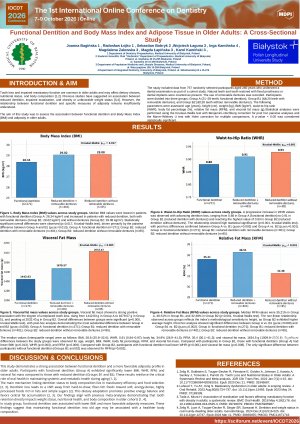
The study included data from 757 randomly selected participants aged ≥60 years who underwent a dental examination as part of a cohort study. Natural teeth and teeth restored with fixed prostheses or dental implants were counted as present. The use of removable dentures was recorded. Participants were divided into three groups: Group A (21–28 teeth; functional dentition), Group B1 (<20 teeth with removable dentures), and Group B2 (<20 teeth without removable dentures). The following parameters were assessed: age (years), height (cm), weight (kg), BMI (kg/m²), waist-to-hip ratio (WHR), body fat percentage (%), relative fat mass (RFM), and visceral fat mass (g). Statistical analyses were performed using Kruskall-Wallis test with post hoc pairwise analyses. A p-value <0.05 was considered statistically significant.
Results
The median values (interquartile range) were as follows: BMI, 28.8 (25.8–32.0); WHR, 0.91 (0.84–0.97); body fat, 34.9% (28.9–41.5); RFM, 35.4 (30.1–41.3); and visceral fat mass, 1634.5 g (1009.8–2500.6). Significant differences between the study groups were observed for age, weight, BMI, WHR, body fat percentage, RFM, and visceral fat mass. Compared with participants in Group B1, those with functional dentition (Group A) had lower BMI (p=0.013), WHR (p=0.003), and RFM (p=0.009). Compared with Group B2, participants with functional dentition had lower WHR (p<0.001) and visceral fat mass (p=0.008). The only significant difference between participants without functional dentition (Groups B1 and B2) was observed for RFM (p=0.002).
Conclusions
In study group, functional dentition was associated with lower BMI and more favorable adiposity measures. These findings suggest that maintaining functional dentition into old age may be associated with a healthier body composition.
Keywords
older adults
functional dentition
BMI
adiposity
body composition
Poster
Functional Dentition and Body Mass Index and Adipose Tissue in Older Adults A Cross-Sectional Study .pdf
GAME ON, PLAQUE OFF!
Development and Evaluation of an Interactive Board Game for Improving Oral Health Knowledge Among Preschool Children: A Child–Parent Acceptability Study
Neonatal Endotracheal Intubation as an Iatrogenic Oral–Dental Trauma: Long-term Oral and Dental Sequelae in High-risk NICU Graduates.