Event submissions
Published
This submission belongs to the session S1. Preventive Dentistry and Oral Hygiene of the event The 1st International Online Conference on Dentistry
Published date
02 Oct, 2026
Academic Editor
'%3e%3cpath%20d='M12.6657%2010.9104C12.4185%2010.325%2012.0599%209.79327%2011.6097%209.34482C11.1609%208.89508%2010.6293%208.5365%2010.0442%208.28888C10.0389%208.28626%2010.0337%208.28495%2010.0285%208.28233C10.8446%207.69279%2011.3752%206.73249%2011.3752%205.64904C11.3752%203.8542%209.92103%202.39999%208.1262%202.39999C6.33136%202.39999%204.87715%203.8542%204.87715%205.64904C4.87715%206.73249%205.40774%207.69279%206.22393%208.28364C6.21869%208.28626%206.21345%208.28757%206.20821%208.29019C5.62129%208.5378%205.09463%208.89284%204.64265%209.34613C4.1929%209.79493%203.83432%2010.3266%203.58671%2010.9117C3.34345%2011.4845%203.21226%2012.0987%203.20023%2012.7209C3.19988%2012.7349%203.20233%2012.7488%203.20744%2012.7619C3.21255%2012.7749%203.22022%2012.7867%203.22998%2012.7968C3.23975%2012.8068%203.25142%2012.8147%203.26431%2012.8202C3.2772%2012.8256%203.29105%2012.8284%203.30504%2012.8284H4.09109C4.14874%2012.8284%204.19459%2012.7825%204.1959%2012.7262C4.2221%2011.7148%204.62823%2010.7676%205.34617%2010.0497C6.08899%209.30683%207.0755%208.89808%208.1262%208.89808C9.17689%208.89808%2010.1634%209.30683%2010.9062%2010.0497C11.6242%2010.7676%2012.0303%2011.7148%2012.0565%2012.7262C12.0578%2012.7838%2012.1037%2012.8284%2012.1613%2012.8284H12.9474C12.9613%2012.8284%2012.9752%2012.8256%2012.9881%2012.8202C13.001%2012.8147%2013.0126%2012.8068%2013.0224%2012.7968C13.0322%2012.7867%2013.0398%2012.7749%2013.0449%2012.7619C13.0501%2012.7488%2013.0525%2012.7349%2013.0522%2012.7209C13.0391%2012.0947%2012.9094%2011.4855%2012.6657%2010.9104ZM8.1262%207.9024C7.52486%207.9024%206.9589%207.6679%206.53312%207.24211C6.10733%206.81633%205.87283%206.25037%205.87283%205.64904C5.87283%205.0477%206.10733%204.48174%206.53312%204.05596C6.9589%203.63018%207.52486%203.39567%208.1262%203.39567C8.72753%203.39567%209.29349%203.63018%209.71927%204.05596C10.1451%204.48174%2010.3796%205.0477%2010.3796%205.64904C10.3796%206.25037%2010.1451%206.81633%209.71927%207.24211C9.29349%207.6679%208.72753%207.9024%208.1262%207.9024Z'%20fill='%235D1EE1'/%3e%3c/g%3e%3c/svg%3e) Chun Hung Chu
Chun Hung ChuCitation
KANUPRIYA RATHORE, Sushil Choudhary, Neonatal Endotracheal Intubation as an Iatrogenic Oral–Dental Trauma: Long-term Oral and Dental Sequelae in High-risk NICU Graduates., in Proceedings of The 1st International Online Conference on Dentistry, 7 October–9 October 2026, MDPI: Basel, Switzerland
Share
Email
Facebook
Twitter
LinkedIn
Neonatal Endotracheal Intubation as an Iatrogenic Oral–Dental Trauma: Long-term Oral and Dental Sequelae in High-risk NICU Graduates.
'%3e%3cpath%20d='M12.6647%2010.9104C12.4176%2010.325%2012.0589%209.7933%2011.6088%209.34485C11.16%208.89511%2010.6283%208.53653%2010.0432%208.28891C10.038%208.28629%2010.0327%208.28498%2010.0275%208.28236C10.8437%207.69282%2011.3743%206.73252%2011.3743%205.64907C11.3743%203.85423%209.92005%202.40002%208.12522%202.40002C6.33038%202.40002%204.87618%203.85423%204.87618%205.64907C4.87618%206.73252%205.40677%207.69282%206.22296%208.28367C6.21772%208.28629%206.21248%208.2876%206.20724%208.29022C5.62031%208.53783%205.09365%208.89287%204.64167%209.34616C4.19192%209.79496%203.83334%2010.3266%203.58573%2010.9117C3.34247%2011.4846%203.21128%2012.0987%203.19925%2012.721C3.1989%2012.735%203.20135%2012.7489%203.20646%2012.7619C3.21157%2012.7749%203.21924%2012.7868%203.22901%2012.7968C3.23877%2012.8068%203.25045%2012.8148%203.26334%2012.8202C3.27623%2012.8256%203.29007%2012.8284%203.30406%2012.8284H4.09012C4.14776%2012.8284%204.19362%2012.7825%204.19493%2012.7262C4.22113%2011.7148%204.62726%2010.7676%205.34519%2010.0497C6.08802%209.30686%207.07452%208.89811%208.12522%208.89811C9.17592%208.89811%2010.1624%209.30686%2010.9052%2010.0497C11.6232%2010.7676%2012.0293%2011.7148%2012.0555%2012.7262C12.0568%2012.7839%2012.1027%2012.8284%2012.1603%2012.8284H12.9464C12.9604%2012.8284%2012.9742%2012.8256%2012.9871%2012.8202C13%2012.8148%2013.0117%2012.8068%2013.0214%2012.7968C13.0312%2012.7868%2013.0389%2012.7749%2013.044%2012.7619C13.0491%2012.7489%2013.0515%2012.735%2013.0512%2012.721C13.0381%2012.0947%2012.9084%2011.4856%2012.6647%2010.9104ZM8.12522%207.90243C7.52388%207.90243%206.95792%207.66793%206.53214%207.24215C6.10636%206.81636%205.87185%206.2504%205.87185%205.64907C5.87185%205.04773%206.10636%204.48177%206.53214%204.05599C6.95792%203.63021%207.52388%203.3957%208.12522%203.3957C8.72655%203.3957%209.29252%203.63021%209.7183%204.05599C10.1441%204.48177%2010.3786%205.04773%2010.3786%205.64907C10.3786%206.2504%2010.1441%206.81636%209.7183%207.24215C9.29252%207.66793%208.72655%207.90243%208.12522%207.90243Z'%20fill='%235D1EE1'/%3e%3c/g%3e%3c/svg%3e)
KANUPRIYA RATHORE 1
Sushil Choudhary 2
1. Model Early Intervention Center, Department of Neonatology, All India Institute of Medical Science, Jodhpur, 342005, India
2. Department of Neonatology, All India Institute of Medical Science, Jodhpur, 342005, India
Abstract
ABSTRACT
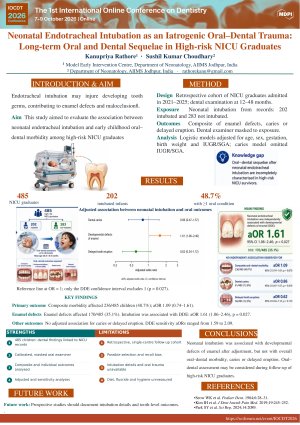
Background: This study aimed to evaluate the association between neonatal endotracheal intubation and early childhood oral–dental morbidity among high-risk NICU graduates
Methods: It was a retrospective cohort study of high-risk NICU graduates aged 12-48 months who underwent a follow-up oral-dental examination after NICU admission between January 2021 and January 2025. The primary exposure was neonatal endotracheal intubation, and the primary outcome was composite oral–dental morbidity. Associations were assessed by logistic regression. Sensitivity analyses, subgroup analyses, and assessment of collinearity were conducted.
Results: We enrolled 485 high-risk NICU graduates with an average birth weight of 2481.6 ± 837.5 g, a gestational age of 36.1 ± 3.7 weeks, and an age at oral examination of 28.4 ± 8.5 months. Of these, 202 (41.6%) had undergone neonatal endotracheal intubation and 283 (58.4%) had not. Composite oral–dental morbidity was observed in 236 children (48.7%). The rate was similar in intubated (46.5%) and non-intubated children (50.2%). On unadjusted analysis, neonatal endotracheal intubation was not significantly associated with composite oral–dental morbidity. The only significant adjusted domain-specific association observed was for DDE, where children who were intubated had higher odds than children who were not intubated. Exploratory subgroup analyses suggested a stronger association in preterm and low birth weight children.
Conclusions: Neonatal endotracheal intubation was independently associated with DDE, but not with composite oral–dental morbidity, dental caries, or delayed tooth eruption. This result suggests that neonatal airway instrumentation may be more specifically related to enamel developmental outcomes than to overall early childhood oral–dental morbidity. Oral–dental assessment may be considered as part of a structured follow-up for high-risk NICU graduates.
Keywords
Keywords: Endotracheal intubation
Neonatal intensive care unit
High-risk infants
Developmental defects of enamel
Dental caries
Tooth eruption
Oral health
Poster
IOCDT2026_Neonatal Endotracheal Intubation as an Iatrogenic Oral–Dental Trauma.pdf
Functional Dentition and Body Mass Index and Adipose Tissue in Older Adults: A Cross-Sectional Study
Accuracy of Dental Implant Placement using an Inertial Angulation Device-based Guided Implant Surgery - An Invitro Study