Event submissions
Published
This submission belongs to the session S5. Periodontics and Implant Dentistry of the event The 1st International Online Conference on Dentistry
Published date
02 Oct, 2026
Academic Editor
'%3e%3cpath%20d='M12.6657%2010.9104C12.4185%2010.325%2012.0599%209.79327%2011.6097%209.34482C11.1609%208.89508%2010.6293%208.5365%2010.0442%208.28888C10.0389%208.28626%2010.0337%208.28495%2010.0285%208.28233C10.8446%207.69279%2011.3752%206.73249%2011.3752%205.64904C11.3752%203.8542%209.92103%202.39999%208.1262%202.39999C6.33136%202.39999%204.87715%203.8542%204.87715%205.64904C4.87715%206.73249%205.40774%207.69279%206.22393%208.28364C6.21869%208.28626%206.21345%208.28757%206.20821%208.29019C5.62129%208.5378%205.09463%208.89284%204.64265%209.34613C4.1929%209.79493%203.83432%2010.3266%203.58671%2010.9117C3.34345%2011.4845%203.21226%2012.0987%203.20023%2012.7209C3.19988%2012.7349%203.20233%2012.7488%203.20744%2012.7619C3.21255%2012.7749%203.22022%2012.7867%203.22998%2012.7968C3.23975%2012.8068%203.25142%2012.8147%203.26431%2012.8202C3.2772%2012.8256%203.29105%2012.8284%203.30504%2012.8284H4.09109C4.14874%2012.8284%204.19459%2012.7825%204.1959%2012.7262C4.2221%2011.7148%204.62823%2010.7676%205.34617%2010.0497C6.08899%209.30683%207.0755%208.89808%208.1262%208.89808C9.17689%208.89808%2010.1634%209.30683%2010.9062%2010.0497C11.6242%2010.7676%2012.0303%2011.7148%2012.0565%2012.7262C12.0578%2012.7838%2012.1037%2012.8284%2012.1613%2012.8284H12.9474C12.9613%2012.8284%2012.9752%2012.8256%2012.9881%2012.8202C13.001%2012.8147%2013.0126%2012.8068%2013.0224%2012.7968C13.0322%2012.7867%2013.0398%2012.7749%2013.0449%2012.7619C13.0501%2012.7488%2013.0525%2012.7349%2013.0522%2012.7209C13.0391%2012.0947%2012.9094%2011.4855%2012.6657%2010.9104ZM8.1262%207.9024C7.52486%207.9024%206.9589%207.6679%206.53312%207.24211C6.10733%206.81633%205.87283%206.25037%205.87283%205.64904C5.87283%205.0477%206.10733%204.48174%206.53312%204.05596C6.9589%203.63018%207.52486%203.39567%208.1262%203.39567C8.72753%203.39567%209.29349%203.63018%209.71927%204.05596C10.1451%204.48174%2010.3796%205.0477%2010.3796%205.64904C10.3796%206.25037%2010.1451%206.81633%209.71927%207.24211C9.29349%207.6679%208.72753%207.9024%208.1262%207.9024Z'%20fill='%235D1EE1'/%3e%3c/g%3e%3c/svg%3e) Fawad Javed
Fawad JavedCitation
Deep Chaudhari, Ujban Hussain, Ranjit Misal, Artificial Intelligence Driven Salivary Multi-Omics Biomarkers for Early Detection of Periodontitis: A Systematic Review, in Proceedings of The 1st International Online Conference on Dentistry, 7 October–9 October 2026, MDPI: Basel, Switzerland
Share
Email
Facebook
Twitter
LinkedIn
Artificial Intelligence Driven Salivary Multi-Omics Biomarkers for Early Detection of Periodontitis: A Systematic Review
'%3e%3cpath%20d='M12.6647%2010.9104C12.4176%2010.325%2012.0589%209.7933%2011.6088%209.34485C11.16%208.89511%2010.6283%208.53653%2010.0432%208.28891C10.038%208.28629%2010.0327%208.28498%2010.0275%208.28236C10.8437%207.69282%2011.3743%206.73252%2011.3743%205.64907C11.3743%203.85423%209.92005%202.40002%208.12522%202.40002C6.33038%202.40002%204.87618%203.85423%204.87618%205.64907C4.87618%206.73252%205.40677%207.69282%206.22296%208.28367C6.21772%208.28629%206.21248%208.2876%206.20724%208.29022C5.62031%208.53783%205.09365%208.89287%204.64167%209.34616C4.19192%209.79496%203.83334%2010.3266%203.58573%2010.9117C3.34247%2011.4846%203.21128%2012.0987%203.19925%2012.721C3.1989%2012.735%203.20135%2012.7489%203.20646%2012.7619C3.21157%2012.7749%203.21924%2012.7868%203.22901%2012.7968C3.23877%2012.8068%203.25045%2012.8148%203.26334%2012.8202C3.27623%2012.8256%203.29007%2012.8284%203.30406%2012.8284H4.09012C4.14776%2012.8284%204.19362%2012.7825%204.19493%2012.7262C4.22113%2011.7148%204.62726%2010.7676%205.34519%2010.0497C6.08802%209.30686%207.07452%208.89811%208.12522%208.89811C9.17592%208.89811%2010.1624%209.30686%2010.9052%2010.0497C11.6232%2010.7676%2012.0293%2011.7148%2012.0555%2012.7262C12.0568%2012.7839%2012.1027%2012.8284%2012.1603%2012.8284H12.9464C12.9604%2012.8284%2012.9742%2012.8256%2012.9871%2012.8202C13%2012.8148%2013.0117%2012.8068%2013.0214%2012.7968C13.0312%2012.7868%2013.0389%2012.7749%2013.044%2012.7619C13.0491%2012.7489%2013.0515%2012.735%2013.0512%2012.721C13.0381%2012.0947%2012.9084%2011.4856%2012.6647%2010.9104ZM8.12522%207.90243C7.52388%207.90243%206.95792%207.66793%206.53214%207.24215C6.10636%206.81636%205.87185%206.2504%205.87185%205.64907C5.87185%205.04773%206.10636%204.48177%206.53214%204.05599C6.95792%203.63021%207.52388%203.3957%208.12522%203.3957C8.72655%203.3957%209.29252%203.63021%209.7183%204.05599C10.1441%204.48177%2010.3786%205.04773%2010.3786%205.64907C10.3786%206.2504%2010.1441%206.81636%209.7183%207.24215C9.29252%207.66793%208.72655%207.90243%208.12522%207.90243Z'%20fill='%235D1EE1'/%3e%3c/g%3e%3c/svg%3e)
Deep Chaudhari 1
Ujban Hussain 2
Ranjit Misal 3
1. Department of pharmaceutical chemistry, P. R. Pote Patil College of Pharmacy, Amravati, Maharashtra 444604, India
2. Department of Pharmaceutical Sciences, Rashtrasant Tukadoji Maharaj Nagpur University, Nagpur 440033, Maharashtra, India
3. Department of Biological Sciences, BITS Pilani K K Birla Goa Campus, Zuarinagar, Goa 403726, India
Abstract
Background
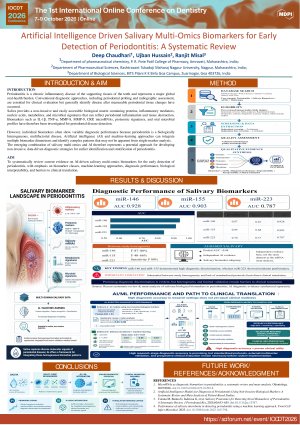
Periodontitis is a highly prevalent chronic disease, with severe forms affecting approximately 10% of adults worldwide. Conventional diagnostic methods, including periodontal probing and radiography, detect disease only after substantial tissue destruction. Saliva contains diverse biomarkers reflecting inflammation and tissue breakdown, while artificial intelligence (AI) can integrate multi-omics datasets to support earlier diagnosis. This systematic review synthesizes current evidence on AI-driven salivary multi-omics biomarkers for early detection of periodontitis.
Methods
We have searched PubMed, Scopus, Web of Science, Embase, and Cochrane (January 2020–2026) for peer-reviewed human studies. Eligible studies included systematic reviews, meta-analyses, randomized trials, prospective cohorts, diagnostic accuracy studies, and observational studies evaluating salivary biomarkers and AI for periodontitis. Two reviewers independently screened studies, extracted data, assessed methodological quality using validated tools, and performed a qualitative evidence synthesis.
Results
Frequently investigated biomarkers included IL-1β, TNF-α, MMP-8, MMP-9, CRP and oxidative stress markers. Proteomic studies consistently identified complement C3, S100A8, and fibrinogen, although diagnostic reporting remained limited (S100A8 pooled AUC≈0.71). Salivary microRNAs proved higher diagnostic performance, with pooled sensitivity of approximately 0.85–0.87, specificity of 0.83–0.88, and HSROC AUC of 0.90–0.93 for miR-146/miR-155. Metabolomic evidence remained limited. Salivary microbiome-based LightGBM models achieved AUCs of 0.81–0.87. Random forests and gradient boosting were the major AI approaches, while integrated multi-omics models generally outperformed single-marker models (pooled AUC≈0.94). Current evidence remains heterogeneous, with limited external validation, inconsistent protocols and challenges in reproducibility and interpretability.
Discussion
AI-assisted salivary diagnostics support precision periodontology, but clinical translation remains constrained by methodological heterogeneity, small cohorts, and limited multicenter validation. Standardized sampling, assay harmonization, and prospective validation of integrated biomarker–AI models are required before routine implementation.
Conclusion
AI-driven salivary multi-omics models demonstrate high diagnostic accuracy in research settings; however, heterogeneous evidence and limited clinical validation currently preclude routine clinical implementation.
Keywords
Periodontitis
Salivary biomarkers
Multi-omics
Artificial intelligence
Machine learning
Oral microbiome
Poster
IOCDT POSTER Sciforum-203886.pdf
Local Neuro-immunomodulatory Mechanism in Periodontitis: A Systematic Review.
The genetic and epigenetic mechanisms on masticatory muscles in the development of dental malocclusion: A systematic review.