Event submissions
Published
This submission belongs to the session S3. Pediatric Dentistry and Orthodontics of the event The 1st International Online Conference on Dentistry
Published date
02 Oct, 2026
Academic Editor
'%3e%3cpath%20d='M12.6657%2010.9104C12.4185%2010.325%2012.0599%209.79327%2011.6097%209.34482C11.1609%208.89508%2010.6293%208.5365%2010.0442%208.28888C10.0389%208.28626%2010.0337%208.28495%2010.0285%208.28233C10.8446%207.69279%2011.3752%206.73249%2011.3752%205.64904C11.3752%203.8542%209.92103%202.39999%208.1262%202.39999C6.33136%202.39999%204.87715%203.8542%204.87715%205.64904C4.87715%206.73249%205.40774%207.69279%206.22393%208.28364C6.21869%208.28626%206.21345%208.28757%206.20821%208.29019C5.62129%208.5378%205.09463%208.89284%204.64265%209.34613C4.1929%209.79493%203.83432%2010.3266%203.58671%2010.9117C3.34345%2011.4845%203.21226%2012.0987%203.20023%2012.7209C3.19988%2012.7349%203.20233%2012.7488%203.20744%2012.7619C3.21255%2012.7749%203.22022%2012.7867%203.22998%2012.7968C3.23975%2012.8068%203.25142%2012.8147%203.26431%2012.8202C3.2772%2012.8256%203.29105%2012.8284%203.30504%2012.8284H4.09109C4.14874%2012.8284%204.19459%2012.7825%204.1959%2012.7262C4.2221%2011.7148%204.62823%2010.7676%205.34617%2010.0497C6.08899%209.30683%207.0755%208.89808%208.1262%208.89808C9.17689%208.89808%2010.1634%209.30683%2010.9062%2010.0497C11.6242%2010.7676%2012.0303%2011.7148%2012.0565%2012.7262C12.0578%2012.7838%2012.1037%2012.8284%2012.1613%2012.8284H12.9474C12.9613%2012.8284%2012.9752%2012.8256%2012.9881%2012.8202C13.001%2012.8147%2013.0126%2012.8068%2013.0224%2012.7968C13.0322%2012.7867%2013.0398%2012.7749%2013.0449%2012.7619C13.0501%2012.7488%2013.0525%2012.7349%2013.0522%2012.7209C13.0391%2012.0947%2012.9094%2011.4855%2012.6657%2010.9104ZM8.1262%207.9024C7.52486%207.9024%206.9589%207.6679%206.53312%207.24211C6.10733%206.81633%205.87283%206.25037%205.87283%205.64904C5.87283%205.0477%206.10733%204.48174%206.53312%204.05596C6.9589%203.63018%207.52486%203.39567%208.1262%203.39567C8.72753%203.39567%209.29349%203.63018%209.71927%204.05596C10.1451%204.48174%2010.3796%205.0477%2010.3796%205.64904C10.3796%206.25037%2010.1451%206.81633%209.71927%207.24211C9.29349%207.6679%208.72753%207.9024%208.1262%207.9024Z'%20fill='%235D1EE1'/%3e%3c/g%3e%3c/svg%3e) Gianrico Spagnuolo
Gianrico SpagnuoloCitation
Kazi Ahsan Jamil, Aida Nur Ashikin Abd Rahman, Noor Azliza Wani Abd. Aziz , Alyssa Juneta Aminul Hasrin, Wan Arman Sarhan Wan Samsuri, Muhammad Arif Iman Nooramlee, The genetic and epigenetic mechanisms on masticatory muscles in the development of dental malocclusion: A systematic review., in Proceedings of The 1st International Online Conference on Dentistry, 7 October–9 October 2026, MDPI: Basel, Switzerland
Share
Email
Facebook
Twitter
LinkedIn
The genetic and epigenetic mechanisms on masticatory muscles in the development of dental malocclusion: A systematic review.
'%3e%3cpath%20d='M12.6647%2010.9104C12.4176%2010.325%2012.0589%209.7933%2011.6088%209.34485C11.16%208.89511%2010.6283%208.53653%2010.0432%208.28891C10.038%208.28629%2010.0327%208.28498%2010.0275%208.28236C10.8437%207.69282%2011.3743%206.73252%2011.3743%205.64907C11.3743%203.85423%209.92005%202.40002%208.12522%202.40002C6.33038%202.40002%204.87618%203.85423%204.87618%205.64907C4.87618%206.73252%205.40677%207.69282%206.22296%208.28367C6.21772%208.28629%206.21248%208.2876%206.20724%208.29022C5.62031%208.53783%205.09365%208.89287%204.64167%209.34616C4.19192%209.79496%203.83334%2010.3266%203.58573%2010.9117C3.34247%2011.4846%203.21128%2012.0987%203.19925%2012.721C3.1989%2012.735%203.20135%2012.7489%203.20646%2012.7619C3.21157%2012.7749%203.21924%2012.7868%203.22901%2012.7968C3.23877%2012.8068%203.25045%2012.8148%203.26334%2012.8202C3.27623%2012.8256%203.29007%2012.8284%203.30406%2012.8284H4.09012C4.14776%2012.8284%204.19362%2012.7825%204.19493%2012.7262C4.22113%2011.7148%204.62726%2010.7676%205.34519%2010.0497C6.08802%209.30686%207.07452%208.89811%208.12522%208.89811C9.17592%208.89811%2010.1624%209.30686%2010.9052%2010.0497C11.6232%2010.7676%2012.0293%2011.7148%2012.0555%2012.7262C12.0568%2012.7839%2012.1027%2012.8284%2012.1603%2012.8284H12.9464C12.9604%2012.8284%2012.9742%2012.8256%2012.9871%2012.8202C13%2012.8148%2013.0117%2012.8068%2013.0214%2012.7968C13.0312%2012.7868%2013.0389%2012.7749%2013.044%2012.7619C13.0491%2012.7489%2013.0515%2012.735%2013.0512%2012.721C13.0381%2012.0947%2012.9084%2011.4856%2012.6647%2010.9104ZM8.12522%207.90243C7.52388%207.90243%206.95792%207.66793%206.53214%207.24215C6.10636%206.81636%205.87185%206.2504%205.87185%205.64907C5.87185%205.04773%206.10636%204.48177%206.53214%204.05599C6.95792%203.63021%207.52388%203.3957%208.12522%203.3957C8.72655%203.3957%209.29252%203.63021%209.7183%204.05599C10.1441%204.48177%2010.3786%205.04773%2010.3786%205.64907C10.3786%206.2504%2010.1441%206.81636%209.7183%207.24215C9.29252%207.66793%208.72655%207.90243%208.12522%207.90243Z'%20fill='%235D1EE1'/%3e%3c/g%3e%3c/svg%3e)
Kazi Ahsan Jamil 1
Aida Nur Ashikin Abd Rahman 2
Noor Azliza Wani Abd. Aziz 1
Alyssa Juneta Aminul Hasrin 3
Wan Arman Sarhan Wan Samsuri 3
Muhammad Arif Iman Nooramlee 3
1. Centre of Preclinical Science Studies, Faculty of Dentistry, Universiti Teknologi MARA, Jalan Hospital, 47000 SUNGAI BULOH, Selangor, Malaysia
2. Centre of Paediatric Dentistry and Orthodontics, Faculty of Dentistry, University Teknologi MARA, Jalan Hospital, 47000 SUNGAI BULOH
Selangor, Malaysia.
3. Faculty of Dentistry, Universiti Teknologi MARA, Sungai Buloh, Malaysia
Abstract
Objective: Emerging evidence indicates that masticatory muscle function and fiber composition influence craniofacial morphology and jaw development. This systematic review synthesizes current evidence on genetic and epigenetic regulators of masticatory muscle biology and their association with malocclusion and skeletal jaw discrepancies. Methods: A systematic search was conducted in accordance with PRISMA guidelines. Methodological validity was assessed using a critical appraisal checklist for cross-sectional and molecular studies. PubMed, ScienceDirect, Web of Science, and Google Scholar databases were searched for relevant articles published between 2010 and 2025. The inclusion criteria required studies to report on genetic and epigenetic contributions to masticatory muscle variations that cause malocclusion or maxillofacial bone deformities. Results: Of an initial 53 articles, 5 studies were eventually included. All five studies analysed human masseter muscle. Three studies showed genetic regulation of muscle fibre types I and II and epigenetic mechanisms influencing skeletal muscle phenotype in relation to craniofacial growth. Two studies documented single-nucleotide polymorphisms (SNPs) in muscle-related genes and craniofacial skeletal morphology. Masseter muscle fibre composition was significantly modulated by the balance between growth factors such as IGF-I and GDF-8. Expression of the epigenetic regulators KAT6B and HDAC4 was observed in skeletal Class II and Class III malocclusions and was involved in muscle differentiation. MYO1C and KAT6B expression showed associations with RUNX2 activity in type II muscle fibres that regulated bone development. SNP studies identified the ACTN3 rs1815739 SNP as being related to the anteroposterior maxillary position, while MYO1H rs10850110 was associated with mandibular prognathism and skeletal Class III malocclusion. Conclusion: The role of genetic and epigenetic factors influencing masseter muscle variations in malocclusion suggests that other masticatory muscles may also significantly impact craniofacial growth and deformities. These molecular markers show potential as diagnostic and prognostic indicators, supporting further studies into personalized orthodontic diagnosis and treatment planning.
Keywords
malocclusion
masseter muscle
masticatory muscles
genetics
epigenetics
craniofacial growth
single nucleotide polymorphism (SNP).
Poster
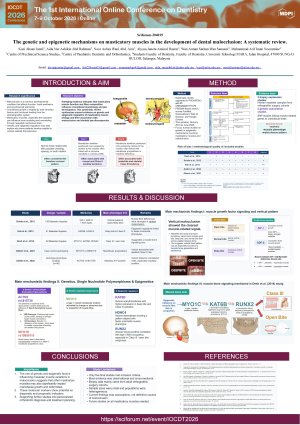
IOCDT_2026 FINAL OCT 05 2026.pdf
Artificial Intelligence Driven Salivary Multi-Omics Biomarkers for Early Detection of Periodontitis: A Systematic Review
Implant Bed Preparation Techniques: A Comparative Study of Crestal Bone and Peri-Implant Soft Tissue Changes