Event submissions
Published
This submission belongs to the session S1. Preventive Dentistry and Oral Hygiene of the event The 1st International Online Conference on Dentistry
Published date
02 Oct, 2026
Academic Editor
'%3e%3cpath%20d='M12.6657%2010.9104C12.4185%2010.325%2012.0599%209.79327%2011.6097%209.34482C11.1609%208.89508%2010.6293%208.5365%2010.0442%208.28888C10.0389%208.28626%2010.0337%208.28495%2010.0285%208.28233C10.8446%207.69279%2011.3752%206.73249%2011.3752%205.64904C11.3752%203.8542%209.92103%202.39999%208.1262%202.39999C6.33136%202.39999%204.87715%203.8542%204.87715%205.64904C4.87715%206.73249%205.40774%207.69279%206.22393%208.28364C6.21869%208.28626%206.21345%208.28757%206.20821%208.29019C5.62129%208.5378%205.09463%208.89284%204.64265%209.34613C4.1929%209.79493%203.83432%2010.3266%203.58671%2010.9117C3.34345%2011.4845%203.21226%2012.0987%203.20023%2012.7209C3.19988%2012.7349%203.20233%2012.7488%203.20744%2012.7619C3.21255%2012.7749%203.22022%2012.7867%203.22998%2012.7968C3.23975%2012.8068%203.25142%2012.8147%203.26431%2012.8202C3.2772%2012.8256%203.29105%2012.8284%203.30504%2012.8284H4.09109C4.14874%2012.8284%204.19459%2012.7825%204.1959%2012.7262C4.2221%2011.7148%204.62823%2010.7676%205.34617%2010.0497C6.08899%209.30683%207.0755%208.89808%208.1262%208.89808C9.17689%208.89808%2010.1634%209.30683%2010.9062%2010.0497C11.6242%2010.7676%2012.0303%2011.7148%2012.0565%2012.7262C12.0578%2012.7838%2012.1037%2012.8284%2012.1613%2012.8284H12.9474C12.9613%2012.8284%2012.9752%2012.8256%2012.9881%2012.8202C13.001%2012.8147%2013.0126%2012.8068%2013.0224%2012.7968C13.0322%2012.7867%2013.0398%2012.7749%2013.0449%2012.7619C13.0501%2012.7488%2013.0525%2012.7349%2013.0522%2012.7209C13.0391%2012.0947%2012.9094%2011.4855%2012.6657%2010.9104ZM8.1262%207.9024C7.52486%207.9024%206.9589%207.6679%206.53312%207.24211C6.10733%206.81633%205.87283%206.25037%205.87283%205.64904C5.87283%205.0477%206.10733%204.48174%206.53312%204.05596C6.9589%203.63018%207.52486%203.39567%208.1262%203.39567C8.72753%203.39567%209.29349%203.63018%209.71927%204.05596C10.1451%204.48174%2010.3796%205.0477%2010.3796%205.64904C10.3796%206.25037%2010.1451%206.81633%209.71927%207.24211C9.29349%207.6679%208.72753%207.9024%208.1262%207.9024Z'%20fill='%235D1EE1'/%3e%3c/g%3e%3c/svg%3e) Chun Hung Chu
Chun Hung ChuCitation
Oliwia Gagacka, Karolina Banaszek, Radosław Łojko, Wojciech Łaguna, Inga Kamińska, Magdalena Zalewska, Magda Łapińska, Karol Kamiński, Joanna Bagińska, The association between tooth loss and difficulties in food consumption in senior population, in Proceedings of The 1st International Online Conference on Dentistry, 7 October–9 October 2026, MDPI: Basel, Switzerland
Share
Email
Facebook
Twitter
LinkedIn
The association between tooth loss and difficulties in food consumption in senior population
'%3e%3cpath%20d='M12.6647%2010.9104C12.4176%2010.325%2012.0589%209.7933%2011.6088%209.34485C11.16%208.89511%2010.6283%208.53653%2010.0432%208.28891C10.038%208.28629%2010.0327%208.28498%2010.0275%208.28236C10.8437%207.69282%2011.3743%206.73252%2011.3743%205.64907C11.3743%203.85423%209.92005%202.40002%208.12522%202.40002C6.33038%202.40002%204.87618%203.85423%204.87618%205.64907C4.87618%206.73252%205.40677%207.69282%206.22296%208.28367C6.21772%208.28629%206.21248%208.2876%206.20724%208.29022C5.62031%208.53783%205.09365%208.89287%204.64167%209.34616C4.19192%209.79496%203.83334%2010.3266%203.58573%2010.9117C3.34247%2011.4846%203.21128%2012.0987%203.19925%2012.721C3.1989%2012.735%203.20135%2012.7489%203.20646%2012.7619C3.21157%2012.7749%203.21924%2012.7868%203.22901%2012.7968C3.23877%2012.8068%203.25045%2012.8148%203.26334%2012.8202C3.27623%2012.8256%203.29007%2012.8284%203.30406%2012.8284H4.09012C4.14776%2012.8284%204.19362%2012.7825%204.19493%2012.7262C4.22113%2011.7148%204.62726%2010.7676%205.34519%2010.0497C6.08802%209.30686%207.07452%208.89811%208.12522%208.89811C9.17592%208.89811%2010.1624%209.30686%2010.9052%2010.0497C11.6232%2010.7676%2012.0293%2011.7148%2012.0555%2012.7262C12.0568%2012.7839%2012.1027%2012.8284%2012.1603%2012.8284H12.9464C12.9604%2012.8284%2012.9742%2012.8256%2012.9871%2012.8202C13%2012.8148%2013.0117%2012.8068%2013.0214%2012.7968C13.0312%2012.7868%2013.0389%2012.7749%2013.044%2012.7619C13.0491%2012.7489%2013.0515%2012.735%2013.0512%2012.721C13.0381%2012.0947%2012.9084%2011.4856%2012.6647%2010.9104ZM8.12522%207.90243C7.52388%207.90243%206.95792%207.66793%206.53214%207.24215C6.10636%206.81636%205.87185%206.2504%205.87185%205.64907C5.87185%205.04773%206.10636%204.48177%206.53214%204.05599C6.95792%203.63021%207.52388%203.3957%208.12522%203.3957C8.72655%203.3957%209.29252%203.63021%209.7183%204.05599C10.1441%204.48177%2010.3786%205.04773%2010.3786%205.64907C10.3786%206.2504%2010.1441%206.81636%209.7183%207.24215C9.29252%207.66793%208.72655%207.90243%208.12522%207.90243Z'%20fill='%235D1EE1'/%3e%3c/g%3e%3c/svg%3e)
Oliwia Gagacka 1
Karolina Banaszek 1
Radosław Łojko 2
Wojciech Łaguna 3
Inga Kamińska 4
Magdalena Zalewska 3
Magda Łapińska 3

Karol Kamiński 3
Joanna Bagińska 2
1. Students Scientific Club “StuDentio” Department of Propaedeutics, Medical University of Bialystok, Poland, ul. Szpitalna 30 15-295 Białystok, Poland
2. Department of Dentistry Propaedeutics, Medical University of Bialystok, Poland
ul. Szpitalna 30 15-295 Białystok, Poland
3. Department of Population Medicine and Lifestyle Diseases, Medical University of Bialystok, Poland, ul. Waszyngtona 15b 15-269 Białystok, Poland
4. Department of Integrated Dentistry, University of Bialystok, Poland, ul. Skłodowskiej 24 a 15-276 Bialystok, Poland
Abstract
Objectives
The aim of this study was to identify food consumption problems associated with tooth loss among older adults.
Materials and Methods
The study included data from randomly selected 751 participants aged ≥60 years. The number of teeth was determined during a dental examination. Teeth considered present included natural dentition and teeth restored with fixed prostheses or implants. Participants were divided into three groups: I (28–21 teeth; functional dentition), II (20–1 teeth), and III (edentulous). Food consumption problems were assessed using items from OHIP-14 (4 questions) and GOHAI (4 questions) questionnaires. Responses were categorized as never, sometimes, and often. The chi-square test with post hoc pairwise comparisons was used, p-value <0.05.
Results
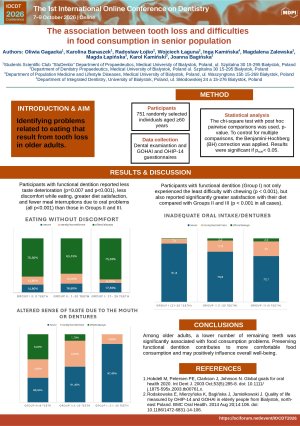
There were no differences between the groups according to the ability to swallow food. With regard to the previous 3 months, participants with functional dentition reported limiting the types of food they ate less frequently than those in Groups II and III (p<0.001 and p=0.017, respectively). They also reported fewer difficulties biting hard foods than participants in the other two groups (p<0.001) and experienced discomfort while eating less frequently than those with 1–20 teeth (p<0.001). Regarding the previous 12 months, participants with functional dentition reported worsening of taste less frequently than those in Groups II and III (p=0.007 and p<0.001, respectively). They also experienced less discomfort while eating, were more satisfied with their diet, and were less likely to interrupt meals because of problems with oral cavity than participants in Groups II and III (all p<0.001).
Conclusions
Among older adults, a lower number of remaining teeth was significantly associated with food consumption problems. Individuals with functional dentition reported problems less frequently than those with partial or complete tooth loss. Preserving functional dentition contributes to more comfortable food consumption and may positively influence overall well-being.
Keywords
functional dentition
edentulism
senior population
oral health-related quality of life
food consumption
Poster
Poster - The association between tooth loss and difficulties in food consumption in senior population.pdf
Vertical Dimension Meets Facial Metrics: Unlocking Hidden Correlations
Bisphosphonate-Related Osteonecrosis of the Jaw in Breast Cancer Patients: A Retrospective Cohort Study