Event submissions
EventsMOL2NET'16, Conference on Molecular, Biomed., Comput. & Network Science and Engineering, 2nd ed.
Published

This submission belongs to the session 01. CHEMBIOINFO-02: Chem-Bioinformatics Congress Cambridge, UK-Chapel Hill and Richmond, USA, 2016. of the event MOL2NET'16, Conference on Molecular, Biomed., Comput. & Network Science and Engineering, 2nd ed.
Published date
22 Jun, 2016
Citation
Lorena Simon-Vidal, Sonia Arrasate, Nuria Sotomayor, Esther Lete, Humberto González-Díaz, QSRR model of reactivity for Parham cyclization reactions, in Proceedings of MOL2NET'16, Conference on Molecular, Biomed., Comput. & Network Science and Engineering, 2nd ed., 15 October–20 October 2022, MDPI: Basel, Switzerland, doi: 10.3390/MOL2NET-02-A001
Share
Email
Facebook
Twitter
LinkedIn
QSRR model of reactivity for Parham cyclization reactions
'%3e%3cpath%20d='M12.6647%2010.9104C12.4176%2010.325%2012.0589%209.7933%2011.6088%209.34485C11.16%208.89511%2010.6283%208.53653%2010.0432%208.28891C10.038%208.28629%2010.0327%208.28498%2010.0275%208.28236C10.8437%207.69282%2011.3743%206.73252%2011.3743%205.64907C11.3743%203.85423%209.92005%202.40002%208.12522%202.40002C6.33038%202.40002%204.87618%203.85423%204.87618%205.64907C4.87618%206.73252%205.40677%207.69282%206.22296%208.28367C6.21772%208.28629%206.21248%208.2876%206.20724%208.29022C5.62031%208.53783%205.09365%208.89287%204.64167%209.34616C4.19192%209.79496%203.83334%2010.3266%203.58573%2010.9117C3.34247%2011.4846%203.21128%2012.0987%203.19925%2012.721C3.1989%2012.735%203.20135%2012.7489%203.20646%2012.7619C3.21157%2012.7749%203.21924%2012.7868%203.22901%2012.7968C3.23877%2012.8068%203.25045%2012.8148%203.26334%2012.8202C3.27623%2012.8256%203.29007%2012.8284%203.30406%2012.8284H4.09012C4.14776%2012.8284%204.19362%2012.7825%204.19493%2012.7262C4.22113%2011.7148%204.62726%2010.7676%205.34519%2010.0497C6.08802%209.30686%207.07452%208.89811%208.12522%208.89811C9.17592%208.89811%2010.1624%209.30686%2010.9052%2010.0497C11.6232%2010.7676%2012.0293%2011.7148%2012.0555%2012.7262C12.0568%2012.7839%2012.1027%2012.8284%2012.1603%2012.8284H12.9464C12.9604%2012.8284%2012.9742%2012.8256%2012.9871%2012.8202C13%2012.8148%2013.0117%2012.8068%2013.0214%2012.7968C13.0312%2012.7868%2013.0389%2012.7749%2013.044%2012.7619C13.0491%2012.7489%2013.0515%2012.735%2013.0512%2012.721C13.0381%2012.0947%2012.9084%2011.4856%2012.6647%2010.9104ZM8.12522%207.90243C7.52388%207.90243%206.95792%207.66793%206.53214%207.24215C6.10636%206.81636%205.87185%206.2504%205.87185%205.64907C5.87185%205.04773%206.10636%204.48177%206.53214%204.05599C6.95792%203.63021%207.52388%203.3957%208.12522%203.3957C8.72655%203.3957%209.29252%203.63021%209.7183%204.05599C10.1441%204.48177%2010.3786%205.04773%2010.3786%205.64907C10.3786%206.2504%2010.1441%206.81636%209.7183%207.24215C9.29252%207.66793%208.72655%207.90243%208.12522%207.90243Z'%20fill='%235D1EE1'/%3e%3c/g%3e%3c/svg%3e)
Lorena Simon-Vidal 1
Sonia Arrasate 1
Nuria Sotomayor 1
Esther Lete 1

Humberto González-Díaz 1
1. Department of Organic Chemistry II, University of the Basque Country UPV/EHU, 48940, Bilbao, Spain.
Abstract
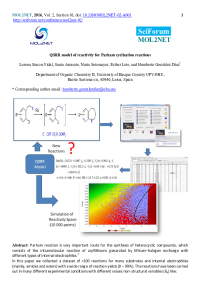
Parham reaction is very important route for the synthesis of heterocyclic compounds, which consists of the intramolecular reaction of aryllithiums generated by lithium–halogen exchange with different types of internal electrophiles.1 In this paper we collected a dataset of >100 reactions for many substrates and internal electrophiles (mainly, amides and esters) with a wide range of reaction yields (0 – 99%). The reactions have been carried out in many different experimental conditions with different values non-structural variables (δk) like: temperature of addition, addition time, organolithium equivalents, reaction times, and reaction temperature. Next, we calculated many structural and/or physicochemical variables (Vk) for the substrates and products of the reaction. After that, we constructed a Quantitative Structure-Reactivity Relationship (QSRR) model2 able to predict the yield of reaction under many different conditions with acceptable accuracy. We also carried a 10.000-points simulation of the reaction conditions.
References
1. a) Ruiz, J.; Sotomayor, N.; Lete, E. Org. Lett. 2003, 5, 1115. b) Ruiz, J.; Ardeo, A.; Ignacio, R.; Sotomayor, N.; Lete, E. Tetrahedron 2005, 61, 3311. For a review, see: Sotomayor, N.; Lete, E. Curr. Org. Chem. 2003, 7, 275.
2. For related examples of our work; see: a) Blázquez-Barbadillo, C.; Aranzamendi, E.; Coya, E.; Lete, E.; Sotomayor, N.; González-Díaz, H. RSC Adv. 2016; 6, 38602. b) Aranzamendi, E.; Arrasate, S.; Lete, E.; Sotomayor, N.; González-Díaz, H. ChemistryOpen 2016, http://dx.doi.org/10.1002/open.201600120.
Keywords
Parham reaction
QSRR models
Organolithium reagents
Cyclization
Poster
mol2net-02_6133a2550df2f571a001c1edc6ffce3d_MOL2NET_corregido.pdf
New catalytic systems for oxygen-mediated oxidative processes
Prediction of the Antagonistic Activity On the Receiving AT1 of the Angiotensin II